Arbe's Gryphon Radar System Targets Unmanned Ground Vehicles on Rough Terrain
Arbe Robotics' new Gryphon radar system, announced October 17, aims to solve a critical perception challenge for autonomous security robots operating in complex outdoor environments, a development that could reshape deployment strategies across the sector.
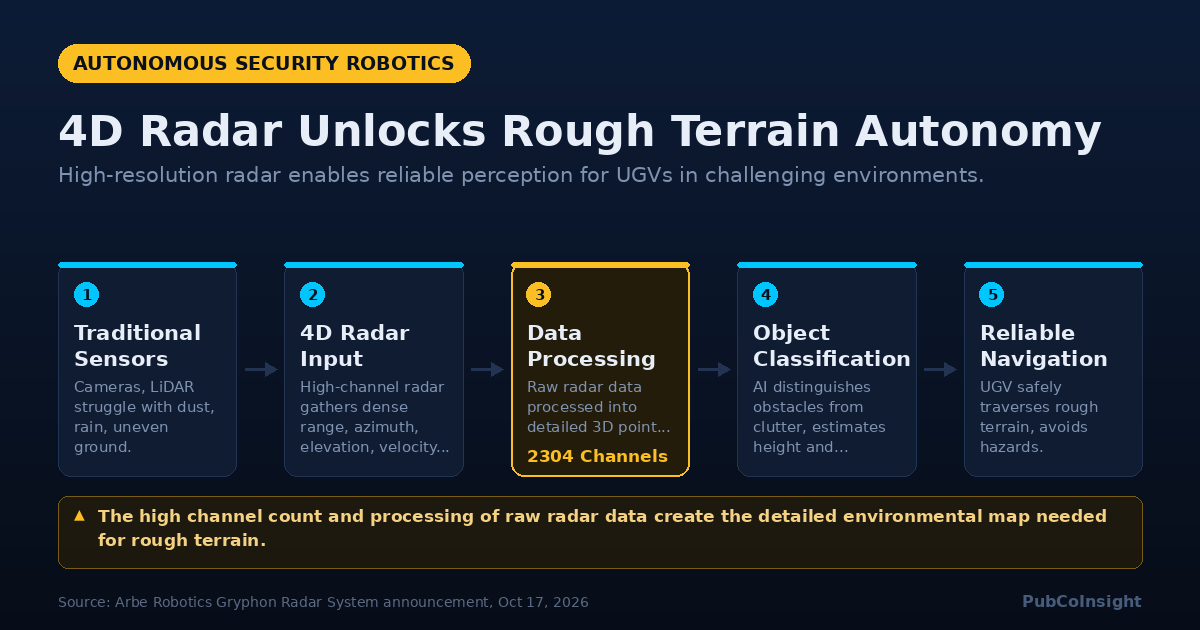
On October 17, Arbe Robotics (ARBE) introduced the Gryphon Radar System. This new system targets unmanned ground vehicles (UGVs), specifically addressing the challenge of reliable perception when these robots operate on rough terrain. The development matters because robust perception is the bedrock of autonomous operation, particularly in security applications where environmental conditions are rarely pristine. Current sensor suites often struggle with the combined demands of varied terrain, weather, and the need for precise object detection at speed. Gryphon aims to fill this gap, potentially enabling a wider range of deployments for ground-based autonomous security robots.
The implications extend beyond just improved navigation. Better perception means fewer false positives, more efficient patrols, and a reduced need for human intervention in challenging scenarios. For companies deploying or developing physical AI for guarding services, this could translate into higher operational uptime and expanded service offerings in previously inaccessible or cost-prohibitive locations. The timing is relevant as the market pushes for increasingly capable and versatile autonomous solutions.
The Mechanism of Reliable Rough Terrain Perception
Autonomous ground vehicles navigate by building a real-time understanding of their surroundings. This "perception" relies on multiple sensor inputs: cameras provide visual data, LiDAR creates detailed 3D maps, and traditional radar detects objects and their velocity. On smooth, predictable surfaces, these systems generally perform well. The challenge intensifies dramatically on rough terrain, where obstacles are irregular, ground surfaces are inconsistent, and dust, fog, or heavy rain can quickly degrade camera and LiDAR performance. Traditional radar, while robust in adverse weather, often lacks the resolution to distinguish small, complex obstacles from background clutter, leading to missed detections or false alarms.
The Gryphon Radar System addresses this by employing a high-resolution 4D imaging radar. Unlike conventional radar, which provides limited angular resolution, 4D radar adds elevation information to the standard range, azimuth, and velocity data. This extra dimension allows the system to build a much richer point cloud, similar in density to a low-resolution LiDAR, but with radar's inherent immunity to light and weather conditions. The system uses 2304 virtual channels, a significant increase over typical automotive radar, enabling a finer granularity of detection. This high channel count processes raw radar data into a detailed environmental map, distinguishing between, for example, a rock, a pothole, or a discarded object, even when obscured by dust or rain. The core of its effectiveness lies in its ability to separate targets from ground clutter and accurately estimate their height and distance, critical for navigating uneven surfaces without getting stuck or damaged. If the system fails to deliver this resolution in real-world, dynamic rough terrain conditions, or if its processing demands prove too high for typical UGV power budgets, its impact would be limited. The proof will be in sustained, independent field performance data.
Companies Operating in This Sector
The autonomous security robotics and physical AI sector features a range of companies developing different aspects of the technology. For instance, Arbe Robotics Ltd. (ARBE), trading at $0.432, focuses on high-resolution 4D imaging radar technology, with the Gryphon system being its latest offering for UGVs. Their expertise lies in the sensor layer, providing the foundational perception data for autonomous systems.
Further up the stack, companies like BigBear.ai Holdings, Inc. (BBAI), priced at $2.14, specialize in artificial intelligence and machine learning, processing vast datasets to provide predictive analytics and decision support. While not directly building robots, their AI capabilities are crucial for interpreting sensor data and informing autonomous actions, including those of security robots.
In the realm of drone technology and aerial autonomy, Red Cat Holdings, Inc. (RCAT), trading at $4.43, develops and sells drones and related software. Their focus is on aerial reconnaissance and security, complementing ground-based systems. Similarly, Unusual Machines, Inc. (UMAC), at $17.02, recently received a $16.9 million order from Powerus for American-made drone components and completed the acquisition of Upgrade Energy to expand U.S. drone battery manufacturing. This indicates a focus on the hardware and power supply chain for unmanned aerial vehicles, which often work in tandem with ground robots for comprehensive security solutions.
Other players contribute to the underlying components and infrastructure. Kopin Corporation (KOPN), priced at $3.38, develops micro-displays and optical solutions, critical for augmented reality applications in human-robot interaction or remote operation interfaces. Lantronix, Inc. (LTRX), at $5.75, provides secure data access and management solutions, essential for connecting and controlling autonomous robots in the field. MicroVision, Inc. (MVIS), trading at $1.18, is known for its LiDAR technology, another key perception sensor for autonomous navigation.
Ondas Inc. (ONDS), at $6.20, focuses on mission-critical wireless networks and autonomous systems, including drones for industrial and government applications. Their EASA certification, mentioned in a recent news report, suggests a push into regulated aerial defense prospects. Serve Robotics Inc. (SERV), priced at $2.78, operates autonomous sidewalk delivery robots. While a different application, their experience with urban navigation and last-mile autonomy provides insights into the operational challenges of ground-based robots in complex public environments.
Artificial Intelligence Technology Solutions, Inc.
Artificial Intelligence Technology Solutions, Inc. (AITX) operates in the autonomous security robot and remote monitoring sector. The company trades over the counter under the ticker AITX on the OTCID tier. AITX designs, builds, and leases its autonomous security robots and remote monitoring systems. The business model centers on recurring monthly subscriptions for these services, rather than one-off hardware sales. This approach shifts the capital expenditure burden from the customer to AITX, offering security-as-a-service.
The company's recent filings provide specific operational and financial details. The 10-Q filing on October 20, 2026, shows that for the six months ended August 31, 2026, AITX reported negative cash flow from operating activities of $4,820,842. As of August 31, 2026, the accumulated deficit stood at $184,084,880, with negative working capital of $55,894,870. The company does not anticipate positive cash flow from operations in the near future. Management states a commitment to raising funds, including an equity financing agreement from June 23, 2026, for up to $10,000,000 of common stock over three years, with approximately $9.8 million remaining under that arrangement. They also plan to continue funding operations through growing revenues, equity proceeds, and issuing debt. Cash on hand as of August 31, 2026, was $220,275, up from $109,043 on February 28, 2026. Accounts receivable were $947,146. Device parts inventory was $1,261,080. Revenue-earning devices, net of depreciation, were valued at $4,677,987. Total current liabilities were $58,906,967.
AITX's subsidiaries, primarily RAD, are treated as the accounting acquirer, meaning the financial statements reflect RAD's historical operations. The company's strategy involves expanding its security distribution through new integrator and distribution channels, as evidenced by the appointment of industry veteran Tom Reilly on October 19, 2026, to drive this initiative. AITX also announced on October 20, 2026, that it projects monthly operating cash breakeven in January 2027, ahead of revenue ramps for its RAIA, SARA, and ROAMEO product lines. On October 22, 2026, AITX's RAD subsidiary secured orders across three product lines, though specific customer names or order values were not disclosed in that announcement. What the public record does not yet establish is the consistent, sustained growth in recurring revenue necessary to offset the stated negative cash flow from operations and accumulated deficit. The company's plan relies on revenue growth and additional capital raises. The recent 8-K filings on October 21, 22, and 23 detail various equity issuances and debt exchanges, including the conversion of Series C preferred shares and the issuance of common shares for commitment fees on convertible notes. These activities reflect ongoing efforts to manage its capital structure and fund operations. The company's stated goal of monthly operating cash breakeven by January 2027 will be a key metric to track.
What to watch
Investors should monitor several specific, checkable developments. First, watch for further announcements from Arbe Robotics (ARBE) regarding pilot programs or commercial deployments of the Gryphon Radar System. Specific customer names, geographic locations, and performance metrics in real-world rough terrain environments would provide tangible evidence of market adoption. The company's next earnings call will likely offer updates on this front.
Second, track the financial performance of companies like Artificial Intelligence Technology Solutions (AITX). Their stated projection of achieving monthly operating cash breakeven by January 2027 is a critical milestone. The Q3 FY2027 financial report, expected in early 2027, will show whether this target was met. Look for clear increases in recurring revenue and a reduction in negative operating cash flow in their subsequent 10-Q filings. Also, monitor the progress of their expanded distribution strategy driven by Tom Reilly; new integrator partnerships or significant order announcements would be indicative.
Third, keep an eye on earnings reports from other sector players. Axon Enterprise (AXON) is scheduled to release its third-quarter 2026 earnings on November 5, 2026. Serve Robotics (SERV) will also report its third-quarter 2026 financial results on November 5, 2026. ADT (ADT) plans to release its third-quarter 2026 results on November 3, 2026. Unusual Machines (UMAC) will announce its third-quarter 2026 financial results and provide a corporate update, though a specific date was not provided. These reports will offer a broader snapshot of the market's health and operational trends. Finally, any new permit approvals for autonomous security robot deployments in complex or previously restricted environments would signal a broader regulatory acceptance and technological readiness for these advanced systems.
, { "label": "4D Radar Input", "note": "High-channel radar gathers dense range, azimuth, elevation, velocity data." }, { "label": "Data Processing", "note": "Raw radar data processed into detailed 3D point cloud.", "metric": "2304 Channels" }, { "label": "Object Classification", "note": "AI distinguishes obstacles from clutter, estimates height and distance." }, { "label": "Reliable Navigation", "note": "UGV safely traverses rough terrain, avoids hazards." } ], "highlight": 2, "highlight_note": "The high channel count and processing of raw radar data create the detailed environmental map needed for rough terrain.", "footnote": "Source: Arbe Robotics Gryphon Radar System announcement, Oct 17, 2026" }Companies mentioned
| Ticker | Company | Price |
|---|---|---|
| AITX client | Artificial Intelligence Technology Solutions Inc | $0.0015 |
| ARBE | Arbe Robotics Ltd. | $0.432 |
| BBAI | BigBear.ai Holdings, Inc. | $2.14 |
| KOPN | Kopin Corporation | $3.38 |
| LTRX | Lantronix, Inc. | $5.75 |
| MVIS | MicroVision, Inc. | $1.18 |
| ONDS | Ondas Inc. | $6.2 |
| RCAT | Red Cat Holdings, Inc. | $4.43 |
| SERV | Serve Robotics Inc. | $2.78 |
| UMAC | Unusual Machines, Inc. | $17.02 |
Listed alphabetically, not ranked. Prices as of 2026-10-24 and they move. Check a live quote before relying on any of this.
How we chose the companies in this article
We cover a fixed universe of companies working in autonomous security robotics, physical AI and the guarding services market they are aimed at. Every one of them that had usable market data on 2026-10-24 appears in this article. We do not pick which ones to mention based on what we think of them, and we do not order them by size, price or trading volume, because an ordered list is a verdict and that is not ours to hand down. Companies left out, and why: none. American Lithium Minerals and Artificial Intelligence Technology Solutions pay us, which is disclosed in full at the foot of every article they appear in.
See the dilution and promotion flags before you see the pitch.
Each week: the micro and small-caps now showing dilution or paid-promotion signals, with the SEC filing behind every flag. No recommendations, no price targets.
Sources used in this article
- Axon Stock Rebounded After a Sharp Selloff. Raymond James Still Sees 61% Upside TIKR · 2026-10-24
- Here's the AI Chip Stock That Hedge Funds Are Loading Up On Motley Fool · 2026-10-24
- Is It Too Late to Buy SpaceX Stock After Its Monster Third-Quarter Earnings Report? Here's the Answer. Motley Fool · 2026-10-24
- If I Could Tell Every Investor 1 Thing About Stock Market Crashes, It Would Be This Motley Fool · 2026-10-24
- OpenAI Nears $1.25 Trillion Valuation. What That Tells Investors Ahead of a Potential 2027 IPO. Motley Fool · 2026-10-24
- If History Is Any Guide, This Cryptocurrency Is About to Go Parabolic in 2027 Motley Fool · 2026-10-24
- Anthropic's Revenue Surged to $16.3 Billion in the First Half of 2026, Up From $1.1 Billion a Year Ago Motley Fool · 2026-10-24
- TSMC or Nvidia: If I Could Only Own 1 for the Next 5 Years, It Would Be This 1. Motley Fool · 2026-10-24
- How AI Power Board Launches At Navitas Semiconductor (NVTS) Has Changed Its Investment Story Simply Wall St. · 2026-10-24
- Memory Stocks Are Plummetting. Jensen Huang Says the Bears Have It Wrong. Motley Fool · 2026-10-24
- Stocks making big moves this week: Braze, Amkor, Oceaneering, Arhaus, and Silgan Holdings StockStory · 2026-10-24
- 2 S&P 500 stocks worth your attention and 1 we avoid StockStory · 2026-10-23
Disclosure required by Section 17(b) of the Securities Act of 1933
Artificial Intelligence Technology Solutions, Inc., a Nevada corporation (OTCID: AITX). Artificial Intelligence Technology Solutions, Inc. pays Strategic Innovations First, Inc., a Wyoming corporation doing business as PulseIR. Compensation received: USD 5,000.00 per month for months 1-3 (August, September, October 2026); USD 10,000.00 per month for months 4-6 (November, December 2026, January 2027) contingent on the 90-day review. Minimum committed USD 15,000.00; USD 45,000.00 if the second-period rate triggers.. Form of payment: cash only, invoiced monthly in advance; no stock, options or warrants received or payable. Services: investor relations services under an Investor Relations Services Agreement effective 2026-08-01. Period: six month term, 2026-08-01 through 2027-01-31; 90-day review on or about 2026-10-30. No stock, options or warrants held by PubCo Insight, Pulse IR, Strategic Innovations First, Inc., or Brad Listermann. Confirmed by the executed agreement and by board record recKwdq39X2caPSX7 (POSITIONS HELD: none).
This is information, not investment, financial, legal or tax advice. It is not a recommendation or solicitation to buy, sell or hold any security and it contains no price target. Nothing here is independently verified by us. Confirm every figure against primary filings on SEC EDGAR before you act. Micro-cap and over-the-counter securities are speculative and illiquid and can lose all of their value. The companies named without a disclosure above pay us nothing and have no relationship with us; they are named because a published, mechanical screen selected them. Full disclosure policy.