MP Materials' Aerospace Deal Shifts Rare Earth Focus to Domestic Magnet Production
MP Materials' recent "secret aerospace deal" and subsequent revenue surge highlight a critical bottleneck in the rare earth supply chain: the domestic production of high-performance magnets.
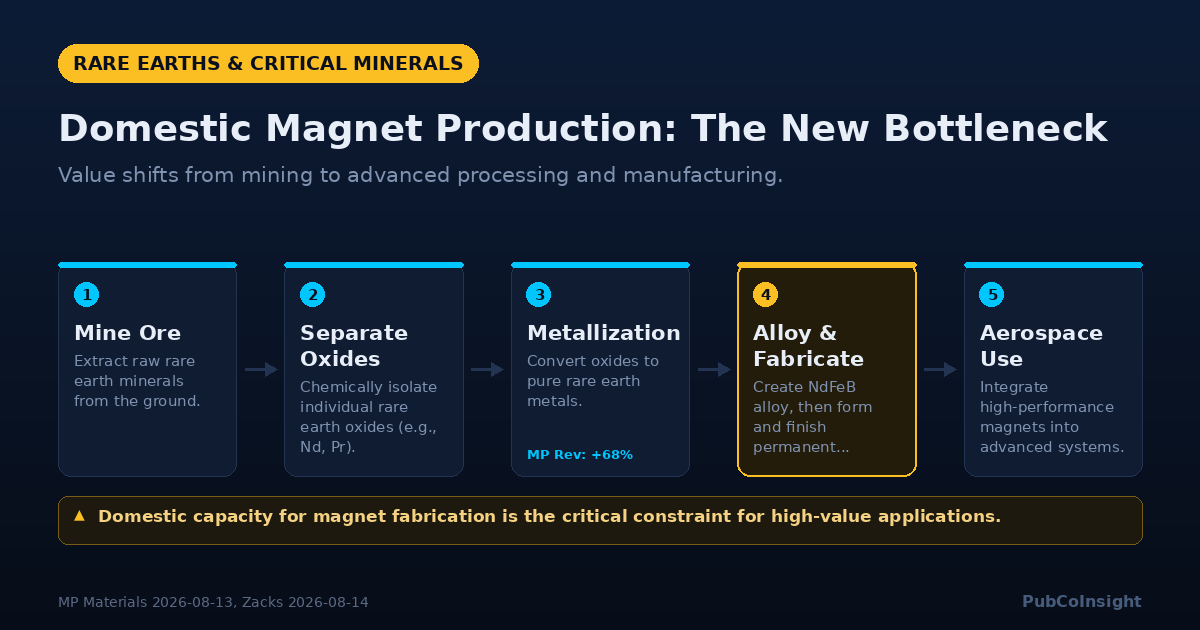
The Mechanism of Magnet Production
Rare earth elements, specifically neodymium and praseodymium, are essential for high-strength permanent magnets. These magnets power everything from electric vehicle motors to guided missile systems. The process begins with mining rare earth ore, then concentrating it. Next comes the complex chemical separation of individual rare earth oxides, a step historically dominated by China due to proprietary solvent extraction techniques developed over decades. This separation is difficult because rare earth elements share similar chemical properties, requiring precise control of pH and solvent mixtures across hundreds of stages to isolate each element. Once separated, the oxides must be converted into metals. Neodymium oxide, for example, is reduced to neodymium metal. This metal is then alloyed with iron and boron to create the NdFeB alloy, which forms the basis of the permanent magnet. The alloy is then pulverized into fine powder, pressed, sintered at high temperatures, and finally shaped and coated to produce the finished magnet. The bottleneck for Western supply chains has not been the initial mining, nor even the separation of oxides, but the subsequent metallization, alloying, and magnet fabrication. A deal like MP Materials' suggests a move to close this gap, bringing these higher-value, more technically demanding stages back to domestic shores. The value accumulates at each step, from ore to oxide to metal to magnet.Companies in the Sector Address Supply Chain Gaps
Several companies are working to establish or expand domestic capabilities across this critical minerals supply chain. MP Materials (MP), with its Mountain Pass mine in California, has been a key player in upstream rare earth supply. Its recent revenue surge and aerospace deal suggest a push into downstream processing, specifically magnet manufacturing. The company reported a 68% revenue increase in the first half of 2026, signaling momentum beyond just raw concentrate sales. USA Rare Earth, Inc. (USAR) is another company focused on establishing a fully integrated rare earth supply chain in the US. It aims to go from mine to magnet. NioCorp Developments Ltd. (NB) is developing its Elk Creek project in Nebraska, targeting niobium, scandium, and titanium, alongside rare earth elements. Its focus extends to processing these materials for various high-tech applications. Critical Metals Corp. (CRML) is developing the Tanbreez project in Greenland, which is rich in heavy rare earth elements, aiming to provide a non-Chinese source. The company's CEO has explicitly stated the goal of beating China's REE monopoly. In the lithium space, companies are working to secure domestic supply for battery production. Standard Lithium Ltd. (SLI) recently announced a collaboration with Nano One to qualify its South West Arkansas lithium carbonate for LFP cathodes, demonstrating progress in downstream battery material production. Lithium Americas (LAC) continues to advance its Thacker Pass project in Nevada, securing $175 million in financing as it approaches peak construction. Albemarle (ALB), a major global lithium producer, saw its stock slide 28% in three months but is still expected to benefit from low-cost assets. Atlas Lithium Corporation (ATLX) is developing its lithium projects in Brazil. Ioneer Ltd (IONR) is advancing its Rhyolite Ridge lithium-boron project in Nevada, aiming to produce both critical minerals from a single deposit. American Battery Technology Company (ABAT) focuses on lithium-ion battery recycling and primary mineral extraction, recently announcing an offtake agreement.American Lithium Minerals, Inc.
American Lithium Minerals, Inc. (AMLM) is an exploration stage company, trading over the counter, with a stated focus on lithium and boron properties in Nevada. The company is pre-revenue. It was incorporated in Nevada in 2005 and has since acquired mineral rights and explored for minerals. AMLM's current primary project is the Sarcobatus Lithium property, comprising 1,780 acres of mining claims in Central Nevada. The company's activities since 2009 have centered on lithium exploration in this region. Beyond lithium, AMLM has also acquired and divested cobalt, nickel, and graphite prospects in Central Nevada, and rare earth elements projects in Kingman, Arizona, and Southeast Illinois. AMLM's filings indicate an intention to expand its exploration and acquisition for mineral properties worldwide. The company is also developing the use of Real World Asset Tokens to provide capital for mining. This tokenization strategy aims to create an interoperable ecosystem for asset acquisition, tokenization, and trading. The public record does not yet establish the commercial viability or production timeline for the Sarcobatus project. The company qualified a Regulation A offering on Form 1-A on February 4, 2026, covering up to 80,000,000 units, with up to 120,000,000 shares issuable if attached warrants are fully exercised. Each unit includes one share of common stock and a warrant to purchase 1.5 shares of common stock, exercisable at $0.05 per share until December 31, 2028. The maximum total offering amount is $20,000,000. AMLM does not own any real property such as land or buildings, focusing instead on mineral rights.What to watch
The rare earth and critical minerals sector will see several key developments in the coming months. Watch for further details on MP Materials' "secret aerospace deal," specifically any announced timelines for new magnet production facilities or expanded downstream processing capabilities. Any new offtake agreements for processed rare earth metals or finished magnets from US-based operations will signal progress. On the lithium front, look for updates from Lithium Americas (LAC) regarding construction progress at Thacker Pass and any further financing announcements to support its development. Standard Lithium (SLI) will likely provide more information on the qualification of its South West Arkansas lithium carbonate for LFP cathodes, including potential commercial agreements with battery manufacturers. For American Lithium Minerals (AMLM), watch for any updates on exploration results at its Sarcobatus Lithium property or further details on its Real World Asset Token initiative. For Critical Metals Corp. (CRML), any progress on permitting or development at the Tanbreez project in Greenland will be significant., { "label": "Separate Oxides", "note": "Chemically isolate individual rare earth oxides (e.g., Nd, Pr)." }, { "label": "Metallization", "note": "Convert oxides to pure rare earth metals.", "metric": "MP Rev: +68% 1H26" }, { "label": "Alloy & Fabricate", "note": "Create NdFeB alloy, then form and finish permanent magnets." }, { "label": "Aerospace Use", "note": "Integrate high-performance magnets into advanced systems." } ], "highlight": 3, "highlight_note": "Domestic capacity for magnet fabrication is the critical constraint for high-value applications.", "footnote": "MP Materials 2026-08-13, Zacks 2026-08-14" }Companies mentioned
| Ticker | Company | Price |
|---|---|---|
| ABAT | American Battery Technology Company | $2.49 |
| AMLM client | American Lithium Minerals, Inc. | $0.073 |
| ATLX | Atlas Lithium Corporation | $3.21 |
| CRML | Critical Metals Corp. | $6.66 |
| IONR | ioneer Ltd | $3.17 |
| NB | NioCorp Developments Ltd. | $5.11 |
| SLI | Standard Lithium Ltd. | $2.38 |
| USAR | USA Rare Earth, Inc. | $20.0 |
Listed alphabetically, not ranked. Prices as of 2026-08-16 and they move. Check a live quote before relying on any of this.
How we chose the companies in this article
We cover a fixed universe of companies working in lithium, boron and the critical minerals that feed battery and energy-storage supply chains. Every one of them that had usable market data on 2026-08-16 appears in this article. We do not pick which ones to mention based on what we think of them, and we do not order them by size, price or trading volume, because an ordered list is a verdict and that is not ours to hand down. Companies left out, and why: none. American Lithium Minerals and Artificial Intelligence Technology Solutions pay us, which is disclosed in full at the foot of every article they appear in.
See the dilution and promotion flags before you see the pitch.
Each week: the micro and small-caps now showing dilution or paid-promotion signals, with the SEC filing behind every flag. No recommendations, no price targets.
Sources used in this article
- Albemarle Stock Slides 28% in 3 Months: Should You Buy the Dip? Zacks · 2026-08-14
- MP Materials, USA Rare Earth Stock Rise Amid Trump Drone News; Energy Fuels Touted Investor's Business Daily · 2026-08-14
- MP Sees 68% Surge in Revenues in 1H26: Can This Momentum Last? Zacks · 2026-08-14
- Rare Earth Stocks Soar on Friday: MP Materials Up 8%, USA Rare Earth Up 9%, NioCorp Up 3%. What’s Behind the Jump? 24/7 Wall St. · 2026-08-14
- USA Rare Earth Gains 7%, MP Materials Jumps 8%: Here’s Why Critical Minerals Are Moving Today 24/7 Wall St. · 2026-08-14
- MP Materials vs. The Metals Company: Which Critical-Minerals Stock Is the Smarter Long-Term Buy? Motley Fool · 2026-08-14
- MP Materials (MP) Q2 2026 Earnings Call Transcript Motley Fool · 2026-08-14
- American Lithium Minerals, Inc. (OTC: AMLM) Reports Fiscal Q3 2026 Results GlobeNewswire · 2026-08-14
- Albemarle (ALB) Q2 2026 Earnings Call Transcript Motley Fool · 2026-08-13
- Basic Materials Roundup: Market Talk The Wall Street Journal · 2026-08-13
- Lithium Americas' Q2 Net Loss Narrows MT Newswires · 2026-08-13
- Lithium Americas: Q2 Earnings Snapshot Associated Press · 2026-08-13
Disclosure required by Section 17(b) of the Securities Act of 1933
American Lithium Minerals, Inc.. American Lithium Minerals, Inc. (issuer) paid Strategic Innovations First, Inc., an affiliate of PubCo Insight and Pulse IR. Compensation received: USD 11,550.00 total, three equal monthly installments of USD 3,850.00. Form of payment: cash only; no stock, options or warrants. Services: investor relations, marketing and content creation under Master Services Agreement dated June 22, 2026. Period: three month initial term, June 2026 through August 2026. No position, options or warrants held by PubCo Insight, Pulse IR, Strategic Innovations First, Inc., or Brad Listermann.
This is information, not investment, financial, legal or tax advice. It is not a recommendation or solicitation to buy, sell or hold any security and it contains no price target. Nothing here is independently verified by us. Confirm every figure against primary filings on SEC EDGAR before you act. Micro-cap and over-the-counter securities are speculative and illiquid and can lose all of their value. The companies named without a disclosure above pay us nothing and have no relationship with us; they are named because a published, mechanical screen selected them. Full disclosure policy.