Rare Earth Processing Fuels MP Materials Surge: A Look at the Supply Chain's Chokepoints
MP Materials' Q3 revenue jump of 176% on November 13, 2026, highlights a critical bottleneck in the rare earth supply chain: the complex and capital-intensive process of separating rare earth elements into usable forms.
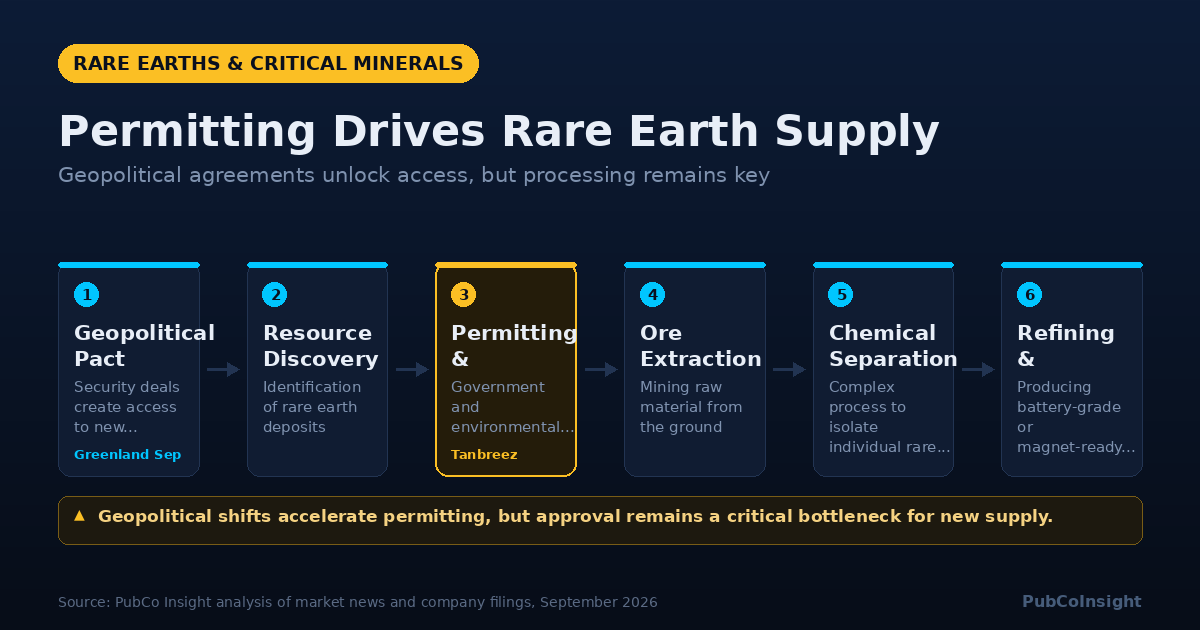
The Mechanism of Rare Earth Separation
Separating rare earth elements from a mixed concentrate is a multi-stage chemical engineering challenge. Rare earth elements, or REEs, occur together in mineral deposits because their atomic structures are very similar. This similarity makes them difficult to differentiate and isolate. The most common industrial method is solvent extraction. First, the rare earth ore is crushed and milled into a fine powder. This powder then undergoes a flotation process to create a concentrate, which is then leached with acids to dissolve the rare earth minerals. The resulting solution, a mixed rare earth liquor, contains various REEs along with other impurities. This is where the core challenge begins. Solvent extraction involves repeatedly mixing the aqueous rare earth solution with an organic solvent. Each rare earth element has a slightly different affinity for the organic solvent based on its ionic radius and chemical properties. By carefully controlling pH, temperature, and the specific organic extractant used, engineers can selectively pull individual rare earth elements into the organic phase. This process is repeated hundreds, sometimes thousands, of times in a cascade of mixer-settler units or pulse columns. Each stage refines the separation, gradually isolating individual rare earth oxides like neodymium, praseodymium, dysprosium, and terbium, which are crucial for high-strength magnets in electric vehicles and wind turbines. The complexity lies in maintaining precise control over each stage to achieve high purity, a critical requirement for downstream applications.Companies Operating in This Sector
Several companies are navigating the rare earth and critical minerals landscape, focusing on different parts of the supply chain. MP Materials (MP), with its Mountain Pass mine in California, is a key player in the US, processing rare earth concentrates and moving towards full separation capabilities. Their recent revenue increase reflects progress in this area. Further down the processing chain, USA Rare Earth, Inc. (USAR), trading at $8.16, is developing its Round Top project in Texas, which aims to produce a range of critical minerals, including rare earths, lithium, and uranium. Their focus extends beyond just mining to integrated processing. Critical Metals Corp. (CRML), priced at $4.88, recently announced full ownership of the Tanbreez Rare Earth Project, signaling a move to consolidate control over raw material supply. In the lithium space, companies like Albemarle (ALB) and Sociedad Quimica y Minera (SQM) are established producers, though recent reports indicate shifts in price targets and funding for US lithium projects. Lithium Americas (LAC), despite a Q3 loss per share narrowing, saw its Thacker Pass Phase 1 capital cost estimate rise to $3.83 billion, highlighting the significant investment required for new large-scale projects. Other companies are exploring different extraction methods or mineral types. Standard Lithium Ltd. (SLI), at $1.37, is focused on direct lithium extraction from brine resources in Arkansas. Atlas Lithium Corporation (ATLX), trading at $1.54, is developing hard rock lithium projects. ioneer Ltd (IONR), at $2.18, is advancing its Rhyolite Ridge lithium-boron project in Nevada, a unique co-deposit that could offer diversified output. NioCorp Developments Ltd. (NB), priced at $2.77, is working on a niobium, scandium, and titanium project in Nebraska, which also has potential for rare earth byproducts. American Battery Technology Company (ABAT), at $1.13, reported 83% year-over-year revenue growth in its Q1 FY27 results, indicating traction in battery recycling and critical mineral recovery.American Lithium Minerals, Inc.
American Lithium Minerals, Inc. (AMLM) trades over the counter and is an exploration stage company, currently pre-revenue. The company's stated focus is on lithium and boron properties located in Nevada. AMLM was incorporated in Nevada on March 10, 2005. The company's primary asset is the Sarcobatus Lithium property, which comprises 1,780 acres of mining claims in Central Nevada. This project is the current focus of its exploration activities. AMLM has also, at various times since 2009, acquired and divested cobalt, nickel, and graphite prospects in Central Nevada, and rare earth elements projects in Kingman, Arizona, and Southeast Illinois. The public record does not yet establish the economic viability or resource estimates for the Sarcobatus property. AMLM’s strategy includes exploring for lithium in Nevada and an intention to expand its exploration and acquisition for mineral properties globally. The company also states an interest in developing the use of Real World Asset Tokens to provide capital for mining operations, aiming to create an interoperable ecosystem for asset acquisition, tokenization, and trading. On February 4, 2026, the SEC qualified a Regulation A offering on Form 1-A. This offering covers up to 80,000,000 units, with each unit including one share of common stock and a warrant to purchase 1.5 shares of common stock. The warrants are exercisable at $0.05 per share until December 31, 2028, potentially issuing up to an additional 120,000,000 shares if fully exercised. The maximum total offering amount is $20,000,000. AMLM's most recent substantive filing, the Regulation A Offering Circular, was dated February 19, 2026. The company does not currently own any real property such as land or physical plants.What to watch
Investors should monitor specific, dated developments. For Lithium Americas (LAC), watch for updates on the Thacker Pass Phase 1 capital cost estimate, which was recently raised to $3.83 billion. Any further revisions or financing announcements will be material. For Critical Metals Corp. (CRML), the 2027 roadmap, outlined in their November 11, 2026, GlobeNewswire release, will detail their plans for the Tanbreez Rare Earth Project and any further consolidation of assets. For American Battery Technology Company (ABAT), the continuation of their revenue growth, as seen in their Q1 FY27 results, will indicate the scalability of their recycling and recovery operations. For American Lithium Minerals, Inc. (AMLM), look for any future filings detailing exploration results or resource estimates for the Sarcobatus Lithium property, as these would provide concrete data on their Nevada assets. The exercise of warrants from their Regulation A offering, which expire December 31, 2028, will also impact the share structure., { "label": "Concentrate", "note": "Process ore into a mixed rare earth concentrate." }, { "label": "Chemical Separation", "note": "Isolate individual rare earth oxides (e.g., Nd, Pr) via solvent extraction.", "metric": "176% Q3 Rev Growth" }, { "label": "Metal & Alloy", "note": "Convert oxides into metals and alloys for manufacturing." }, { "label": "End Product", "note": "Use rare earth magnets in EVs, wind turbines, electronics." } ], "highlight": 2, "highlight_note": "Complex chemical separation is capital-intensive and the primary constraint for high-purity rare earths.", "footnote": "Source: MP Materials Q3 2026 Revenue Report, Nov 13, 2026" }Companies mentioned
| Ticker | Company | Price |
|---|---|---|
| ABAT | American Battery Technology Company | $1.13 |
| AMLM client | American Lithium Minerals, Inc. | $0.037 |
| ATLX | Atlas Lithium Corporation | $1.54 |
| CRML | Critical Metals Corp. | $4.88 |
| IONR | ioneer Ltd | $2.18 |
| NB | NioCorp Developments Ltd. | $2.77 |
| SLI | Standard Lithium Ltd. | $1.37 |
| USAR | USA Rare Earth, Inc. | $8.16 |
Listed alphabetically, not ranked. Prices as of 2026-11-15 and they move. Check a live quote before relying on any of this.
How we chose the companies in this article
We cover a fixed universe of companies working in lithium, boron and the critical minerals that feed battery and energy-storage supply chains. Every one of them that had usable market data on 2026-11-15 appears in this article. We do not pick which ones to mention based on what we think of them, and we do not order them by size, price or trading volume, because an ordered list is a verdict and that is not ours to hand down. Companies left out, and why: none. American Lithium Minerals and Artificial Intelligence Technology Solutions pay us, which is disclosed in full at the foot of every article they appear in.
See the dilution and promotion flags before you see the pitch.
Each week: the micro and small-caps now showing dilution or paid-promotion signals, with the SEC filing behind every flag. No recommendations, no price targets.
Sources used in this article
- Could Investing $5,000 in MP Materials Help Make You a Millionaire? Motley Fool · 2026-11-14
- Are Wall Street Analysts Predicting Albemarle Stock Will Climb or Sink? Barchart · 2026-11-13
- Are Options Traders Betting on a Big Move in Sociedad Quimica y Minera Stock? Zacks · 2026-11-13
- Deutsche Bank Lowers Price Target on Lithium Americas to $2.20 From $2.80, Keeps Hold Rating MT Newswires · 2026-11-13
- Critical Metals Rises 3% as Rare Earth Stocks Extend Rally; USA Rare Earth Climbs 3%, MP Materials Gains 2% 24/7 Wall St. · 2026-11-13
- Heavy Lifting: Can USA Rare Earth Turn Its First Sales Into Big Profits? MarketBeat · 2026-11-13
- MP's Q3 Revenues Jump 176%: Can This Growth Be Sustained? Zacks · 2026-11-13
- Wall Street Wrap: Nvidia Faces Downgrades As Jensen Huang’s Exit Rattles Analysts — AMD, MP Materials, Riot Platforms Get Bullish Calls Stocktwits · 2026-11-13
- Rare Earth Wars: U.S. General Sounds Alarm Over China's Military Leverage Oilprice.com · 2026-11-13
- American Battery Technology Company Announces First Quarter FY27 Financial Results Including 83% Year-Over-Year Revenue Growth GlobeNewswire · 2026-11-13
- BofA Adjusts Price Target on Albemarle to $120 From $131 MT Newswires · 2026-11-12
- CICC Adjusts Price Target on Albemarle to $108.58 From $83.28 MT Newswires · 2026-11-12
Disclosure required by Section 17(b) of the Securities Act of 1933
American Lithium Minerals, Inc.. American Lithium Minerals, Inc. (issuer) paid Strategic Innovations First, Inc., an affiliate of PubCo Insight and Pulse IR. Compensation received: USD 11,550.00 total, three equal monthly installments of USD 3,850.00. Form of payment: cash only; no stock, options or warrants. Services: investor relations, marketing and content creation under Master Services Agreement dated June 22, 2026. Period: three month initial term, June 2026 through August 2026. No position, options or warrants held by PubCo Insight, Pulse IR, Strategic Innovations First, Inc., or Brad Listermann.
This is information, not investment, financial, legal or tax advice. It is not a recommendation or solicitation to buy, sell or hold any security and it contains no price target. Nothing here is independently verified by us. Confirm every figure against primary filings on SEC EDGAR before you act. Micro-cap and over-the-counter securities are speculative and illiquid and can lose all of their value. The companies named without a disclosure above pay us nothing and have no relationship with us; they are named because a published, mechanical screen selected them. Full disclosure policy.