Market Pulse: Critical Minerals & Hard Assets
Rare Earth Downgrades Ripple: Small Caps Face Reality Check on Critical Mineral Supply
William Blair's downgrade of USA Rare Earth triggers a sectorwide repricing, exposing feedstock risks and capital constraints across junior miners and processors.
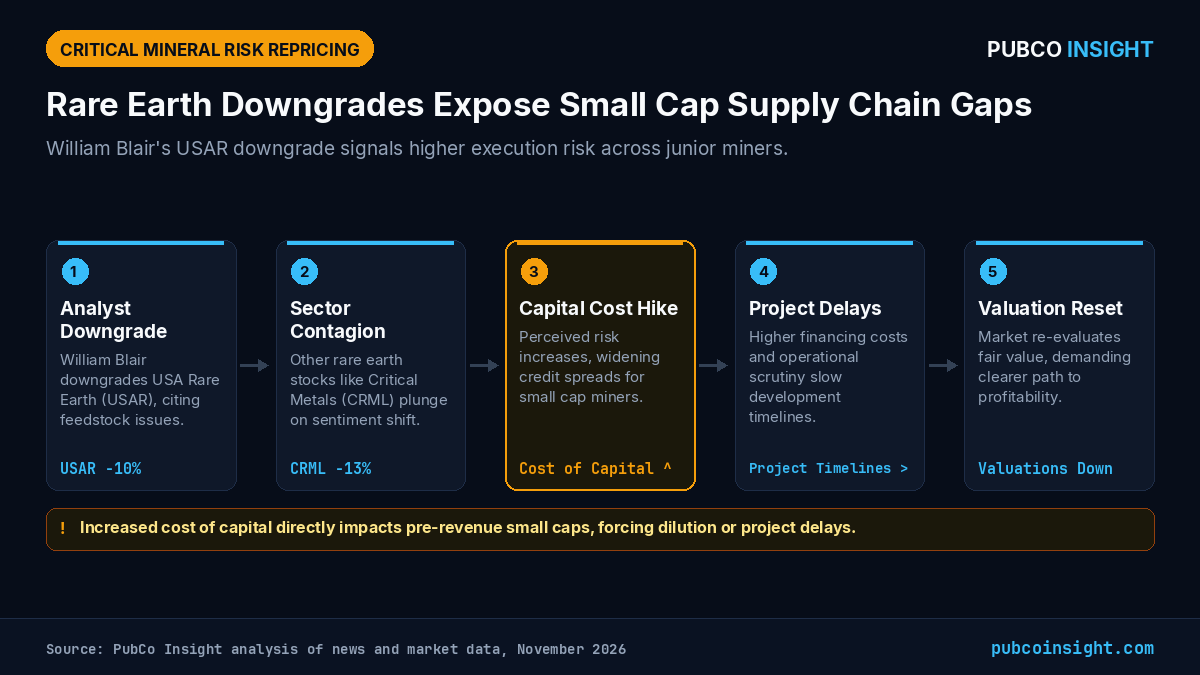
The critical minerals sector just took a gut punch. William Blair's downgrade of USA Rare Earth, Inc. (USAR) to Market Perform from Outperform on November 16, citing "near-term challenges" and pushing sales and margin estimates to 2028, wasn't just about one stock. It sent shivers through the entire rare earth complex. Critical Metals Corp. (CRML) plunged 13%, MP Materials (MP) dropped 5%, and USA Rare Earth itself tumbled 10% on the news. This isn't theoretical market chatter; it's a direct hit on the valuations and operational timelines of small-cap and microcap players betting big on domestic critical mineral supply chains.
This repricing isn't an isolated event. It's the market's cold assessment of a fundamental challenge: the gap between geopolitical ambition for secure domestic supply and the gritty, expensive reality of getting critical minerals out of the ground and into functional products. While headlines trumpet the need for rare earths in defense and EV batteries, the street is now scrutinizing the path to commercial scale. The focus has shifted from "if" these resources are needed to "when" they can be economically produced, processed, and sold, especially when facing feedstock issues highlighted by William Blair.
The Market Transmission Mechanism: From Geopolitics to Balance Sheets
The rare earth market transmission mechanism is a complex interplay of geopolitics, capital availability, and highly specialized processing technology. When a major player like William Blair downgrades a key domestic miner like USA Rare Earth (USAR), it signals increased perceived risk across the entire supply chain. This isn't just about a single analyst's opinion; it reflects a broader re-evaluation of the timelines and costs associated with establishing viable, non-Chinese critical mineral supply. The immediate impact is a widening of credit spreads for companies in the sector, making it harder and more expensive for junior miners and processors to secure the capital needed for exploration, development, and plant construction. Small-cap and microcap companies, often pre-revenue or in early production stages, are particularly vulnerable. Their access to capital is already constrained compared to majors like Freeport-McMoRan (FCX) or MP Materials (MP). A sectorwide downgrade, especially one citing "feedstock issues," directly impacts investor confidence. It suggests that even with significant mineral deposits, the path to commercialization is fraught with processing bottlenecks, permitting delays, and higher-than-anticipated operational costs. This translates to increased dilution risk for existing shareholders as companies are forced to raise capital at lower valuations or through more expensive debt. Furthermore, the "collectible" tax status for some silver sales, as reported for SLV's $149,842 gain on a $300,000 sale on November 16, highlights the idiosyncratic regulatory and tax risks that can emerge in the metals markets, adding another layer of complexity for retail and institutional investors alike.
The weekly Flags Watchlist: small-caps now showing dilution or promotion signals, each linked to the SEC filing behind the flag.
How the Small-Cap and Microcap Cohort Positions Around This Trend
The recent market action has forced a harsh spotlight on the operational realities of the critical minerals cohort. USA Rare Earth, Inc. (USAR), with its $149.6M 30-day average daily dollar volume, remains a bellwether for the domestic rare earth story. Its 44% slide and subsequent downgrade by William Blair on November 16 underscores the market's concern over its near-term commercialization timeline and feedstock challenges. Despite its significant trading liquidity, the company now faces heightened scrutiny on its path to generating substantial revenue. USAR's stock looks "below fair value," according to Simply Wall St. on November 16, but the downgrade reflects a re-evaluation of that "fair value" in light of new information. Critical Metals Corp. (CRML), with a 30-day average daily dollar volume of $40.2M, saw its shares plunge 13% following the USA Rare Earth downgrade. This contagion effect demonstrates how interconnected these smaller players are, often seen by the market as a single thematic basket. CRML's operational milestones and balance sheet constraints will now be viewed through a more skeptical lens, especially regarding its ability to secure and process critical feedstocks. NioCorp Developments Ltd. (NB), trading with an $8.7M 30-day average daily dollar volume, is focused on niobium, scandium, and titanium. While not directly a rare earth player, its fortunes are tied to the broader critical minerals narrative and the cost of capital for complex mineral processing projects. The market's repricing of risk for USAR could impact NB's ability to finance its Elk Creek Superalloy Materials Project, particularly if debt markets become tighter or equity valuations compress further. American Battery Technology Company (ABAT), with a $4.0M 30-day average daily dollar volume, operates in the battery recycling and lithium extraction space. While it offers a different angle on critical mineral supply, the broader market sentiment around the feasibility and cost of domestic mineral processing will inevitably affect its valuation. ABAT's ability to demonstrate scalable, cost-effective recycling or extraction technologies will be crucial in a market now demanding clearer paths to profitability. Standard Lithium Ltd. (SLI), with a $2.5M 30-day average daily dollar volume, focuses on direct lithium extraction (DLE) projects. The challenges faced by rare earth miners underscore the inherent difficulties in all novel mineral extraction technologies. SLI's progress on its Lanxess and South Arkansas projects will be scrutinized for operational efficiency and capital expenditure, especially as the market prices in higher execution risk across the sector. Atlas Lithium Corporation (ATLX), with a more modest $610K 30-day average daily dollar volume, is developing lithium projects in Brazil. For companies like ATLX, lower trading liquidity can exacerbate volatility during sector downturns. Its success hinges on demonstrating significant resource potential and a clear, capital-efficient development pathway, even as the broader market grows more cautious about critical mineral timelines. Finally, ioneer Ltd (IONR), trading with a $194K 30-day average daily dollar volume, is developing the Rhyolite Ridge Lithium Boron Project in Nevada. With the lowest liquidity among this group, IONR faces significant challenges in attracting institutional capital in a risk-off environment for critical minerals. Its ability to secure project financing and navigate permitting hurdles will be paramount, particularly when the market is demanding more immediate and tangible progress from its peers. The recent focus on MP Materials' operating loss narrowing in Q3, as reported by Zacks on November 16, suggests that even larger players are under pressure to demonstrate a recovery and a clear path to profitability, setting a high bar for the smaller, less liquid names.What Active Traders and Desks Are Watching Next
- Q4 2026 Earnings Season for Critical Mineral Companies: Watch for revised guidance, capital expenditure projections, and updates on feedstock procurement and processing timelines. Specific attention will be paid to MP Materials (MP) and its path to narrowing operating losses.
- SEC Filings for Junior Miners: Scrutinize 10-Qs and 8-Ks for any new debt offerings, equity raises, or changes in project development schedules, especially from companies like USA Rare Earth (USAR) and NioCorp Developments Ltd. (NB). Increased dilution or higher cost of capital will be key indicators.
- Updates on Critical Mineral Export Controls and Tariffs: Any new policy announcements from the US or China could significantly alter supply chain economics and impact the viability of domestic projects.
- Major Project Milestones: Look for concrete progress reports on permitting, construction, or initial production from companies like American Battery Technology Company (ABAT), Standard Lithium Ltd. (SLI), and ioneer Ltd (IONR). Delays or cost overruns will be heavily penalized.
- Commodity Price Action for Gold, Silver, and Copper: While not direct critical minerals, the performance of major metals like gold (GLD), silver (SLV), and copper (FCX) often signals broader sentiment towards hard assets and can influence capital flows into the critical minerals sector. Ray Dalio's continued advocacy for gold, despite its recent decline, suggests ongoing debate on its role as a hedge.
Companies mentioned
| Ticker | Company | Price |
|---|---|---|
| ABAT | American Battery Technology Company | $1.025 |
| ATLX | Atlas Lithium Corporation | $1.46 |
| CRML | Critical Metals Corp. | $4.19 |
| IONR | ioneer Ltd | $2.15 |
| NB | NioCorp Developments Ltd. | $2.56 |
| SLI | Standard Lithium Ltd. | $1.31 |
| USAR | USA Rare Earth, Inc. | $7.13 |
Listed alphabetically, not ranked. Prices as of 2026-11-17 and they move. Check a live quote before relying on any of this.
How we chose the companies in this article
Candidate pool of 10 small-cap, microcap, and OTC names in Market Pulse: Critical Minerals & Hard Assets; ranked by 30-day average daily dollar volume (Yahoo Finance) as of 2026-11-17. All compensated IR clients are excluded from this editorial lane.
PubCo Insight
See the dilution and promotion flags before you see the pitch.
Each week: the micro and small-caps now showing dilution or paid-promotion signals, with the SEC filing behind every flag. No recommendations, no price targets.
Every flag links to its EDGAR filing so you can check it yourself. Sponsored coverage disclosed under SEC 17(b). One-click unsubscribe.
Sources used in this article
- Silver Crashes 61% From All-Time High: One Wall Street Bull Sees A Buy Signal, Another Critic Says Wait Stocktwits · 2026-11-17
- MP Materials' Earnings Report Had Multiple Bright Spots, and There's 1 Thing I'm Watching Motley Fool · 2026-11-17
- Can Newmont Stock Fall 40%? Trefis · 2026-11-17
- 3 US Defense Stocks Facing A Rare Earth Magnet Supply Chain Shift Simply Wall St. · 2026-11-17
- USA Rare Earth (USAR) Gets a Reality Check From Wall Street. Shares Slide Insider Monkey · 2026-11-17
- SLV’s $149,842 Gain on a $300,000 Sale Could Be Taxed as a Collectible, Not a Stock 24/7 Wall St. · 2026-11-16
- USA Rare Earth Tumbles 10% on William Blair Downgrade Over Feedstock Issues; Critical Metals Plunges 13%, MP Materials Drops 5% 24/7 Wall St. · 2026-11-16
- One Downgrade Brings Down All Rare-Earth Stocks Ahead of Trump-Xi Meeting Barrons.com · 2026-11-16
- MP Materials' Operating Loss Narrows in Q3: Is There a Recovery Ahead? Zacks · 2026-11-16
- Freeport-McMoRan's Indonesian JV Unveils Planned Notes Offering MT Newswires · 2026-11-16
- PT Freeport Indonesia Announces Senior Notes Offering Business Wire · 2026-11-16
- USA Rare Earth (USAR) Stock Looks Below Fair Value After A 44% Slide Simply Wall St. · 2026-11-16
PubCo Insight publishes research on small and micro-cap companies. Nothing here is investment advice, we make no buy or sell recommendations, and we publish no price targets. Small and micro-cap shares are speculative and illiquid and you can lose everything you put into them. Check every figure against primary filings on SEC EDGAR before you act on it.