Antimony Plunge Signals Rare Earth Price Pressure Beyond Lithium
United States Antimony's recent guidance cut highlights a broader market vulnerability in critical minerals, where pricing volatility can quickly reshape company outlooks.
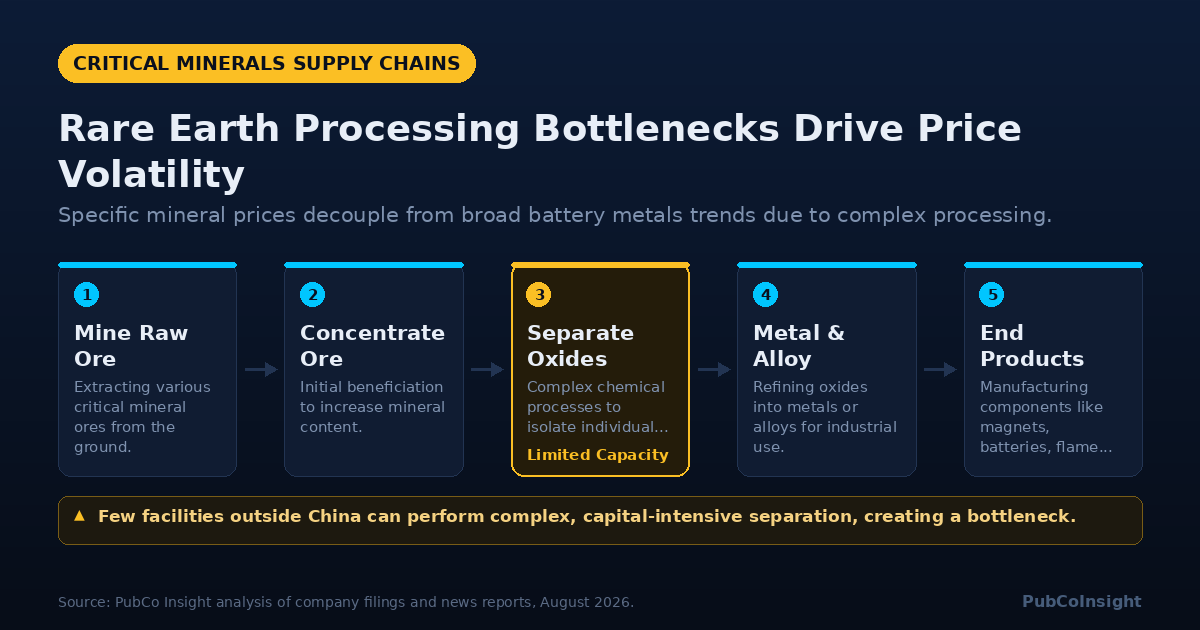
The Mechanics of Price Dislocation
The critical minerals market is not a single entity. It is a collection of distinct supply chains, each with its own geology, extraction methods, processing requirements, and end-use applications. Lithium, for instance, primarily serves the battery market, driven by electric vehicle adoption. Its price is largely dictated by battery demand and the pace of new brine and hard rock project development. Rare earth elements, while also critical, have a more diverse set of end-uses, including permanent magnets, catalysts, and specialized alloys. Antimony, the mineral that hit UAMY, is essential for flame retardants, lead-acid batteries, and as a hardening agent in alloys. Its market is smaller and less liquid than lithium, making it more susceptible to price swings from shifts in industrial demand or inventory cycles. The difficulty lies in the processing. Separating rare earth oxides, for example, requires complex solvent extraction circuits, a capital-intensive and technically demanding process that few facilities outside of China have fully mastered. This bottleneck in processing capacity, not just raw material availability, creates distinct market dynamics. When a specific industrial demand for a non-lithium critical mineral weakens, the impact can be swift and severe for producers focused on that particular element, even as the broader battery metals narrative remains strong.Companies Navigating Diverse Mineral Markets
Several companies in this sector operate across a range of critical minerals, not just lithium. MP Materials (MP) is a prime example, focusing on rare earth elements from its Mountain Pass mine in California. The company has been working to expand its processing capabilities to produce separated rare earth oxides and, eventually, permanent magnets. MP gained 15% on August 12, even with an earnings miss, with headlines pointing to a fading Chinese rare-earth monopoly as a driver. Critical Metals Corp. (CRML), trading at $6.61, is advancing its Mrima Hill Rare Earth and Niobium Project in Kenya, recently reaching the final round of a government tender. Its CEO has publicly stated the need to challenge China's REE monopoly. NioCorp Developments Ltd. (NB), priced at $5.22, is developing a niobium, scandium, and titanium project in Nebraska. Niobium is crucial for high-strength low-alloy steel, while scandium improves aluminum alloys. USA Rare Earth, Inc. (USAR), at $18.41, is also working on rare earth projects in the United States. In the lithium space, companies like Albemarle (ALB), trading around $136.00, and Sociedad Química y Minera de Chile (SQM), around $60.00, are major established players. Albemarle recently saw multiple price target adjustments from analysts, with RBC Capital and Scotiabank maintaining outperform ratings, citing low-cost assets. Lithium Americas (LAC), priced at $10.00, is developing its Thacker Pass project in Nevada and recently secured $175 million in financing to support peak construction. Standard Lithium Ltd. (SLI), at $2.41, is focused on direct lithium extraction (DLE) projects in Arkansas. Atlas Lithium Corporation (ATLX), at $3.13, is developing its hard rock lithium project in Brazil. ioneer Ltd (IONR), at $3.32, is advancing its Rhyolite Ridge lithium-boron project in Nevada. American Battery Technology Company (ABAT), trading at $2.52, is working on lithium-ion battery recycling and primary mineral extraction projects. Stardust Power, a private entity, recently announced an offtake agreement for its lithium products.American Lithium Minerals, Inc.
American Lithium Minerals, Inc. (AMLM), trading over the counter at $0.066, is an exploration-stage company incorporated in Nevada in 2005. The company is pre-revenue and states its primary focus is lithium and boron properties in Nevada. AMLM filed a Regulation A offering on Form 1-A, qualified by the SEC on February 4, 2026. This offering covers up to 80,000,000 units, with each unit comprising one share of common stock and one warrant to purchase 1.5 shares of common stock. The warrants are exercisable at $0.05 per share until December 31, 2028. An additional 120,000,000 shares could be issued if all warrants are exercised. The minimum purchase requirement for investors is $1,000, though the company can waive this on a case-by-case basis. AMLM's current project is the Sarcobatus Lithium property, which consists of 1,780 acres of mining claims in Central Nevada. The company has stated its intention to expand its exploration and acquisition for mineral properties worldwide. Beyond its core exploration activities, AMLM has also indicated it is developing the use of Real World Asset Tokens to provide capital for mining, aiming to create an interoperable ecosystem for tokenizing and trading assets. The company's filings also note that it has acquired and divested cobalt, nickel, and graphite prospects in Central Nevada, and rare earth elements projects in Kingman, Arizona, and Southeast Illinois, indicating a broader historical interest in various critical minerals. The public record does not yet establish the extent of the company's current exploration activities or any definitive resource estimates for its Sarcobatus project. The company's long-term vision, as outlined in its filings, includes consolidating in-ground mining assets and innovating through blockchain technology.What to watch
Investors should monitor several key developments across the critical minerals sector. For rare earth producers, watch for further updates on processing capacity expansion, particularly for separated rare earth oxides, as this is where significant value is added and supply chain independence is built. For MP Materials, the ramp-up of its magnet manufacturing facility will be a critical indicator. For Critical Metals Corp., the outcome of the Kenya government tender for the Mrima Hill project will be an important milestone. In the lithium sector, construction progress at major projects like Lithium Americas' Thacker Pass and Standard Lithium's DLE facilities will dictate future supply. Any new offtake agreements or strategic partnerships announced by smaller players like Atlas Lithium Corporation or American Battery Technology Company could signal progress towards commercialization. For American Lithium Minerals, Inc., watch for any announcements regarding exploration results from its Sarcobatus Lithium property or details on its stated plans to expand acquisitions and develop its Real World Asset Tokens initiative. Any new SEC filings will provide further insight into the company's operational and financial status., { "label": "Concentrate Ore", "note": "Initial beneficiation to increase mineral content." }, { "label": "Separate Oxides", "note": "Complex chemical processes to isolate individual rare earth oxides.", "metric": "Limited Capacity" }, { "label": "Metal & Alloy", "note": "Refining oxides into metals or alloys for industrial use." }, { "label": "End Products", "note": "Manufacturing components like magnets, batteries, flame retardants." } ], "highlight": 2, "highlight_note": "Few facilities outside China can perform complex, capital-intensive separation, creating a bottleneck.", "footnote": "Source: PubCo Insight analysis of company filings and news reports, August 2026." }Companies mentioned
| Ticker | Company | Price |
|---|---|---|
| ABAT | American Battery Technology Company | $2.52 |
| AMLM client | American Lithium Minerals, Inc. | $0.066 |
| ATLX | Atlas Lithium Corporation | $3.13 |
| CRML | Critical Metals Corp. | $6.61 |
| IONR | ioneer Ltd | $3.32 |
| NB | NioCorp Developments Ltd. | $5.22 |
| SLI | Standard Lithium Ltd. | $2.41 |
| USAR | USA Rare Earth, Inc. | $18.41 |
Listed alphabetically, not ranked. Prices as of 2026-08-13 and they move. Check a live quote before relying on any of this.
How we chose the companies in this article
We cover a fixed universe of companies working in lithium, boron and the critical minerals that feed battery and energy-storage supply chains. Every one of them that had usable market data on 2026-08-13 appears in this article. We do not pick which ones to mention based on what we think of them, and we do not order them by size, price or trading volume, because an ordered list is a verdict and that is not ours to hand down. Companies left out, and why: none. American Lithium Minerals and Artificial Intelligence Technology Solutions pay us, which is disclosed in full at the foot of every article they appear in.
See the dilution and promotion flags before you see the pitch.
Each week: the micro and small-caps now showing dilution or paid-promotion signals, with the SEC filing behind every flag. No recommendations, no price targets.
Sources used in this article
- Standard Lithium Q2 Earnings Call Highlights MarketBeat · 2026-08-13
- United States Antimony Plummets 25% After Slashing 2026 Guidance on Plunging Antimony Prices 24/7 Wall St. · 2026-08-12
- MP Gains 15% Despite Q2 Earnings Miss: How to Play the Stock? Zacks · 2026-08-12
- Is Wall Street Bullish or Bearish on Albemarle Stock? Barchart · 2026-08-11
- Lithium Americas: Q2 Earnings Snapshot Associated Press · 2026-08-11
- Albemarle to Benefit From Low-cost Assets, Brownfield Opportunity, RBC Says MT Newswires · 2026-08-10
- We Said These 4 Dividend Aristocrats Could Soar. Here’s How They Did, Plus 3 New Picks. 24/7 Wall St. · 2026-08-10
- Scotiabank Adjusts Albemarle PT to $190 From $200, Maintains Sector Outperform Rating MT Newswires · 2026-08-10
- RBC Capital Adjusts Price Target on Albemarle to $157 From $166, Keeps Outperform Rating MT Newswires · 2026-08-10
- Morgan Stanley Adjusts Price Target on Albemarle to $161 From $189, Keeps Equalweight Rating MT Newswires · 2026-08-10
- MP Materials (MP) Stock Is Rising Today: What’s Behind the Rally in Rare Earth Stocks? 24/7 Wall St. · 2026-08-10
- Deutsche Bank Adjusts MP Materials Price Target to $58 From $61, Maintains Buy Rating MT Newswires · 2026-08-10
Disclosure required by Section 17(b) of the Securities Act of 1933
American Lithium Minerals, Inc.. American Lithium Minerals, Inc. (issuer) paid Strategic Innovations First, Inc., an affiliate of PubCo Insight and Pulse IR. Compensation received: USD 11,550.00 total, three equal monthly installments of USD 3,850.00. Form of payment: cash only; no stock, options or warrants. Services: investor relations, marketing and content creation under Master Services Agreement dated June 22, 2026. Period: three month initial term, June 2026 through August 2026. No position, options or warrants held by PubCo Insight, Pulse IR, Strategic Innovations First, Inc., or Brad Listermann.
This is information, not investment, financial, legal or tax advice. It is not a recommendation or solicitation to buy, sell or hold any security and it contains no price target. Nothing here is independently verified by us. Confirm every figure against primary filings on SEC EDGAR before you act. Micro-cap and over-the-counter securities are speculative and illiquid and can lose all of their value. The companies named without a disclosure above pay us nothing and have no relationship with us; they are named because a published, mechanical screen selected them. Full disclosure policy.