Critical Metals Unlocks Rare Earths from Eudialyte, Targets $2.2B Revenue in Romania
Critical Metals Corp. announced a processing breakthrough for its Tanbreez heavy rare earth project, achieving high-purity rare earth separation from eudialyte concentrate, a geology that presents unique challenges and opportunities for the supply chain.
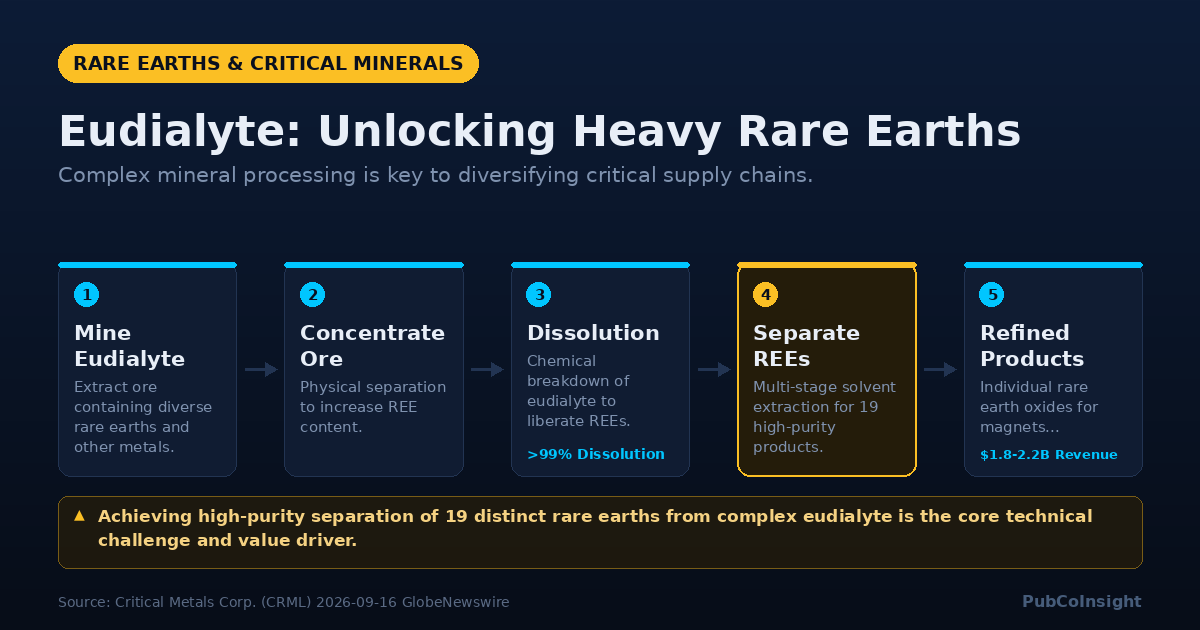
The Mechanism of Rare Earth Separation
Rare earth elements, or REEs, are not truly rare in the Earth's crust, but they are rarely found in economic concentrations and even more rarely found in easily processable forms. They are also chemically very similar, making their separation a complex and costly process. The standard industrial method, solvent extraction, involves multiple stages of mixing aqueous solutions containing dissolved rare earths with organic solvents. Each stage selectively extracts a specific rare earth element based on slight differences in their chemical affinity for the organic phase. Imagine a long chain of tiny, precise sieves, each designed to catch only one specific type of particle. The eudialyte mineral, unlike more common rare earth ores like monazite or bastnäsite, contains a broader spectrum of elements that must first be liberated from the silicate structure. This initial breakdown, or dissolution, must be highly efficient to maximize recovery. Then, the subsequent solvent extraction circuits must be finely tuned to separate not just a few, but 19 distinct rare earth products, each requiring its own purity specification. This requires significant capital investment in a refinery, a deep understanding of complex chemistry, and operational expertise to manage the reagents and waste streams. High purity is critical; even small amounts of contaminants can degrade the performance of end products like neodymium-iron-boron magnets or specialized phosphors.Companies Working in Critical Minerals Processing
Several companies are navigating the complexities of critical mineral processing, each with distinct approaches. Critical Metals Corp. (CRML) is pushing forward with its Tanbreez heavy rare earth project, aiming for a Romanian refinery to process eudialyte concentrate. This strategy involves establishing a European processing hub for a Greenlandic resource, a move that could diversify supply chains for heavy rare earths. In the lithium space, Standard Lithium Ltd. (SLI) is focused on direct lithium extraction (DLE) from brines in Arkansas and Texas. The company announced a positive Preliminary Economic Assessment for its Franklin Project in East Texas on September 8, projecting up to 70,000 tonnes of annual lithium carbonate output. This DLE technology aims to reduce the environmental footprint and accelerate production compared to traditional evaporation ponds. Another DLE player, ioneer Ltd (IONR), is developing its Rhyolite Ridge lithium-boron project in Nevada, which combines the extraction of both critical minerals from a single ore body. American Battery Technology Company (ABAT) is tackling battery recycling, a crucial component of a circular economy for critical minerals. ABAT reported strong financial results on September 14, delivering 407% revenue growth and positive adjusted gross profit in Q4 2026. This indicates progress in their efforts to recover lithium, nickel, cobalt, and other materials from spent batteries. NioCorp Developments Ltd. (NB) is developing its Elk Creek project in Nebraska, which targets niobium, scandium, and titanium, with potential for rare earth byproducts. This project represents a domestic source for these strategic metals. Atlas Lithium Corporation (ATLX) is advancing its Neves Project in Brazil, de-risking the project by contracting 71% of its direct capital budget, as reported on September 9. This focus on capital deployment suggests a move towards production. USA Rare Earth, Inc. (USAR) is another domestic player, with its Round Top project in Texas, which aims to produce a wide range of heavy and light rare earths, lithium, and other critical minerals from a unique rhyolite deposit.American Lithium Minerals, Inc.
American Lithium Minerals, Inc. (AMLM) is an exploration stage company, trading over the counter, with a stated focus on lithium and boron properties in Nevada. The company was incorporated in Nevada in 2005 and has since acquired mineral rights and conducted exploration. Its current primary project is the Sarcobatus Lithium property, comprising 1,780 acres of mining claims in Central Nevada. The company has also explored and divested cobalt, nickel, graphite, and rare earth prospects in Arizona and Illinois in the past. AMLM's plan involves exploring for lithium in Nevada and expanding its exploration and acquisition activities for mineral properties globally. The company also states an intention to develop Real World Asset Tokens to provide capital for mining, aiming to create an interoperable ecosystem for asset acquisition, tokenization, and trading. The public record does not yet establish a measured, indicated, or inferred resource for the Sarcobatus Lithium property. The company qualified a Regulation A offering on February 4, 2026, covering up to 80,000,000 units, with an additional 120,000,000 shares issuable if attached warrants are fully exercised. Each unit includes one share of common stock and one warrant to purchase 1.5 shares of common stock, exercisable at $0.05 per share until December 31, 2028. The maximum total offering amount is $20,000,000. AMLM has not generated significant revenues to date and acknowledges that its ability to generate revenue will depend on executing its business plan and expanding its client base. The company's activities since 2009 have primarily focused on lithium exploration at the Sarcobatus project.What to Watch
The rare earth sector will be watching for further details on Critical Metals Corp.'s Romanian refinery. Specifically, the market will look for updates on permitting, engineering studies, and financing for the proposed facility. Any firm offtake agreements for the 19 high-purity rare earth products would provide significant validation for CRML's processing breakthrough. For Standard Lithium, the next steps include advancing the Franklin Project towards a Definitive Feasibility Study and securing necessary permits for its DLE operations in Texas. American Battery Technology Company's continued revenue growth and sustained profitability in battery recycling will be key indicators of their scaling capabilities. NioCorp Developments will need to provide updates on project financing and construction timelines for its Elk Creek project. American Lithium Minerals will need to demonstrate progress on its Sarcobatus Lithium property through exploration results and resource definition. The market will also track any developments regarding AMLM's stated intention to use Real World Asset Tokens for capital raising., { "label": "Concentrate Ore", "note": "Physical separation to increase REE content." }, { "label": "Dissolution", "note": "Chemical breakdown of eudialyte to liberate REEs.", "metric": ">99% Dissolution" }, { "label": "Separate REEs", "note": "Multi-stage solvent extraction for 19 high-purity products." }, { "label": "Refined Products", "note": "Individual rare earth oxides for magnets, electronics.", "metric": "$1.8-2.2B Revenue" } ], "highlight": 3, "highlight_note": "Achieving high-purity separation of 19 distinct rare earths from complex eudialyte is the core technical challenge and value driver.", "footnote": "Source: Critical Metals Corp. (CRML) 2026-09-16 GlobeNewswire" }Companies mentioned
| Ticker | Company | Price |
|---|---|---|
| ABAT | American Battery Technology Company | $2.24 |
| AMLM client | American Lithium Minerals, Inc. | $0.0747 |
| ATLX | Atlas Lithium Corporation | $2.86 |
| CRML | Critical Metals Corp. | $6.87 |
| IONR | ioneer Ltd | $3.28 |
| NB | NioCorp Developments Ltd. | $3.65 |
| SLI | Standard Lithium Ltd. | $2.09 |
| USAR | USA Rare Earth, Inc. | $15.63 |
Listed alphabetically, not ranked. Prices as of 2026-09-18 and they move. Check a live quote before relying on any of this.
How we chose the companies in this article
We cover a fixed universe of companies working in lithium, boron and the critical minerals that feed battery and energy-storage supply chains. Every one of them that had usable market data on 2026-09-18 appears in this article. We do not pick which ones to mention based on what we think of them, and we do not order them by size, price or trading volume, because an ordered list is a verdict and that is not ours to hand down. Companies left out, and why: none. American Lithium Minerals and Artificial Intelligence Technology Solutions pay us, which is disclosed in full at the foot of every article they appear in.
See the dilution and promotion flags before you see the pitch.
Each week: the micro and small-caps now showing dilution or paid-promotion signals, with the SEC filing behind every flag. No recommendations, no price targets.
Sources used in this article
- 3 Mining Stocks Retail Investors Are Watching For Europe Critical Minerals Demand Simply Wall St. · 2026-09-18
- MP's Operating Losses Continue in Q2: Can It Revert to Profitability? Zacks · 2026-09-17
- CRML Stock Rises Premarket: Retail Calls For ‘Much Higher' Prices After $2.2B Revenue Target From Romania Refinery Stocktwits · 2026-09-17
- Can Albemarle's Lithium Expansion Fuel Sales Volume Growth? Zacks · 2026-09-16
- Critical Metals Rallies 5% on Tanbreez Refinery Study Projecting Up to $2.2B in Annual Revenue; USA Rare Earth Inches Higher, MP Materials Unmoved 24/7 Wall St. · 2026-09-16
- Critical Metals Projects Up to $2.2 Billion Annual Revenue From Proposed Romanian Refinery MT Newswires · 2026-09-16
- Critical Metals Corp (Nasdaq: CRML) Achieves Breakthrough Tanbreez Heavy Rare Earth Results: >99% Dissolution of Eudialyte Concentrate Into 19 Ultra-High-Purity Rare Earth Products; Refinery Study Projects US$1.8–2.2b in Annual Refinery Revenue GlobeNewswire · 2026-09-16
- American Battery Technology (ABAT) Turns A Profit, But Faces A New Export Threat Insider Monkey · 2026-09-16
- Should You Buy, Sell or Hold ALB Stock After a 29% Dip in 6 Months? Zacks · 2026-09-15
- Is MP Materials (MP) Cheap On Its Conference Spotlight And $75 Fair Value Narrative? Simply Wall St. · 2026-09-15
- Critical Metals Says Court Clears European Lithium Deal for October Shareholder Vote MT Newswires · 2026-09-15
- Critical Metals Corp. Merger with European Lithium Advances to Shareholder Vote Following Court Ruling GlobeNewswire · 2026-09-15
Disclosure required by Section 17(b) of the Securities Act of 1933
American Lithium Minerals, Inc.. American Lithium Minerals, Inc. (issuer) paid Strategic Innovations First, Inc., an affiliate of PubCo Insight and Pulse IR. Compensation received: USD 11,550.00 total, three equal monthly installments of USD 3,850.00. Form of payment: cash only; no stock, options or warrants. Services: investor relations, marketing and content creation under Master Services Agreement dated June 22, 2026. Period: three month initial term, June 2026 through August 2026. No position, options or warrants held by PubCo Insight, Pulse IR, Strategic Innovations First, Inc., or Brad Listermann.
This is information, not investment, financial, legal or tax advice. It is not a recommendation or solicitation to buy, sell or hold any security and it contains no price target. Nothing here is independently verified by us. Confirm every figure against primary filings on SEC EDGAR before you act. Micro-cap and over-the-counter securities are speculative and illiquid and can lose all of their value. The companies named without a disclosure above pay us nothing and have no relationship with us; they are named because a published, mechanical screen selected them. Full disclosure policy.