Market Pulse: Critical Minerals & Hard Assets
Rare Earth Resurgence: How MP Materials and USA Rare Earth Drive Small Cap Mineral Plays
China's rare earth reprieve and USA Rare Earth's commercial shipments are reshaping critical mineral supply chains, creating new dynamics for active small cap traders.
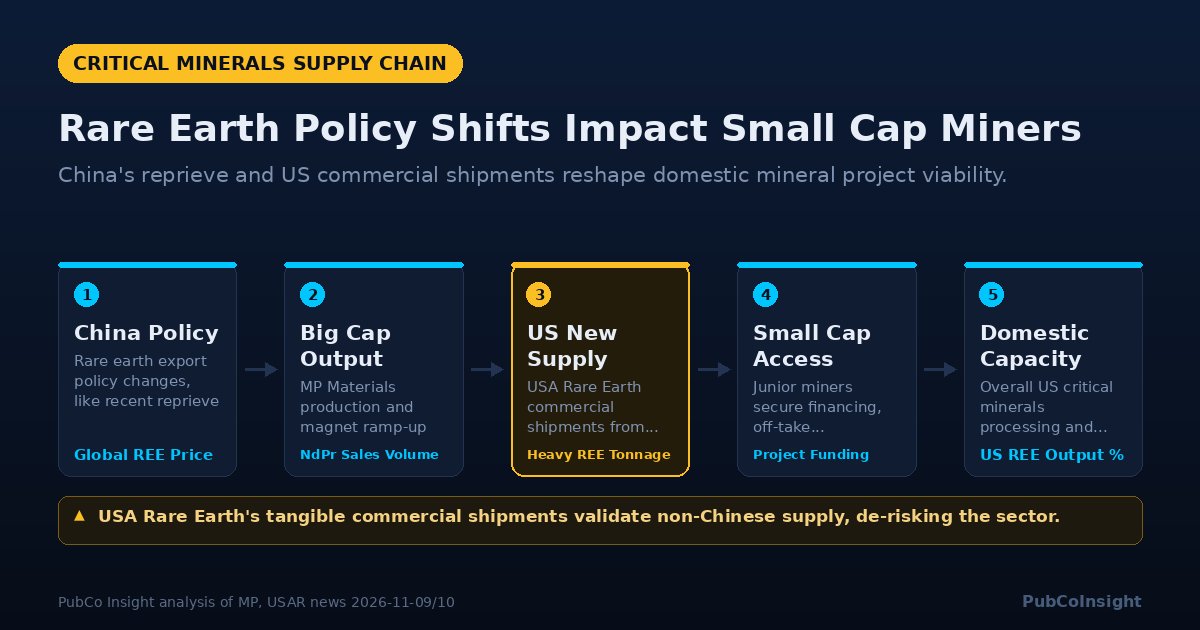
The critical minerals sector is buzzing this week, anchored by significant developments from two key players: MP Materials Corp. (MP) and USA Rare Earth, Inc. (USAR). On November 9, 2026, MP Materials saw its stock rise following news that China extended a rare earth reprieve, a move that provides a temporary easing of geopolitical tensions around these essential elements. Simultaneously, MP reported Q3 earnings that beat estimates on higher neodymium and praseodymium (NdPr) sales and pricing, with analysts like Jefferies highlighting production growth and a measured magnet ramp-up. This big-cap movement sets a crucial backdrop for the entire domestic critical mineral supply chain.
Just a day later, on November 10, 2026, USA Rare Earth (USAR) announced the start of commercial-scale shipments of heavy rare earth mixed rare earth carbonate (MREC) from its Serra Verde project to US SIIE, LLC. This marks a tangible step towards diversifying the global supply of heavy rare earths, a segment historically dominated by China. While USAR reported a Q3 loss and lagged revenue estimates, the market's focus quickly shifted to the Serra Verde shipment milestone, with retail sentiment turning bullish on Stocktwits. These dual developments, one a macro policy signal and the other a concrete operational milestone, transmit directly into the small-cap and microcap ecosystem, impacting everything from project financing to future off-take agreements.
The Market Transmission Mechanism
The interplay between China's rare earth policy and domestic production milestones creates distinct transmission channels for small-cap and microcap critical mineral companies. First, the extension of China's rare earth reprieve, reported on November 9, 2026, reduces immediate supply chain anxieties. This can temporarily ease pricing pressure on key rare earth elements, influencing the cost structures of downstream manufacturers. For junior miners and processors, this means less urgency for domestic production in the short term, but also a potential window to secure financing and develop projects without extreme price volatility. Second, the operational success of companies like USA Rare Earth in bringing new supply online directly impacts the perceived viability of other domestic projects. When USAR begins commercial shipments of heavy rare earths from Serra Verde, it provides a proof of concept for non-Chinese sources. This de-risks the sector, potentially lowering the cost of capital for other nascent projects by demonstrating that domestic production is achievable and can secure off-take agreements. Furthermore, the focus on magnet production by MP Materials, highlighted in their Q3 earnings call with a projected 10X demand increase, signals a robust long-term demand for processed rare earths. This demand pull creates opportunities for smaller players involved in upstream mining, midstream processing, and even downstream component manufacturing. The market's reaction to MP's earnings, despite Deutsche Bank adjusting its price target to $40 from $53, shows a continued belief in the underlying growth trajectory of the rare earth magnet market. For small-cap companies, this translates into a clearer pathway for securing future contracts and demonstrating the strategic importance of their deposits to potential investors and government agencies.
The weekly Flags Watchlist: small-caps now showing dilution or promotion signals, each linked to the SEC filing behind the flag.
How the Small-Cap and Microcap Cohort Positions Around This Trend
The critical minerals cohort is navigating these dynamics with varying operational stages and balance sheet realities. USA Rare Earth, Inc. (USAR), with its $150.4 million 30-day average daily dollar volume, stands out with its recent commercial-scale heavy rare earth shipments from Serra Verde. This milestone, despite a Q3 loss, demonstrates tangible progress in bringing new supply to market, specifically for critical heavy rare earths. The company also delivered its first yttrium oxide samples from its Wheat Ridge Demonstration Facility, signaling broader processing capabilities. Critical Metals Corp. (CRML) trades with a $41.9 million 30-day average daily dollar volume. While their recent focus has been on European lithium acquisitions, the broader critical minerals narrative, particularly around secure supply chains, underpins the strategic value of their resource plays. NioCorp Developments Ltd. (NB), with a $9.1 million 30-day average daily dollar volume, is developing a niobium, scandium, and titanium project in Nebraska. Their Q3 earnings missed estimates, but sales beat on higher prices, indicating underlying commodity strength. The push for domestic rare earth processing could indirectly benefit NioCorp by strengthening the overall US critical minerals ecosystem and attracting broader investment interest. American Battery Technology Company (ABAT), with a $5.9 million 30-day average daily dollar volume, focuses on lithium-ion battery recycling and primary lithium resources. While not directly a rare earth play, the overarching theme of domestic critical mineral supply security directly impacts ABAT's strategic positioning within the battery metals segment. Standard Lithium Ltd. (SLI), trading with a $2.8 million 30-day average daily dollar volume, is advancing its Arkansas lithium brine projects. Like ABAT, SLI benefits from the broader narrative of North American critical mineral independence, as diversified supply chains are sought across the entire EV and renewable energy sectors. Atlas Lithium Corporation (ATLX), with a $697K 30-day average daily dollar volume, is developing lithium projects in Brazil. The global push for critical minerals extends beyond North America, and Atlas Lithium's strategy aligns with securing diverse sources for the burgeoning battery market. Ioneer Ltd (IONR), with a $216K 30-day average daily dollar volume, is progressing its Rhyolite Ridge Lithium Boron Project in Nevada. For Ioneer, the increased focus on domestic processing and secure supply chains, exemplified by USAR's recent success, could improve the project's long-term financing prospects and off-take agreements. The trading liquidity across these names, from USAR's high volume to IONR's lower volume, reflects the market's current allocation of attention and capital within the diverse critical minerals landscape.What Active Traders and Desks Are Watching Next
- USA Rare Earth (USAR) Q4 2026 Earnings Call: Traders will scrutinize the impact of commercial shipments on revenue and profitability, expected in late February or early March 2027.
- MP Materials (MP) Q4 2026 Earnings Call: Focus will be on updates regarding the magnet manufacturing ramp-up and any further guidance on rare earth pricing and production costs, likely in late January or early February 2027.
- US Department of Energy (DOE) Critical Minerals Program Announcements: Any new grants, loans, or strategic partnerships for domestic rare earth or critical mineral projects could provide catalysts for companies like NioCorp (NB) or American Battery Technology Company (ABAT) within the next 90 days.
- Albemarle (ALB) and Freeport (FCX) Analyst Revisions: Continued price target adjustments from major banks like UBS, Deutsche Bank, and Morgan Stanley for big-cap players signal broader sentiment shifts that cascade to smaller miners.
- Global Rare Earth Pricing Trends: Monitoring indices and spot prices for NdPr and heavy rare earths will indicate underlying supply and demand dynamics, especially given China's reprieve.
- SEC Filings for Critical Metals Corp. (CRML) and Standard Lithium (SLI): Upcoming 10-K or 10-Q filings will offer granular details on project development, capital expenditures, and any new off-take agreements.
- Atlas Lithium (ATLX) and Ioneer (IONR) Project Updates: Specific news on exploration results, feasibility studies, or permitting milestones for their respective lithium projects will be key.
Companies mentioned
| Ticker | Company | Price |
|---|---|---|
| ABAT | American Battery Technology Company | $1.42 |
| ATLX | Atlas Lithium Corporation | $1.69 |
| CRML | Critical Metals Corp. | $6.05 |
| IONR | ioneer Ltd | $2.76 |
| NB | NioCorp Developments Ltd. | $3.27 |
| SLI | Standard Lithium Ltd. | $1.6 |
| USAR | USA Rare Earth, Inc. | $8.76 |
Listed alphabetically, not ranked. Prices as of 2026-11-10 and they move. Check a live quote before relying on any of this.
How we chose the companies in this article
Candidate pool of 10 small-cap, microcap, and OTC names in Market Pulse: Critical Minerals & Hard Assets; ranked by 30-day average daily dollar volume (Yahoo Finance) as of 2026-11-10. All compensated IR clients are excluded from this editorial lane.
PubCo Insight
See the dilution and promotion flags before you see the pitch.
Each week: the micro and small-caps now showing dilution or paid-promotion signals, with the SEC filing behind every flag. No recommendations, no price targets.
Every flag links to its EDGAR filing so you can check it yourself. Sponsored coverage disclosed under SEC 17(b). One-click unsubscribe.
Sources used in this article
- Deutsche Bank Adjusts MP Materials Price Target to $40 From $53, Maintains Buy Rating MT Newswires · 2026-11-10
- USA Rare Earth (USAR) Q3 2026 Earnings Call Transcript Motley Fool · 2026-11-10
- USA Rare Earth Inc (USAR) Q3 2026 Earnings Call Highlights: Record Cash, First Magnet Sales, ... GuruFocus.com · 2026-11-10
- What USA Rare Earth (USAR) Said on Its Q3 Earnings Call MarketBeat · 2026-11-10
- USAR Stock Drops Overnight As Loss Widens, But Retail Turns ‘Bullish’ On Serra Verde Rare Earth Shipment Milestone Stocktwits · 2026-11-10
- USA Rare Earth (USAR) Begins Commercial Scale Heavy Rare Earth Shipments Simply Wall St. · 2026-11-10
- MP Materials Sees Lower Rare Earth Costs as Output Rises, Despite Planned 2027 Downtime MarketBeat · 2026-11-09
- MP Materials rises as Jefferies highlights rare earth production growth and magnet ramp-up Proactive · 2026-11-09
- MP Stock Rises as China Extends Rare-Earth Reprieve Ahead of Trump-Xi Meeting Barrons.com · 2026-11-09
- MP Q3 Earnings Beat Estimates on Higher NdPr Sales and Pricing Zacks · 2026-11-09
- MP Q3 Earnings Call Highlights Measured Magnet Ramp-Up and 10X Demand Zacks · 2026-11-09
- UBS Adjusts Price Target on Albemarle to $137 From $150, Maintains Buy Rating MT Newswires · 2026-11-09
PubCo Insight publishes research on small and micro-cap companies. Nothing here is investment advice, we make no buy or sell recommendations, and we publish no price targets. Small and micro-cap shares are speculative and illiquid and you can lose everything you put into them. Check every figure against primary filings on SEC EDGAR before you act on it.