Rare Earth Selloff Highlights Feedstock Bottlenecks
A recent rare earth stock selloff, triggered by concerns over feedstock supply, underscores the complex and often overlooked challenges in securing the raw materials essential for critical mineral processing.
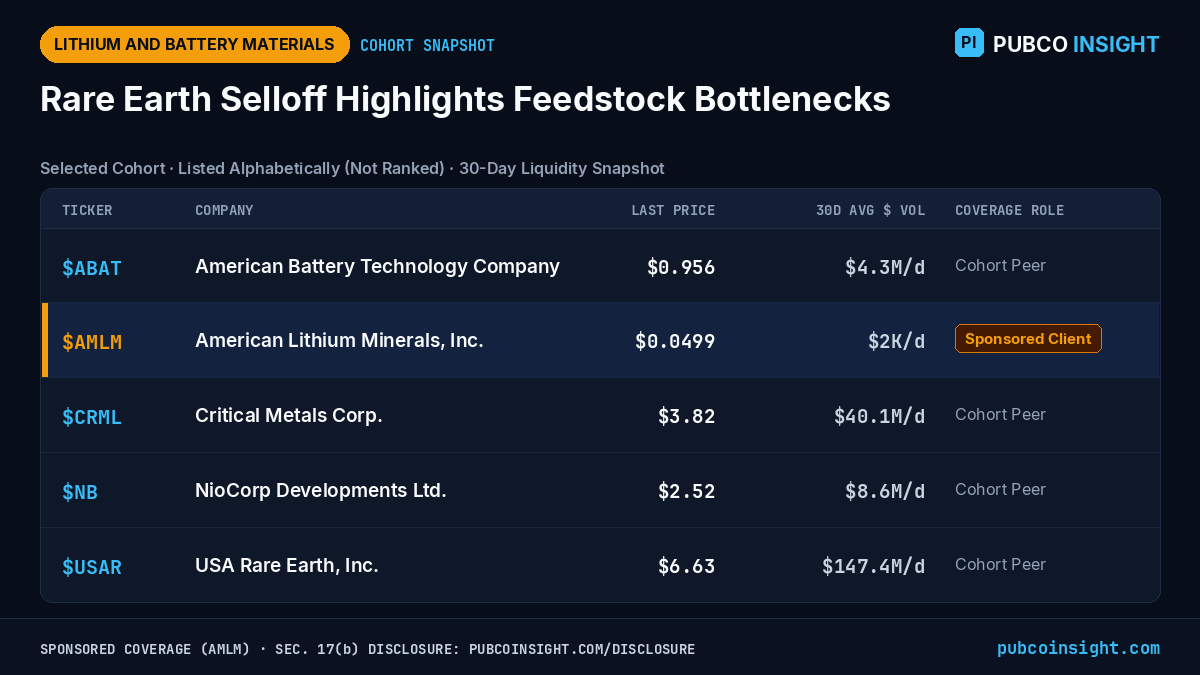
The Mechanism of Rare Earth Processing
Rare earth elements, or REEs, are not found as pure metals in the ground. They occur together in mineral deposits, typically as oxides, within a host rock. The challenge lies in their chemical similarity. All 17 rare earth elements, from lanthanum to lutetium, share similar atomic structures. This makes their separation from one another a highly difficult and energy-intensive process. Miners first extract the ore, then crush and grind it. This material undergoes a beneficiation step, often flotation, to produce a mixed rare earth concentrate. This concentrate is still a blend of all the REEs. The critical bottleneck, and where the value truly unlocks, is the separation stage. This involves solvent extraction, a multi-stage chemical process where different REEs are selectively dissolved and precipitated out of solution. Each individual rare earth oxide, such as neodymium oxide or praseodymium oxide, requires its own specific separation circuit. Building and operating these separation facilities demands significant capital, specialized chemical engineering expertise, and a robust, reliable supply of the mixed concentrate feedstock. Without this dedicated separation capacity, the mixed concentrate has limited value, often needing to be shipped to facilities, predominantly in China, for final processing. This reliance creates a significant supply chain vulnerability, exactly what the recent market movements reflect.Companies Navigating the Supply Chain
Several companies are working to address these bottlenecks, each with distinct approaches to securing and processing critical minerals. In the lithium space, **Standard Lithium Ltd. (SLI)** reported a widened net loss in its Q3 2026 earnings call, with $1.2. The company focuses on lithium brine projects in Arkansas. **Atlas Lithium Corporation (ATLX)**, trading at $1.48, is developing its lithium properties in Brazil. **ioneer Ltd (IONR)**, at $2.14, is advancing its Rhyolite Ridge lithium-boron project in Nevada, a co-production model that diversifies its output. **American Battery Technology Company (ABAT)**, with a price of $0.956, saw its stock fair value fall after an export license reframed analyst views, despite reporting 83% year-over-year revenue growth in its Q1 FY27 financial results. ABAT is focused on lithium-ion battery recycling and primary mineral extraction. For rare earths, **USA Rare Earth, Inc. (USAR)**, trading at $6.635, experienced a significant drop after the William Blair downgrade. The company is developing the Round Top project in Texas, which contains a substantial rare earth deposit. **Critical Metals Corp. (CRML)**, priced at $3.82, also saw a plunge but recently announced it now fully owns the Tanbreez Rare Earth Project after its acquisition from European Lithium, and reported $264.5 million in cash. **NioCorp Developments Ltd. (NB)**, at $2.52, is focused on its Elk Creek project in Nebraska, which aims to produce niobium, scandium, and titanium, with potential for rare earth byproducts. MP Materials (MP), while not in our immediate coverage, was a central figure in the selloff, with its stock dropping 3% on November 17th, even as it began magnet sales. The company operates the Mountain Pass mine, the only integrated rare earth mining and processing facility in North America. The recent market reaction to MP highlights the sensitivity of the sector to feedstock security, even for established players.American Lithium Minerals, Inc.
American Lithium Minerals, Inc. (AMLM) trades over the counter at $0.0499. The company is an exploration stage entity, pre-revenue, focused on lithium and boron properties in Nevada. Its primary asset is the Sarcobatus Lithium property, comprising 1,780 acres of mining claims in Central Nevada. The company has stated its intention to expand its exploration and acquisition for mineral properties worldwide. In addition to its lithium focus, AMLM has previously acquired and divested cobalt, nickel, and graphite prospects in Central Nevada, and rare earth elements projects in Kingman, Arizona, and Southeast Illinois. AMLM’s most recent substantive filing, a Regulation A offering on Form 1-A qualified on February 4, 2026, outlined a plan to offer up to 80,000,000 units, with warrants attached for up to an additional 120,000,000 shares. Each unit includes one share of common stock and a warrant to purchase 1.5 shares at $0.05 per share, exercisable until December 31, 2028. The company is also developing the use of Real World Asset Tokens to provide capital for mining, a strategy it describes as creating an interoperable ecosystem for asset acquisition, tokenization, and trading. The public record does not yet establish the extent of any resource estimates or feasibility studies for the Sarcobatus Lithium property. AMLM's filings indicate that its activities since 2009 have focused on lithium exploration in Central Nevada. The company states that if it brings a mine into production, the likely products would be a lithium compound or a rare earth concentrate, targeting a worldwide market.What to watch
The rare earth sector remains highly sensitive to developments in feedstock security and processing capacity. Investors should watch for further announcements from **Critical Metals Corp. (CRML)** regarding the development timeline and resource definition for its Tanbreez Rare Earth Project, following its full acquisition announced on November 11, 2026. For **American Battery Technology Company (ABAT)**, the market will be looking for clarification on the impact of the export license changes on its operational outlook, particularly as it continues to report strong revenue growth. The broader market will be keenly observing any regulatory or policy shifts from the upcoming Trump-Xi meeting, which could influence trade flows and strategic alliances in critical minerals. Specifically, the 45-day deadline for defense giants to prove their magnets are China-free, as reported on November 18, 2026, will put direct pressure on the domestic rare earth magnet supply chain. Finally, for **American Lithium Minerals, Inc. (AMLM)**, watch for any updates on exploration progress at the Sarcobatus Lithium property and further details on its Real World Asset Token initiative, as well as any subsequent filings or operational updates following the February 4, 2026, Regulation A qualification.Companies mentioned
| Ticker | Company | Price |
|---|---|---|
| ABAT | American Battery Technology Company | $0.956 |
| AMLM client | American Lithium Minerals, Inc. | $0.0499 |
| ATLX | Atlas Lithium Corporation | $1.48 |
| CRML | Critical Metals Corp. | $3.82 |
| IONR | ioneer Ltd | $2.14 |
| NB | NioCorp Developments Ltd. | $2.52 |
| SLI | Standard Lithium Ltd. | $1.2 |
| USAR | USA Rare Earth, Inc. | $6.635 |
Listed alphabetically, not ranked. Prices as of 2026-11-18 and they move. Check a live quote before relying on any of this.
How we chose the companies in this article
We cover a fixed universe of companies working in lithium, boron and the critical minerals that feed battery and energy-storage supply chains. Every one of them that had usable market data on 2026-11-18 appears in this article. We do not pick which ones to mention based on what we think of them, and we do not order them by size, price or trading volume, because an ordered list is a verdict and that is not ours to hand down. Companies left out, and why: none. American Lithium Minerals and Artificial Intelligence Technology Solutions pay us, which is disclosed in full at the foot of every article they appear in.
See the dilution and promotion flags before you see the pitch.
Each week: the micro and small-caps now showing dilution or paid-promotion signals, with the SEC filing behind every flag. No recommendations, no price targets.
Sources used in this article
- Chile’s SQM Q3 profit triples on lithium price surge, but warns of lower Q4 prices Investing.com · 2026-11-18
- In 45 Days Defense Giants Must Prove Their Magnets Are China-Free Oilprice.com · 2026-11-18
- American Battery Technology (ABAT) Stock Fair Value Falls After Export License Reframes Analyst Views Simply Wall St. · 2026-11-18
- Here’s What $10,000 Invested in MP Materials Could Be Worth by 2030 as EV Demand Accelerates Motley Fool · 2026-11-17
- How Risky Is USA Rare Earth Stock? Trefis · 2026-11-17
- How Investors May Respond To MP Materials Stock Q3 Earnings Beat Simply Wall St. · 2026-11-17
- MP Materials (MP) Stock Looks Fully Valued As Magnet Sales Begin Simply Wall St. · 2026-11-17
- USA Rare Earth Drops 7% as Rare-Earth Selloff Extends Ahead of Trump-Xi Meeting; Critical Metals Slides 5%, MP Materials Falls 3% 24/7 Wall St. · 2026-11-17
- MP Materials' Earnings Report Had Multiple Bright Spots, and There's 1 Thing I'm Watching Motley Fool · 2026-11-17
- Standard Lithium Corp (SLI) Q3 2026 Earnings Call Highlights: Widened Net Loss, $1. ... GuruFocus.com · 2026-11-17
- Standard Lithium Q3 Earnings Call Highlights MarketBeat · 2026-11-17
- Canaccord Genuity Downgrades Lithium Americas to Hold, Price Target is CA$2.50 MT Newswires · 2026-11-16
Disclosure required by Section 17(b) of the Securities Act of 1933
American Lithium Minerals, Inc.. American Lithium Minerals, Inc. (issuer) paid Strategic Innovations First, Inc., an affiliate of PubCo Insight and Pulse IR. Compensation received: USD 11,550.00 total, three equal monthly installments of USD 3,850.00. Form of payment: cash only; no stock, options or warrants. Services: investor relations, marketing and content creation under Master Services Agreement dated June 22, 2026. Period: three month initial term, June 2026 through August 2026. No position, options or warrants held by PubCo Insight, Pulse IR, Strategic Innovations First, Inc., or Brad Listermann.
This is information, not investment, financial, legal or tax advice. It is not a recommendation or solicitation to buy, sell or hold any security and it contains no price target. Nothing here is independently verified by us. Confirm every figure against primary filings on SEC EDGAR before you act. Micro-cap and over-the-counter securities are speculative and illiquid and can lose all of their value. The companies named without a disclosure above pay us nothing and have no relationship with us; they are named because a published, mechanical screen selected them. Full disclosure policy.