Drone Initiative Ignites Rare Earth Stocks, Highlighting Supply Chain Gaps
A recent surge in rare earth mineral stocks, driven by renewed defense interest, exposes the persistent challenge of domestic processing capacity for critical materials.
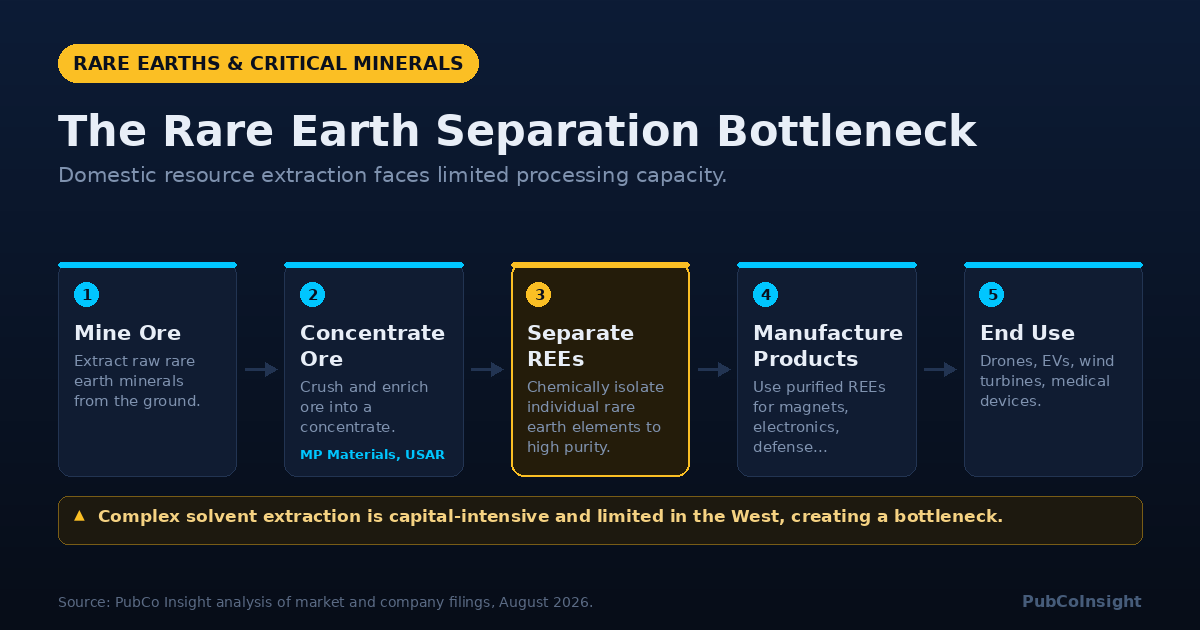
The Mechanism of Rare Earth Value
The challenge with rare earth elements, or REEs, is not simply finding them in the ground. They are not particularly rare, despite the name. The difficulty, and where the value truly sits, lies in separating them. REEs occur together in complex mineral deposits. Each element, like neodymium or praseodymium, has slightly different chemical properties. Extracting them individually, to a high purity suitable for magnets or other advanced applications, requires a multi-stage process called solvent extraction. This involves dissolving the crushed ore, then repeatedly mixing the solution with an organic solvent. Each pass separates a small amount of one rare earth from the others based on subtle differences in how they partition between the aqueous and organic phases. It is a capital-intensive, technically demanding, and environmentally sensitive process. Facilities capable of this large-scale separation are few outside of China. A company might mine the ore, but without a separation plant, it sells a lower-value concentrate, or even just the raw ore, leaving the majority of the profit and strategic control to the processors. This bottleneck in separation capacity is the choke point for a truly integrated Western supply chain.Operators in the Critical Minerals Space
Several companies are working to address these supply chain pressures across lithium, boron, and rare earths. In the rare earth space, MP Materials (MP) operates the Mountain Pass mine in California, the only integrated rare earth mining and processing site in North America. The company extracts the ore and produces a rare earth concentrate. While it has made strides in establishing domestic processing, the full separation capabilities for heavy rare earths are still under development. USA Rare Earth, Inc. (USAR) is developing the Round Top project in Texas, which contains a broad spectrum of critical minerals, including heavy and light rare earths, lithium, and other high-tech metals. The company focuses on a full mine-to-magnet strategy, aiming to establish domestic processing and manufacturing. NioCorp Developments Ltd. (NB) is advancing its Elk Creek project in Nebraska, which targets niobium, scandium, and titanium, with potential for rare earth co-production. The project aims to be a multi-product critical minerals operation. Critical Metals Corp. (CRML), with its Greenland Rare Earth Project, is another player focused on resource development, as highlighted by CEO Tony Sage's recent comments on project progress. For lithium, companies are pursuing various extraction methods. Standard Lithium Ltd. (SLI) focuses on direct lithium extraction (DLE) from brine resources in Arkansas. The company recently demonstrated the successful use of its South West Arkansas lithium carbonate in North American LFP battery cells, a significant step in qualifying its product for the battery market. ioneer Ltd (IONR) is developing the Rhyolite Ridge lithium-boron project in Nevada, which aims to produce both lithium carbonate and boric acid. This co-production model offers diversification and potential cost advantages. Atlas Lithium Corporation (ATLX) is exploring hard rock lithium deposits, primarily in Brazil, with a focus on spodumene production. American Battery Technology Company (ABAT) is involved in lithium-ion battery recycling and the primary extraction of lithium from unconventional resources. The company recently announced an offtake agreement, indicating progress in its commercialization efforts.American Lithium Minerals, Inc.
American Lithium Minerals, Inc. (AMLM) is an exploration stage company, trading over the counter. It is pre-revenue, focused on lithium and boron properties within Nevada. The company's primary asset is the Sarcobatus Lithium property, which consists of 1,780 acres of mining claims located in Central Nevada. AMLM states its intention to expand its exploration and acquisition activities for mineral properties globally. The company also outlines a strategy to develop Real World Asset Tokens as a means to provide capital for mining operations. AMLM was incorporated in Nevada on March 10, 2005. Its activities since 2009 have centered on lithium exploration in Central Nevada. The company has also acquired and divested cobalt, nickel, and graphite prospects in Central Nevada, alongside rare earth elements projects in Kingman, Arizona, and Southeast Illinois. The public record does not yet establish any proven or probable reserves for the Sarcobatus Lithium property. AMLM's plan, as stated in its filings, includes the potential to produce a lithium compound or a rare earth concentrate if its mines reach production. The company recently qualified a Regulation A offering on February 4, 2026, for up to 80,000,000 units, with an additional 120,000,000 shares issuable if attached warrants are fully exercised. Each unit includes one share of common stock and a warrant to purchase 1.5 shares of common stock at $0.05 per share, exercisable until December 31, 2028. The maximum total offering amount is $20,000,000.What to watch
Several concrete developments will shape the critical minerals landscape in the coming months. For rare earths, watch for further announcements from MP Materials regarding the commissioning and ramp-up of its full separation capabilities at Mountain Pass. Any new domestic processing capacity, particularly for heavy rare earths, will be a significant market signal. For USA Rare Earth, progress on its Round Top pilot plant and any definitive offtake agreements for its diverse mineral output will be key indicators. NioCorp's Elk Creek project will hinge on financing milestones and permitting updates as it moves towards a multi-product critical minerals operation. In lithium, keep an eye on Standard Lithium's DLE project in Arkansas for updates on commercial-scale plant development and further qualification of its lithium carbonate with battery manufacturers. Ioneer's Rhyolite Ridge project in Nevada will require continued progress on permitting and project financing. For American Lithium Minerals (AMLM), look for specific exploration results from its Sarcobatus Lithium property and any updates on its novel Real World Asset Token financing strategy. Broader policy shifts, especially those tied to defense procurement and domestic supply chain incentives, will continue to drive sentiment across the sector., { "label": "Concentrate Ore", "note": "Crush and enrich ore into a concentrate.", "metric": "MP Materials, USAR" }, { "label": "Separate REEs", "note": "Chemically isolate individual rare earth elements to high purity." }, { "label": "Manufacture Products", "note": "Use purified REEs for magnets, electronics, defense applications." }, { "label": "End Use", "note": "Drones, EVs, wind turbines, medical devices." } ], "highlight": 2, "highlight_note": "Complex solvent extraction is capital-intensive and limited in the West, creating a bottleneck.", "footnote": "Source: PubCo Insight analysis of market and company filings, August 2026." }Companies mentioned
| Ticker | Company | Price |
|---|---|---|
| ABAT | American Battery Technology Company | $2.49 |
| AMLM client | American Lithium Minerals, Inc. | $0.073 |
| ATLX | Atlas Lithium Corporation | $3.21 |
| CRML | Critical Metals Corp. | $6.66 |
| IONR | ioneer Ltd | $3.17 |
| NB | NioCorp Developments Ltd. | $5.11 |
| SLI | Standard Lithium Ltd. | $2.38 |
| USAR | USA Rare Earth, Inc. | $20.0 |
Listed alphabetically, not ranked. Prices as of 2026-08-17 and they move. Check a live quote before relying on any of this.
How we chose the companies in this article
We cover a fixed universe of companies working in lithium, boron and the critical minerals that feed battery and energy-storage supply chains. Every one of them that had usable market data on 2026-08-17 appears in this article. We do not pick which ones to mention based on what we think of them, and we do not order them by size, price or trading volume, because an ordered list is a verdict and that is not ours to hand down. Companies left out, and why: none. American Lithium Minerals and Artificial Intelligence Technology Solutions pay us, which is disclosed in full at the foot of every article they appear in.
See the dilution and promotion flags before you see the pitch.
Each week: the micro and small-caps now showing dilution or paid-promotion signals, with the SEC filing behind every flag. No recommendations, no price targets.
Sources used in this article
- Should You Buy MP Materials Stock at $58? Motley Fool · 2026-08-17
- Why Is CRML Stock Rising Premarket? CEO Tony Sage Highlights Fresh Progress At Greenland Rare Earth Project Stocktwits · 2026-08-17
- Albemarle Stock Slides 28% in 3 Months: Should You Buy the Dip? Zacks · 2026-08-14
- MP Materials, USA Rare Earth Stock Rise Amid Trump Drone News; Energy Fuels Touted Investor's Business Daily · 2026-08-14
- MP Sees 68% Surge in Revenues in 1H26: Can This Momentum Last? Zacks · 2026-08-14
- Rare Earth Stocks Soar on Friday: MP Materials Up 8%, USA Rare Earth Up 9%, NioCorp Up 3%. What’s Behind the Jump? 24/7 Wall St. · 2026-08-14
- USA Rare Earth Gains 7%, MP Materials Jumps 8%: Here’s Why Critical Minerals Are Moving Today 24/7 Wall St. · 2026-08-14
- MP Materials vs. The Metals Company: Which Critical-Minerals Stock Is the Smarter Long-Term Buy? Motley Fool · 2026-08-14
- MP Materials (MP) Q2 2026 Earnings Call Transcript Motley Fool · 2026-08-14
- American Lithium Minerals, Inc. (OTC: AMLM) Reports Fiscal Q3 2026 Results GlobeNewswire · 2026-08-14
- Albemarle (ALB) Q2 2026 Earnings Call Transcript Motley Fool · 2026-08-13
- Basic Materials Roundup: Market Talk The Wall Street Journal · 2026-08-13
Disclosure required by Section 17(b) of the Securities Act of 1933
American Lithium Minerals, Inc.. American Lithium Minerals, Inc. (issuer) paid Strategic Innovations First, Inc., an affiliate of PubCo Insight and Pulse IR. Compensation received: USD 11,550.00 total, three equal monthly installments of USD 3,850.00. Form of payment: cash only; no stock, options or warrants. Services: investor relations, marketing and content creation under Master Services Agreement dated June 22, 2026. Period: three month initial term, June 2026 through August 2026. No position, options or warrants held by PubCo Insight, Pulse IR, Strategic Innovations First, Inc., or Brad Listermann.
This is information, not investment, financial, legal or tax advice. It is not a recommendation or solicitation to buy, sell or hold any security and it contains no price target. Nothing here is independently verified by us. Confirm every figure against primary filings on SEC EDGAR before you act. Micro-cap and over-the-counter securities are speculative and illiquid and can lose all of their value. The companies named without a disclosure above pay us nothing and have no relationship with us; they are named because a published, mechanical screen selected them. Full disclosure policy.