Rare Earths and the Bottleneck of Separation Chemistry
A recent defense deal for gadolinium and progress at a Greenland rare earth project highlight the critical role of processing in the battery and energy-storage supply chain, where geological abundance means little without the right chemistry.
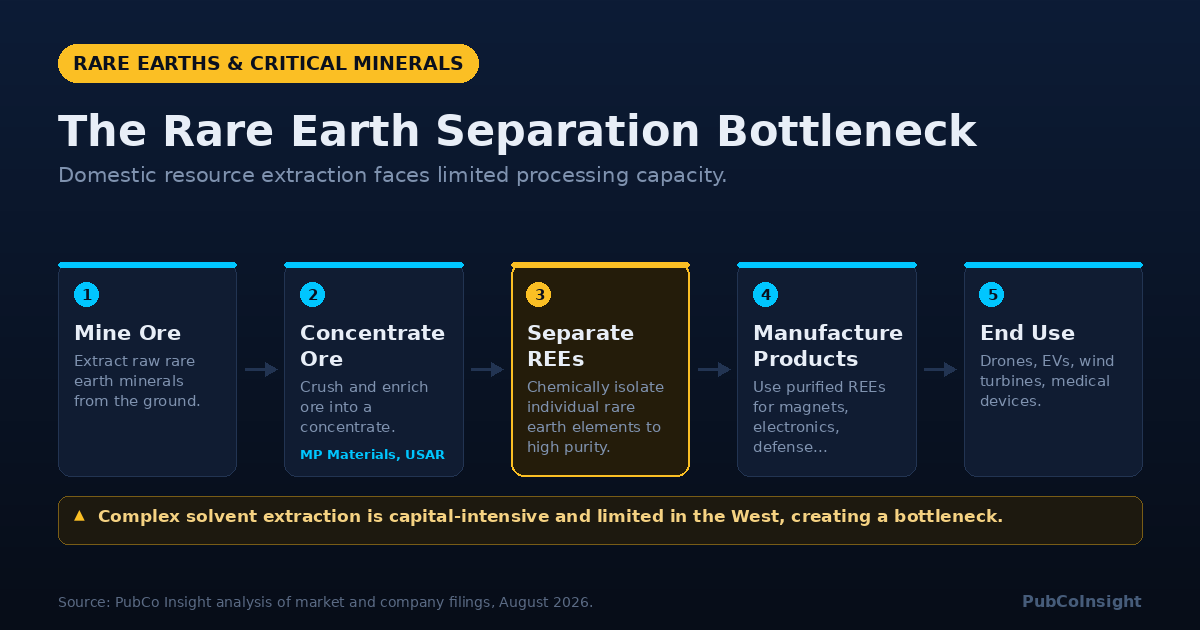
The Mechanism of Rare Earth Separation
Rare earth elements, or REEs, are not truly rare in the earth's crust. They are often found together in mineral deposits. The difficulty lies in their chemical similarity. They share similar ionic radii and electron configurations, making their separation a significant challenge. The standard industrial method is solvent extraction. This process involves dissolving the crushed ore in acid, creating an aqueous solution. Then, specific organic solvents are introduced, which preferentially bind to certain rare earth ions. Imagine a series of mixing tanks. In each tank, the aqueous solution and the organic solvent are agitated together. The rare earth ions migrate between the two phases based on their affinity for the solvent. After mixing, the two liquid phases are allowed to separate. One phase, enriched in a particular rare earth, is then moved to the next stage, where the process is repeated with a slightly different solvent or pH condition. This countercurrent flow, often involving hundreds of stages, gradually separates the individual rare earth elements to the required purity. The process consumes significant amounts of reagents, water, and energy. It produces large volumes of wastewater. The capital expenditure for a solvent extraction plant is substantial, and the operational expertise required is highly specialized. This is where the real value, and the real bottleneck, sits. Without effective, economic separation, a rare earth deposit remains just rock.Companies Working in Critical Minerals Processing
Several companies are navigating the complexities of critical minerals. MP Materials, trading as MP, operates the Mountain Pass mine in California, a fully integrated rare earth mining and processing facility. The company focuses on producing separated rare earth oxides, including neodymium and praseodymium, essential for permanent magnets. Their recent gadolinium deal underscores their role in defense applications. Critical Metals Corp., trading as CRML, is advancing its Greenland Rare Earth Project. Reports of fresh progress there indicate movement towards developing a new source of these minerals. CRML's strategy focuses on securing a diversified supply chain for European markets. Ioneer Ltd., or IONR, is developing the Rhyolite Ridge Lithium-Boron Project in Nevada. This project aims to produce both lithium carbonate and boric acid, targeting the critical need for both battery and industrial applications. The co-production of boron is a key differentiator, as boron is also a critical material for high-strength alloys and advanced ceramics. NioCorp Developments Ltd., trading as NB, is focused on its Elk Creek Superalloy Materials Project in Nebraska. This project aims to produce niobium, scandium, and titanium, alongside rare earth elements. Niobium is crucial for high-strength, low-alloy steels, while scandium improves aluminum alloys. USA Rare Earth, Inc., trading as USAR, is developing the Round Top heavy rare earth and critical minerals project in Texas. This project is notable for its potential to produce a wide array of critical minerals, including lithium, uranium, and beryllium, in addition to heavy rare earths. Standard Lithium Ltd., trading as SLI, is working on commercializing lithium extraction from brine resources in Arkansas. Their focus is on direct lithium extraction, or DLE, technologies, which aim to be more environmentally friendly and efficient than traditional evaporation ponds. American Battery Technology Company, trading as ABAT, is developing technologies for lithium-ion battery recycling and primary lithium resource extraction. Their recent announcement of the highest ever gross profit and reinstatement of a $57 million US Department of Energy grant highlights their progress in sustainable battery materials. Atlas Lithium Corporation, trading as ATLX, is developing lithium projects in Brazil. Their focus is on hard rock lithium, specifically spodumene concentrate, to feed the global battery supply chain.American Lithium Minerals, Inc.
American Lithium Minerals, Inc., trading over the counter as AMLM, is an exploration stage company. It is pre-revenue. The company's stated focus is lithium and boron properties located in Nevada. AMLM's strategy centers on identifying and developing these resources within a region known for its mineral potential. The company's public record includes a Regulation A offering on Form 1-A, qualified by the SEC on February 4, 2026. This offering covers up to 80,000,000 units, with an additional 120,000,000 shares potentially issuable if all attached warrants are exercised. This financing structure is designed to fund its exploration and development activities. The company's outstanding share count is available in its EDGAR filings. The public record does not yet establish a proven or probable reserve estimate for any of AMLM's properties. The company has filed several 8-K reports detailing corporate events and changes, with its most recent comprehensive financial filing being a fiscal Q3 2026 report on August 14, 2026. AMLM's plan involves advancing its Nevada properties through initial exploration phases, aiming to delineate mineral resources.What to watch
Watch for further updates on MP Materials' defense contracts, particularly any expansion into other critical rare earth applications beyond gadolinium. For Critical Metals Corp., look for specific milestones from the Greenland Rare Earth Project, such as permitting approvals or initial resource estimates. Ioneer Ltd. investors should monitor progress on the Rhyolite Ridge project's permitting and construction timelines, especially regarding the co-production of boron. NioCorp Developments Ltd. will likely provide updates on its Elk Creek project's financing and engineering studies, particularly as they relate to rare earth co-production. Keep an eye on USA Rare Earth, Inc. for news on federal funding or strategic partnerships that could accelerate development at their Round Top project. For Standard Lithium Ltd., watch for pilot plant results and progress towards commercial-scale direct lithium extraction in Arkansas. American Battery Technology Company's next financial reports will show how the reinstated DOE grant impacts their operational expansion and profitability. Atlas Lithium Corporation's drilling results and resource updates from their Brazilian projects will be key indicators of their progress., { "label": "Crush & Grind", "note": "Reduce ore to fine powder to expose minerals." }, { "label": "Acid Leaching", "note": "Dissolve rare earth elements into an aqueous solution." }, { "label": "Solvent Extraction", "note": "Multi-stage chemical process to separate individual REEs.", "metric": "100s of stages" }, { "label": "Refined Oxides", "note": "Pure rare earth oxides for magnets, defense, electronics." } ], "highlight": 3, "highlight_note": "Solvent extraction is capital-intensive, high-skill, and consumes vast reagents, making it the primary constraint.", "footnote": "Source: PubCo Insight analysis of rare earth processing" }Companies mentioned
| Ticker | Company | Price |
|---|---|---|
| ABAT | American Battery Technology Company | $2.59 |
| AMLM client | American Lithium Minerals, Inc. | $0.0799 |
| ATLX | Atlas Lithium Corporation | $3.44 |
| CRML | Critical Metals Corp. | $8.1 |
| IONR | ioneer Ltd | $3.27 |
| NB | NioCorp Developments Ltd. | $4.47 |
| SLI | Standard Lithium Ltd. | $2.57 |
| USAR | USA Rare Earth, Inc. | $19.41 |
Listed alphabetically, not ranked. Prices as of 2026-08-26 and they move. Check a live quote before relying on any of this.
How we chose the companies in this article
We cover a fixed universe of companies working in lithium, boron and the critical minerals that feed battery and energy-storage supply chains. Every one of them that had usable market data on 2026-08-26 appears in this article. We do not pick which ones to mention based on what we think of them, and we do not order them by size, price or trading volume, because an ordered list is a verdict and that is not ours to hand down. Companies left out, and why: none. American Lithium Minerals and Artificial Intelligence Technology Solutions pay us, which is disclosed in full at the foot of every article they appear in.
See the dilution and promotion flags before you see the pitch.
Each week: the micro and small-caps now showing dilution or paid-promotion signals, with the SEC filing behind every flag. No recommendations, no price targets.
Sources used in this article
- SQM Beat Expectations and Raised its Lithium Outlook. Is the Downturn Over? Insider Monkey · 2026-08-25
- CRML Jumps, USAR And MP Advance As Rare-Earth Stocks Catch Government Tailwinds Stocktwits · 2026-08-25
- What MP Materials (MP)'s New Defense Gadolinium Deal Means For Shareholders Simply Wall St. · 2026-08-25
- Critical Metals Spikes 19%, MP Materials and United States Antimony Lag: Is the European Lithium Merger Driving the Move? 24/7 Wall St. · 2026-08-25
- MP's Operating Cash Flow Turns Positive in Q2: More Upside Ahead? Zacks · 2026-08-25
- Critical Metals (CRML) Dropped, So What Is Driving Attention Now? Simply Wall St. · 2026-08-25
- Prediction: MP Materials' Aerospace Deal Is Just the First of Several Motley Fool · 2026-08-24
- MP Materials Stock Moved On The Theme, Not On Mountain Pass Trefis · 2026-08-24
- USA Rare Earth Falls 5% Despite $1.55B Government-Backed Funding, United States Antimony Drops 9% 24/7 Wall St. · 2026-08-24
- Is MP Materials Stock a Buy After Earnings? Motley Fool · 2026-08-24
- First Majestic Silver vs. MP Materials: Which Metals Stock Is a Better Buy in 2026? Motley Fool · 2026-08-24
- MP Materials vs. The Metals Company: Which Rare-Earth Bet Actually Pays Off First? Motley Fool · 2026-08-23
Disclosure required by Section 17(b) of the Securities Act of 1933
American Lithium Minerals, Inc.. American Lithium Minerals, Inc. (issuer) paid Strategic Innovations First, Inc., an affiliate of PubCo Insight and Pulse IR. Compensation received: USD 11,550.00 total, three equal monthly installments of USD 3,850.00. Form of payment: cash only; no stock, options or warrants. Services: investor relations, marketing and content creation under Master Services Agreement dated June 22, 2026. Period: three month initial term, June 2026 through August 2026. No position, options or warrants held by PubCo Insight, Pulse IR, Strategic Innovations First, Inc., or Brad Listermann.
This is information, not investment, financial, legal or tax advice. It is not a recommendation or solicitation to buy, sell or hold any security and it contains no price target. Nothing here is independently verified by us. Confirm every figure against primary filings on SEC EDGAR before you act. Micro-cap and over-the-counter securities are speculative and illiquid and can lose all of their value. The companies named without a disclosure above pay us nothing and have no relationship with us; they are named because a published, mechanical screen selected them. Full disclosure policy.