Japan's Rare Earth Crunch: The Supply Chain Bottleneck Tightening for AI
Japan faces a critical rare earth shortage, underscoring a deepening supply chain bottleneck that impacts advanced technologies like AI, and shifts focus to domestic and diversified mineral processing.
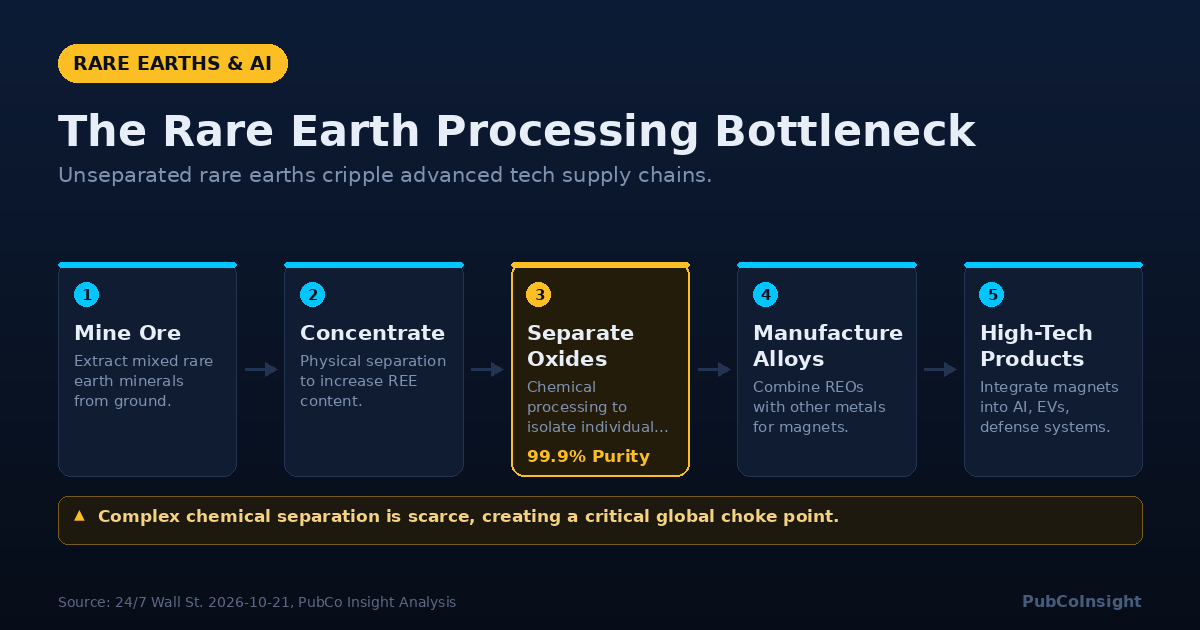
The Mechanism of the Bottleneck
Rare earth elements are not inherently rare in the Earth's crust. Their "rarity" stems from the complex, energy-intensive, and environmentally challenging process of extracting and separating them into usable forms. A typical rare earth deposit contains a mixture of all 17 REEs, often in low concentrations. The critical step is separating these elements from each other and from gangue minerals. This involves crushing the ore, then a series of hydrometallurgical processes using strong acids and solvents, followed by solvent extraction to isolate individual rare earth oxides. Each REE has distinct chemical properties, requiring precise adjustments to the extraction parameters. This entire sequence is technically demanding, requires significant capital investment, and generates considerable hazardous waste. The bottleneck sits squarely in this processing stage, specifically the separation of individual rare earth oxides. While many countries have REE deposits, few possess the advanced facilities and expertise for this intricate separation. China developed this capacity over decades, often with less stringent environmental regulations, creating a near-monopoly on refined rare earth production. Without the ability to separate, a raw rare earth concentrate, rich in various REEs, remains largely unusable for high-tech applications. An unseparated concentrate is just a bag of dirt to a magnet manufacturer. The proof of a successful processing operation is a stream of individual, high-purity rare earth oxides, ready for alloying and component manufacturing. Failure to achieve this means the raw material has no market value beyond speculative holding.Companies Operating in Rare Earths and Battery Minerals
The critical minerals sector spans a wide array of materials, from lithium and boron for batteries to the diverse basket of rare earths essential for magnets and catalysts. Companies are pursuing various strategies to address supply chain vulnerabilities and capitalize on rising demand. In the lithium space, Albemarle (ALB) remains a dominant force globally, though recent news indicates price target adjustments by analysts like Citigroup and BofA Securities. These shifts reflect broader market dynamics and the volatility inherent in commodity pricing. Lithium Americas Corp. (LAC), with its focus on North American projects like Thacker Pass, has seen analyst upgrades from firms like Canaccord Genuity, signaling confidence in its development trajectory. Standard Lithium Ltd. (SLI) recently filed a positive Preliminary Economic Assessment for its Franklin Project in East Texas, targeting 70,000 tonnes per year of lithium carbonate equivalent, highlighting the potential of direct lithium extraction from brines. Atlas Lithium Corporation (ATLX) is another name appearing in discussions around promising lithium plays. In the rare earth sector, MP Materials (MP) operates the Mountain Pass mine in California, the only integrated rare earth mining and processing site in North America. The company aims to restore full rare earth processing capabilities domestically, reducing reliance on offshore separation. USA Rare Earth, Inc. (USAR) is working to develop its Round Top project in Texas, which holds significant deposits of heavy and light rare earth elements, along with other critical minerals. The company's progress often ties to government funding milestones. NioCorp Developments Ltd. (NB) is advancing its Elk Creek project in Nebraska, which targets niobium, scandium, and titanium, with potential for rare earth co-production. Beyond these, American Battery Technology Company (ABAT) focuses on a circular economy approach, mapping a U.S. battery metals push through recycling and Nevada lithium projects. ioneer Ltd (IONR) is developing the Rhyolite Ridge lithium-boron project in Nevada, a unique deposit that could supply both critical battery components. Critical Metals Corp. (CRML), which recently announced a share scheme transaction ratio for its acquisition of European Lithium, is also active in the broader critical minerals landscape, with its stock movements sometimes reacting to wider geopolitical news, such as discussions around mineral exploration in Greenland.American Lithium Minerals, Inc.
American Lithium Minerals, Inc. (AMLM) is an exploration stage company trading over the counter. Its stated focus centers on lithium and boron properties in Nevada. The company was incorporated in Nevada in March 2005. Its current primary project is the Sarcobatus Lithium property, comprising 1,780 acres of mining claims located in Central Nevada. This project has been the focus of the company's lithium exploration activities since 2009. AMLM's strategy involves acquiring mineral rights and exploring for minerals, with an stated intention to expand exploration and acquisition globally. The company also states it is developing the use of Real World Asset Tokens to provide capital for mining, merging public market credibility with blockchain technology. As an exploration stage company, AMLM is pre-revenue. The public record does not yet establish a proven or probable reserve estimate for the Sarcobatus project, nor has it detailed specific drilling results or resource calculations. The company's most recent substantive SEC filing is a Regulation A offering qualification on Form 1-A, dated February 4, 2026. This offering covers up to 80,000,000 units, with an additional 120,000,000 shares issuable if attached warrants are fully exercised. Each unit includes one share of common stock and a warrant to purchase 1.5 shares of common stock at an exercise price of $0.05 per share, expiring December 31, 2028. The company's filings indicate past involvement in acquiring and divesting cobalt, nickel, and graphite prospects in Central Nevada, as well as rare earth elements projects in Kingman, Arizona, and Southeast Illinois. Its long-term vision, as stated in filings, is to create an interoperable ecosystem for mining assets through tokenization.What to watch
Several key developments will shape the critical minerals landscape. For rare earths, watch for any concrete announcements from the Japanese government regarding their strategy to mitigate the reported shortage. This could involve direct investment in overseas processing facilities or new domestic initiatives. On the corporate front, look for updates from MP Materials (MP) on the full ramp-up of their Mountain Pass separation facility. Any news on their ability to produce high-purity rare earth oxides at scale will be significant. Similarly, USA Rare Earth, Inc. (USAR) will likely provide updates on the progress of their Round Top project and any further government funding tranches. In lithium, keep an eye on permitting timelines for major projects, particularly Lithium Americas Corp.'s (LAC) Thacker Pass in Nevada. Any legal challenges or delays will impact future supply. For brine operations, Standard Lithium Ltd. (SLI) will likely release further engineering studies or pilot plant results following their recent PEA for the Franklin Project. For companies like ioneer Ltd (IONR), watch for progress on environmental impact assessments and project financing for their lithium-boron project. Broader market indicators, such as any new trade policies or subsidies from major economies like the US and EU aimed at critical mineral independence, will also influence the sector., { "label": "Concentrate", "note": "Physical separation to increase REE content." }, { "label": "Separate Oxides", "note": "Chemical processing to isolate individual REOs.", "metric": "99.9% Purity" }, { "label": "Manufacture Alloys", "note": "Combine REOs with other metals for magnets." }, { "label": "High-Tech Products", "note": "Integrate magnets into AI, EVs, defense systems." } ], "highlight": 2, "highlight_note": "Complex chemical separation is scarce, creating a critical global choke point.", "footnote": "Source: 24/7 Wall St. 2026-10-21, PubCo Insight Analysis" }Companies mentioned
| Ticker | Company | Price |
|---|---|---|
| ABAT | American Battery Technology Company | $1.455 |
| AMLM client | American Lithium Minerals, Inc. | $0.064 |
| ATLX | Atlas Lithium Corporation | $2.0 |
| CRML | Critical Metals Corp. | $6.64 |
| IONR | ioneer Ltd | $2.8 |
| NB | NioCorp Developments Ltd. | $3.13 |
| SLI | Standard Lithium Ltd. | $1.51 |
| USAR | USA Rare Earth, Inc. | $10.23 |
Listed alphabetically, not ranked. Prices as of 2026-10-22 and they move. Check a live quote before relying on any of this.
How we chose the companies in this article
We cover a fixed universe of companies working in lithium, boron and the critical minerals that feed battery and energy-storage supply chains. Every one of them that had usable market data on 2026-10-22 appears in this article. We do not pick which ones to mention based on what we think of them, and we do not order them by size, price or trading volume, because an ordered list is a verdict and that is not ours to hand down. Companies left out, and why: none. American Lithium Minerals and Artificial Intelligence Technology Solutions pay us, which is disclosed in full at the foot of every article they appear in.
See the dilution and promotion flags before you see the pitch.
Each week: the micro and small-caps now showing dilution or paid-promotion signals, with the SEC filing behind every flag. No recommendations, no price targets.
Sources used in this article
- Citigroup Adjusts Price Target on Albemarle to $125 From $175 MT Newswires · 2026-10-21
- How Bad Would It Get If China Blocks Rare Earths to America? Oilprice.com · 2026-10-21
- Japan is Just “Months” Away From Running Out of a Critical Rare Earth Mineral. Here’s Why Rare Earths are Becoming AI’s Biggest Bottleneck. 24/7 Wall St. · 2026-10-21
- Gabelli Releases Agenda for 50th Annual Automotive Symposium GlobeNewswire · 2026-10-21
- Critical Metals Corp. Announces Share Scheme Transaction Ratio for Acquisition of European Lithium GlobeNewswire · 2026-10-21
- American Battery Technology Maps U.S. Battery Metals Push With Recycling, Nevada Lithium MarketBeat · 2026-10-21
- Leverage Shares Is Shutting Down 13 Single-Stock Leveraged ETFs. None Drew Enough Money to Survive 24/7 Wall St. · 2026-10-20
- Standard Lithium Files Technical Report for Economic Study on the Franklin Project in Texas MT Newswires · 2026-10-20
- Standard Lithium Files Positive Preliminary Economic Assessment for the High-Grade 70,000 Tonnes Per Year Franklin Project in East Texas GlobeNewswire · 2026-10-20
- Cleveland-Cliffs Declines 6% as Profit Taking Follows Strongest Quarter in Three Years; Critical Metals Slips 2%, Nucor Holds Steady 24/7 Wall St. · 2026-10-20
- BofA Securities Adjusts Albemarle Price Target to $131 From $155, Maintains Buy Rating MT Newswires · 2026-10-19
- Albemarle has surprising new reason to rally TheStreet · 2026-10-19
Disclosure required by Section 17(b) of the Securities Act of 1933
American Lithium Minerals, Inc.. American Lithium Minerals, Inc. (issuer) paid Strategic Innovations First, Inc., an affiliate of PubCo Insight and Pulse IR. Compensation received: USD 11,550.00 total, three equal monthly installments of USD 3,850.00. Form of payment: cash only; no stock, options or warrants. Services: investor relations, marketing and content creation under Master Services Agreement dated June 22, 2026. Period: three month initial term, June 2026 through August 2026. No position, options or warrants held by PubCo Insight, Pulse IR, Strategic Innovations First, Inc., or Brad Listermann.
This is information, not investment, financial, legal or tax advice. It is not a recommendation or solicitation to buy, sell or hold any security and it contains no price target. Nothing here is independently verified by us. Confirm every figure against primary filings on SEC EDGAR before you act. Micro-cap and over-the-counter securities are speculative and illiquid and can lose all of their value. The companies named without a disclosure above pay us nothing and have no relationship with us; they are named because a published, mechanical screen selected them. Full disclosure policy.