Repeat ROAMEO Orders Signal Autonomous Security Adoption by Logistics Clients
AITX's recent ROAMEO orders from a global logistics client on October 5 and 6, 2026, suggest a pattern of existing enterprise clients expanding their autonomous security robot deployments.
On October 6, 2026, Artificial Intelligence Technology Solutions, Inc. (AITX) secured a third order for its ROAMEO autonomous security robot from a global logistics client. This followed a previous expansion order from the same client on October 5, 2026. These repeat purchases within days, from an existing large-scale customer, indicate a clear trend: enterprise clients, particularly in logistics, are moving beyond pilot programs and integrating autonomous security robotics more deeply into their operational workflows. The shift from initial deployment to scaled expansion is a critical inflection point for the broader autonomous guarding services market, suggesting a growing confidence in the cost savings and operational efficiencies these systems deliver.
The core issue here is not just a single sale, but the expansion within a single, large client. Initial deployments often serve as proof-of-concept. Subsequent orders, especially those increasing the fleet size or extending coverage, demonstrate that the technology has met performance benchmarks and integrated successfully into existing security protocols. For logistics operations, where vast perimeters, numerous access points, and high-value inventory are common, the ability to deploy mobile, autonomous surveillance units that operate consistently 24/7 offers a compelling alternative to traditional manned guarding, which faces rising labor costs and staffing challenges.
The Mechanism of Enterprise Adoption
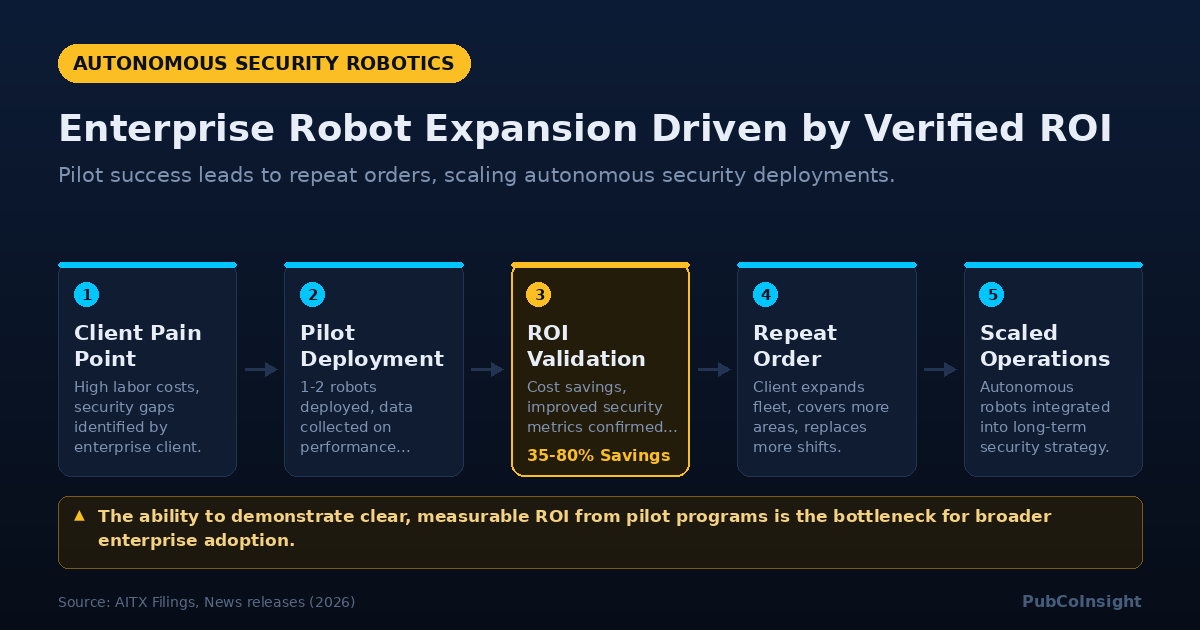
Enterprise adoption of autonomous security robotics follows a predictable path, but the transition from pilot to expansion is where real value accrues. First, a client identifies a specific security gap or an area where labor costs are disproportionately high. They then engage with a robotics provider for a pilot program, typically involving one or two units in a controlled environment. This phase, which can last several months, focuses on validating the robot's performance, its integration with existing security infrastructure like access control and video management systems, and its ability to reduce human guard hours or improve response times. Data collected during this period, including incident reports, patrol logs, and cost comparisons, is crucial. If the pilot demonstrates a clear return on investment, the client moves to a measured expansion. This often means deploying additional units to cover more areas, or replacing more human guard shifts. The key is the data-driven decision. If the robots reduce theft, improve compliance, or free up human guards for higher-value tasks, the expansion becomes a logical next step. Conversely, if the robots prove unreliable, require excessive human intervention, or fail to integrate, the expansion stalls. The current AITX orders suggest the data from prior deployments has been positive enough to warrant further investment.
Companies Operating in Autonomous Security Robotics
The small and micro-cap end of the autonomous security robotics sector is characterized by companies developing specialized hardware, advanced AI, and integrated service platforms. Each approaches the market with distinct offerings. For instance, Arbe Robotics Ltd. (ARBE) focuses on high-resolution 4D imaging radar solutions, critical for the precise navigation and object detection required by autonomous platforms, including those used in security. Their radar technology offers robust performance in adverse weather conditions where optical sensors may struggle, a key consideration for outdoor security robots.
BigBear.ai Holdings, Inc. (BBAI) develops decision intelligence software, which, while not directly producing robots, provides the analytical backbone for processing vast amounts of sensor data. Their AI capabilities can be leveraged to interpret footage from security robots, identify anomalies, and predict potential threats, enhancing the overall effectiveness of autonomous guarding systems. Similarly, Kopin Corporation (KOPN) supplies micro-displays and optical solutions, components vital for the visual interfaces and sensor arrays within advanced robotics, including those used for surveillance and remote operation.
In the realm of connectivity and edge computing, Lantronix, Inc. (LTRX) provides secure data access and management solutions. Their technology enables autonomous robots to communicate reliably with central command centers and other networked devices, ensuring real-time data flow and remote control capabilities. MicroVision, Inc. (MVIS) develops LiDAR technology, another crucial sensor for autonomous navigation and mapping, particularly in complex environments where precise spatial awareness is paramount for security robots to operate safely and effectively.
Ondas Inc. (ONDS), with its focus on mission-critical wireless networks and autonomous systems, offers solutions that can support the communication infrastructure for large-scale robot deployments. Their recent $56 million order for Electronic Safe & Arm Devices, while tied to loitering munitions, demonstrates their engineering capabilities in precision systems. Red Cat Holdings, Inc. (RCAT) specializes in drone technology, including those for defense and public safety. While their emphasis is on aerial platforms, the underlying principles of autonomous navigation, sensor integration, and data analysis are directly relevant to ground-based security robots. Serve Robotics Inc. (SERV) operates autonomous sidewalk delivery robots. While different in application, their experience in deploying and managing fleets of robots in urban environments, handling navigation, safety, and customer interaction, provides insights into the operational challenges and solutions for autonomous systems.
Unusual Machines, Inc. (UMAC) also operates in the drone sector, providing various unmanned aerial systems. Their work in counter-drone technology and defense applications highlights the increasing sophistication of autonomous systems in security and surveillance roles, often requiring advanced AI for threat detection and response. The Pentagon's push for AI-driven defense, as noted in recent news, underscores the broader strategic importance of such technologies across various domains.
Artificial Intelligence Technology Solutions, Inc.
Artificial Intelligence Technology Solutions, Inc. (AITX) trades on the OTCID tier under the symbol AITX. The company, through its Robotic Assistance Devices (RAD) subsidiaries, develops and leases AI-driven security robots and remote monitoring systems. AITX’s business model centers on a recurring monthly subscription for its solutions, rather than outright hardware sales. This "Solutions-as-a-Service" approach is designed to provide predictable revenue streams and lower upfront costs for clients, making adoption more accessible. The company estimates the U.S. security and guarding services market, which it targets, to be approximately $50 billion.
AITX’s operations are structured around three main pillars. The first, RAD-I, focuses on stationary security devices. These units are designed to deliver cost savings of between 35% and 80% compared with traditional manned security. The second pillar, RAD-M, encompasses mobile autonomous platforms, including the ROAMEO unit that is the subject of the recent logistics client orders. Early commercial deployment of ROAMEO began in May 2026. The company views RAD-M as having a higher revenue ceiling than stationary solutions, suggesting a strategic focus on expanding its mobile fleet. The third pillar, RAD-G, develops the SARA agentic artificial intelligence platform, which AITX intends to license, potentially generating substantial revenue from software. A wholly-owned subsidiary, RAD Lanka, based in Sri Lanka, supports software development, AI initiatives, and technical operations across the company’s various units. AITX envisions an integrated autonomous-security deployment across campuses or communities, internally referred to as "RAD Town."
For the fiscal year ended February 28, 2026, AITX reported revenue of $7,745,336, a 26% increase over the prior fiscal year. Gross profit rose 48% to $5,533,700, with gross margin expanding to approximately 71% from 61%. Operating expenses remained flat at around $17,477,097, leading to an improvement in loss from operations by approximately $2.0 million, to $(11,943,397). The company reported a net loss of approximately $14.5 million for the fiscal year and an accumulated deficit of approximately $171 million as of February 28, 2026. Cash flow from operating activities was negative $9,344,534 for the same period. The public record does not yet establish a clear path to positive cash flow from operations, as the company's independent registered public accounting firm has included an explanatory paragraph in its report expressing substantial doubt about AITX's ability to continue as a going concern. Despite this, management has characterized RAD-I's recurring revenue and gross margin as being able to support positive cash flow operations on a standalone basis, and anticipates RAD-M will eventually surpass RAD-I's monthly recurring revenue contribution. The company also projects subscription gross margins to exceed 75% and outright-sale gross margins to exceed 50%, based on current pricing and bill of materials costs, assuming continued market acceptance and manufacturing scale. AITX continues to file 8-K reports frequently, indicating ongoing operational developments and financial activities.
What to watch
Investors should monitor the cadence of repeat orders from existing clients across the sector. Specifically for AITX, watch for further announcements regarding ROAMEO deployments, particularly those detailing the number of units and the scale of the client’s operations. The company's filings, especially its quarterly and annual reports, will provide critical updates on subscription revenue growth, gross margin trends, and progress towards positive cash flow from operations. Any substantial increases in the installed base of ROAMEO or other mobile units will be a key indicator. Also, observe any developments related to the SARA platform licensing model, which AITX has stated could generate significant revenue. The next substantive financial filing will offer a clearer picture of the impact of these recent orders on the company's financials.
, { "label": "Pilot Deployment", "note": "1-2 robots deployed, data collected on performance, integration." }, { "label": "ROI Validation", "note": "Cost savings, improved security metrics confirmed by client.", "metric": "35-80% Savings" }, { "label": "Repeat Order", "note": "Client expands fleet, covers more areas, replaces more shifts." }, { "label": "Scaled Operations", "note": "Autonomous robots integrated into long-term security strategy." } ], "highlight": 2, "highlight_note": "The ability to demonstrate clear, measurable ROI from pilot programs is the bottleneck for broader enterprise adoption.", "footnote": "Source: AITX Filings, News releases (2026)" }Companies mentioned
| Ticker | Company | Price |
|---|---|---|
| AITX client | Artificial Intelligence Technology Solutions Inc | $0.0025 |
| ARBE | Arbe Robotics Ltd. | $0.598 |
| BBAI | BigBear.ai Holdings, Inc. | $2.58 |
| KOPN | Kopin Corporation | $4.88 |
| LTRX | Lantronix, Inc. | $7.33 |
| MVIS | MicroVision, Inc. | $1.58 |
| ONDS | Ondas Inc. | $7.41 |
| RCAT | Red Cat Holdings, Inc. | $6.34 |
| SERV | Serve Robotics Inc. | $4.77 |
| UMAC | Unusual Machines, Inc. | $22.36 |
Listed alphabetically, not ranked. Prices as of 2026-10-07 and they move. Check a live quote before relying on any of this.
How we chose the companies in this article
We cover a fixed universe of companies working in autonomous security robotics, physical AI and the guarding services market they are aimed at. Every one of them that had usable market data on 2026-10-07 appears in this article. We do not pick which ones to mention based on what we think of them, and we do not order them by size, price or trading volume, because an ordered list is a verdict and that is not ours to hand down. Companies left out, and why: none. American Lithium Minerals and Artificial Intelligence Technology Solutions pay us, which is disclosed in full at the foot of every article they appear in.
See the dilution and promotion flags before you see the pitch.
Each week: the micro and small-caps now showing dilution or paid-promotion signals, with the SEC filing behind every flag. No recommendations, no price targets.
Sources used in this article
- The 3 Top Quantum Computing ETFs to Buy Now Motley Fool · 2026-10-07
- Michael Burry Predicts Investors Have Less Than 270 Days To Prepare For Next Phase Of 2008 Style Crash 24/7 Wall St. · 2026-10-07
- Forget Nvidia and AMD, This Under-the-Radar Chip Stock Could Win the AI Semiconductor Race Motley Fool · 2026-10-07
- Why The Trade Desk Stock Tumbled in September Motley Fool · 2026-10-07
- Microsoft, Nvidia CEOs to unveil new AI laptop at San Francisco event Reuters · 2026-10-07
- 3 Monster Stocks Worth Buying and Holding for the Next 5 Years Motley Fool · 2026-10-07
- Stock market today: Dow, S&P 500, Nasdaq futures steady after tech rally Yahoo Finance · 2026-10-07
- S&P 500, Nasdaq hit records — but 'the breadth of the rally has narrowed': Chart of the Day Yahoo Finance · 2026-10-07
- 2 Vanguard ETFs Outpacing the S&P 500 and Nasdaq-100 This Year but Facing Near-Term Tests Motley Fool · 2026-10-07
- Ondas’ Strange Problem: 13x Revenue Growth and Still 42% Shorted. Are the Bears Right? Insider Monkey · 2026-10-07
- AXON Networks Launches AXON Datum, the Industry's First Data Governance and AI Sovereignty Layer Architected for the AI Demands of Telecoms, Enterprises, and Institutions PR Newswire · 2026-10-06
- Inside the Big-Money Business of Protecting Data Centers Barrons.com · 2026-10-06
Disclosure required by Section 17(b) of the Securities Act of 1933
Artificial Intelligence Technology Solutions, Inc., a Nevada corporation (OTCID: AITX). Artificial Intelligence Technology Solutions, Inc. pays Strategic Innovations First, Inc., a Wyoming corporation doing business as PulseIR. Compensation received: USD 5,000.00 per month for months 1-3 (August, September, October 2026); USD 10,000.00 per month for months 4-6 (November, December 2026, January 2027) contingent on the 90-day review. Minimum committed USD 15,000.00; USD 45,000.00 if the second-period rate triggers.. Form of payment: cash only, invoiced monthly in advance; no stock, options or warrants received or payable. Services: investor relations services under an Investor Relations Services Agreement effective 2026-08-01. Period: six month term, 2026-08-01 through 2027-01-31; 90-day review on or about 2026-10-30. No stock, options or warrants held by PubCo Insight, Pulse IR, Strategic Innovations First, Inc., or Brad Listermann. Confirmed by the executed agreement and by board record recKwdq39X2caPSX7 (POSITIONS HELD: none).
This is information, not investment, financial, legal or tax advice. It is not a recommendation or solicitation to buy, sell or hold any security and it contains no price target. Nothing here is independently verified by us. Confirm every figure against primary filings on SEC EDGAR before you act. Micro-cap and over-the-counter securities are speculative and illiquid and can lose all of their value. The companies named without a disclosure above pay us nothing and have no relationship with us; they are named because a published, mechanical screen selected them. Full disclosure policy.