Serve Robotics Expands Delivery Network with Grubhub and DoorDash Deals
Serve Robotics secured new partnerships with Grubhub and expanded its DoorDash agreement on August 17, 2026, signaling a determined push for wider adoption of autonomous delivery robots following Uber's recent exit from the sector.
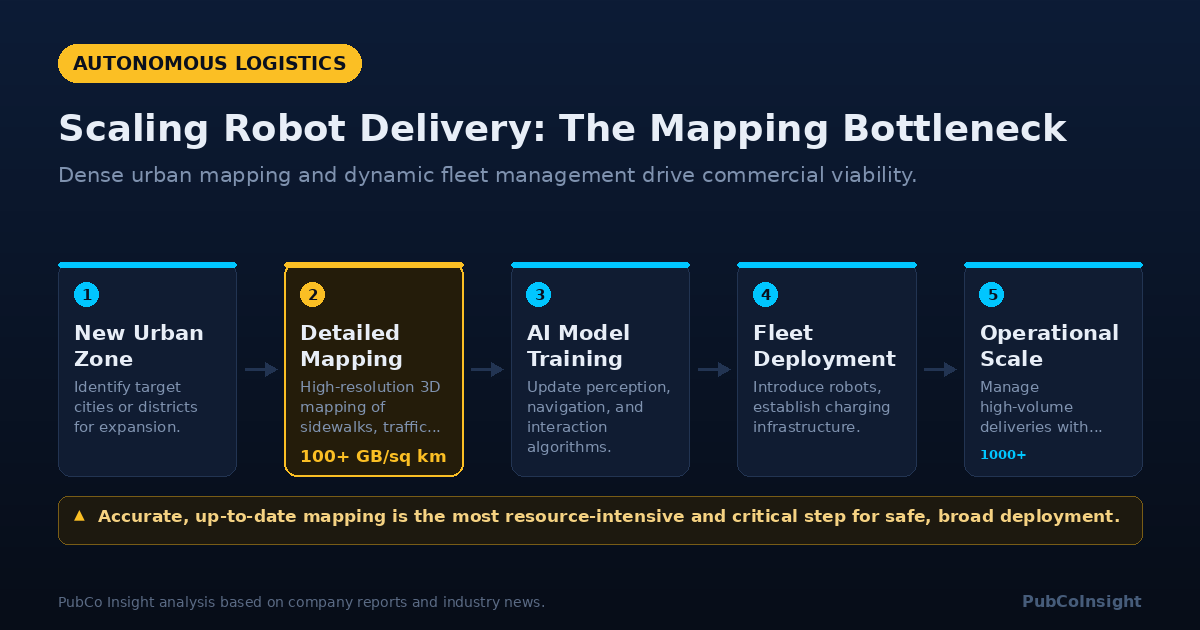
The Mechanism of Scaling Autonomous Delivery
Scaling autonomous delivery hinges on two primary factors: mapping density and fleet management. First, a robot needs precise, high-resolution maps of its operational area. This isn't just street data; it includes sidewalks, curb heights, pedestrian flows, traffic light cycles, and even temporary obstructions like construction zones or street vendors. Each new operational zone, whether a city block or an entire district, requires meticulous mapping and continuous updating. This process is resource-intensive, demanding specialized sensor arrays, data processing, and human validation. The cost and time involved in creating and maintaining these digital twins of urban environments act as a significant bottleneck. Second, efficient fleet management is crucial. This involves not just dispatching robots to fulfill orders, but also dynamic routing to avoid obstacles, battery swapping or charging logistics, and remote human oversight for intervention in complex scenarios. The robots themselves must be robust enough to handle varying weather conditions, interact safely with pedestrians, and navigate unpredictable urban environments. The underlying AI models need constant training on new data to improve perception, prediction, and decision-making capabilities. A single robot operating in a controlled environment is one thing; hundreds operating simultaneously across a dense urban grid, each with its own mission and potential challenges, presents a far more complex system. The real value unlocks when the system can manage high volumes with minimal human intervention, driving down the per-delivery cost.Companies Operating in Autonomous Security and Delivery
The broader sector encompasses a range of companies developing physical AI for security, monitoring, and logistics. These firms often share core competencies in robotics, sensor fusion, and AI, but apply them to different use cases. Serve Robotics Inc. (SERV), trading at $4.99, focuses specifically on autonomous sidewalk delivery. Its recent agreements with Grubhub and DoorDash are critical for expanding its operational footprint. The company's strategy involves integrating its delivery robots directly into the order fulfillment ecosystems of major food delivery platforms, aiming to leverage their existing customer bases and logistical networks. Serve announced on August 17, 2026, that its Diligent Robotics subsidiary also began rolling out Moxi 2.0, indicating a parallel push into healthcare logistics. In the realm of security and industrial automation, Ondas Inc. (ONDS), priced at $9.24, operates through its Ondas Networks and American Robotics subsidiaries. Ondas Networks focuses on wireless private networks for critical infrastructure, a foundational layer for many autonomous systems. American Robotics develops fully autonomous drones for industrial inspection and monitoring, particularly in sectors like oil and gas, and mining. These drones operate without human pilots or visual observers on site, relying on sophisticated AI for flight, data collection, and analysis. Red Cat Holdings, Inc. (RCAT), at $11.13, is known for its drone technology, particularly for defense and public safety applications. Its Skypersonic subsidiary provides software for remote inspection and training, enabling drones to operate in GPS-denied environments. Red Cat's recent focus includes maritime autonomy deals, as reported on August 17, 2026, expanding its reach beyond aerial systems. Unusual Machines, Inc. (UMAC), trading at $34.06, designs and manufactures specialized robotics for niche applications. While specific details on its current deployments are less public, the company’s name suggests a focus on bespoke or highly specialized autonomous systems, potentially for complex industrial or defense scenarios. Other companies provide critical components and underlying technologies. Arbe Robotics Ltd. (ARBE), at $0.797, develops high-resolution 4D imaging radar solutions, essential for autonomous vehicles and robots to perceive their environment accurately in all weather conditions. MicroVision, Inc. (MVIS), priced at $2.24, focuses on lidar technology, another key sensor for autonomous navigation, particularly for precise distance measurement and 3D mapping. Kopin Corporation (KOPN), at $5.50, supplies micro-displays and optical modules, often used in augmented reality headsets and defense systems, which can be critical for remote operation and human-robot interaction interfaces. Lantronix, Inc. (LTRX), at $6.47, provides secure data access and management solutions, crucial for connecting and controlling distributed fleets of autonomous devices. BigBear.ai Holdings, Inc. (BBAI), at $3.27, develops AI-powered analytics and decision intelligence software, which can be integrated into autonomous systems for predictive maintenance, threat detection, or optimizing operational workflows.Artificial Intelligence Technology Solutions, Inc.
Artificial Intelligence Technology Solutions, Inc. (AITX), trading over the counter at $0.006, builds and leases autonomous security robots and remote monitoring systems. The company employs a "Solutions-as-a-Service" model, generating recurring monthly subscription revenue rather than one-off hardware sales. Its operations are structured around three main pillars: stationary security devices through Robotic Assistance Devices, Inc. (RAD-I), mobile autonomous platforms through Robotic Assistance Devices Mobile (RAD-M), and its SARA agentic artificial intelligence platform through Robotic Assistance Devices Group (RAD-G). RAD-I markets AI-driven solutions to the security and guarding services industry, a market AITX estimates at $50 billion in the United States. These solutions aim to deliver significant cost savings, ranging from 35% to 80% compared to traditional manned security. The company's devices include both stationary units and mobile platforms like the ROAMEO mobile security unit, which began early commercial deployment in May 2026. AITX also operates RAD Lanka, a wholly-owned subsidiary in Sri Lanka, which supports software development, AI initiatives, and technical operations across the company's various subsidiaries. The long-term vision, internally referred to as "RAD Town," involves integrated autonomous security deployments across entire campuses, communities, or jurisdictions. For the fiscal year ended February 28, 2026, AITX reported revenue of $7,745,336, a 26% increase year-over-year. Gross profit grew 48% to $5,533,700, with gross margin expanding to approximately 71% from 61%. Operating expenses remained largely flat at $17,477,097. The company's loss from operations improved by approximately $2.0 million to $(11,943,397). AITX reported a net loss of approximately $14.5 million for the fiscal year and an accumulated deficit of approximately $171 million as of February 28, 2026. The independent registered public accounting firm included an explanatory paragraph in its report expressing substantial doubt about the company's ability to continue as a going concern due to negative cash flow from operating activities of $9,344,534 and negative working capital of $17,017,745. The public record does not yet establish a clear timeline for achieving positive cash flow from operations, which management does not anticipate having in the near term. The company's S-1 filing from July 17, 2026, discusses potential for RAD-I's recurring revenue to support positive cash flow on a standalone basis, and for RAD-M to surpass RAD-I's monthly recurring revenue contribution at a future point, but these are forward-looking statements dependent on market acceptance and manufacturing scale.What to watch
Investors should monitor the quarterly reports from Serve Robotics Inc. (SERV) for specific metrics on deployment numbers and geographic expansion following the Grubhub and DoorDash partnerships. Look for updates on the number of active delivery zones and the volume of orders fulfilled by robots. For Ondas Inc. (ONDS), watch for announcements regarding new contracts or deployments for its American Robotics autonomous drones, particularly in industrial sectors, and any expansion of its private wireless network infrastructure. Red Cat Holdings, Inc. (RCAT) investors should track progress on its maritime autonomy deals and any new defense contracts. Specific project names or county-level deployments would indicate tangible progress. Artificial Intelligence Technology Solutions, Inc. (AITX) filings, particularly 10-Qs, will provide updates on subscription counts for RAD-I and RAD-M units, along with any further details on the commercial deployment of ROAMEO mobile security units. Pay attention to any stated plans for SARA platform licensing and its associated revenue generation. The company's ability to reduce its accumulated deficit and improve its cash flow from operations will be key metrics to observe in future financial disclosures., { "label": "Detailed Mapping", "note": "High-resolution 3D mapping of sidewalks, traffic, obstructions.", "metric": "100+ GB/sq km" }, { "label": "AI Model Training", "note": "Update perception, navigation, and interaction algorithms." }, { "label": "Fleet Deployment", "note": "Introduce robots, establish charging infrastructure." }, { "label": "Operational Scale", "note": "Manage high-volume deliveries with minimal human intervention.", "metric": "1000+ deliveries/day" } ], "highlight": 1, "highlight_note": "Accurate, up-to-date mapping is the most resource-intensive and critical step for safe, broad deployment.", "footnote": "PubCo Insight analysis based on company reports and industry news." }Companies mentioned
| Ticker | Company | Price |
|---|---|---|
| AITX client | Artificial Intelligence Technology Solutions Inc | $0.006 |
| ARBE | Arbe Robotics Ltd. | $0.797 |
| BBAI | BigBear.ai Holdings, Inc. | $3.27 |
| KOPN | Kopin Corporation | $5.5 |
| LTRX | Lantronix, Inc. | $6.47 |
| MVIS | MicroVision, Inc. | $2.24 |
| ONDS | Ondas Inc. | $9.24 |
| RCAT | Red Cat Holdings, Inc. | $11.13 |
| SERV | Serve Robotics Inc. | $4.99 |
| UMAC | Unusual Machines, Inc. | $34.06 |
Listed alphabetically, not ranked. Prices as of 2026-08-18 and they move. Check a live quote before relying on any of this.
How we chose the companies in this article
We cover a fixed universe of companies working in autonomous security robotics, physical AI and the guarding services market they are aimed at. Every one of them that had usable market data on 2026-08-18 appears in this article. We do not pick which ones to mention based on what we think of them, and we do not order them by size, price or trading volume, because an ordered list is a verdict and that is not ours to hand down. Companies left out, and why: none. American Lithium Minerals and Artificial Intelligence Technology Solutions pay us, which is disclosed in full at the foot of every article they appear in.
See the dilution and promotion flags before you see the pitch.
Each week: the micro and small-caps now showing dilution or paid-promotion signals, with the SEC filing behind every flag. No recommendations, no price targets.
Sources used in this article
- Sandisk Stock Is Down 30% From Its Peak: Is the Memory Winner Still a Screaming Buy Before September? Motley Fool · 2026-08-18
- Bloom Energy Says It Has Visibility on 25 Gigawatts of Deployments. Here's What That Would Be Worth. Motley Fool · 2026-08-18
- 2 Dividend Stocks That Are No-Brainer Buys in August Motley Fool · 2026-08-18
- 4 (More) Dividend ETFs Worth Holding for the Long Haul Motley Fool · 2026-08-18
- Microsoft Just Announced Great News for AMD Investors Motley Fool · 2026-08-18
- Dow Jones Futures: Trump Comments Spark Stock Market Losses; Elon Musk-Led SpaceX Rallies Investor's Business Daily · 2026-08-18
- Why HIVE Stock Popped Today Motley Fool · 2026-08-18
- Nvidia Backs 8-GW Ohio AI Campus for OpenAI With $1.5 Billion Investment Oilprice.com · 2026-08-18
- Does Take-Two’s Shift To Modest Profit Guidance Reframe The Bull Case For TTWO? Simply Wall St. · 2026-08-18
- Chevron Struck Oil Off Angola. Here's What CVX Investors Need to Know. Motley Fool · 2026-08-18
- 3 High-Flying Stocks for Long-Term Investors StockStory · 2026-08-17
- AppLovin (APP) Stock Looks Cheap On Earnings While Broader Checks Stay Mixed Simply Wall St. · 2026-08-17
Disclosure required by Section 17(b) of the Securities Act of 1933
Artificial Intelligence Technology Solutions, Inc., a Nevada corporation (OTCID: AITX). Artificial Intelligence Technology Solutions, Inc. pays Strategic Innovations First, Inc., a Wyoming corporation doing business as PulseIR. Compensation received: USD 5,000.00 per month for months 1-3 (August, September, October 2026); USD 10,000.00 per month for months 4-6 (November, December 2026, January 2027) contingent on the 90-day review. Minimum committed USD 15,000.00; USD 45,000.00 if the second-period rate triggers.. Form of payment: cash only, invoiced monthly in advance; no stock, options or warrants received or payable. Services: investor relations services under an Investor Relations Services Agreement effective 2026-08-01. Period: six month term, 2026-08-01 through 2027-01-31; 90-day review on or about 2026-10-30. No stock, options or warrants held by PubCo Insight, Pulse IR, Strategic Innovations First, Inc., or Brad Listermann. Confirmed by the executed agreement and by board record recKwdq39X2caPSX7 (POSITIONS HELD: none).
This is information, not investment, financial, legal or tax advice. It is not a recommendation or solicitation to buy, sell or hold any security and it contains no price target. Nothing here is independently verified by us. Confirm every figure against primary filings on SEC EDGAR before you act. Micro-cap and over-the-counter securities are speculative and illiquid and can lose all of their value. The companies named without a disclosure above pay us nothing and have no relationship with us; they are named because a published, mechanical screen selected them. Full disclosure policy.