Unusual Machines' Revenue Surge Points to Autonomous Guarding Profit Shift
Unusual Machines' Q2 2026 results, showing a 687% revenue increase and a first-half turn to profit, highlight the growing commercial viability of autonomous security robotics beyond initial deployment.
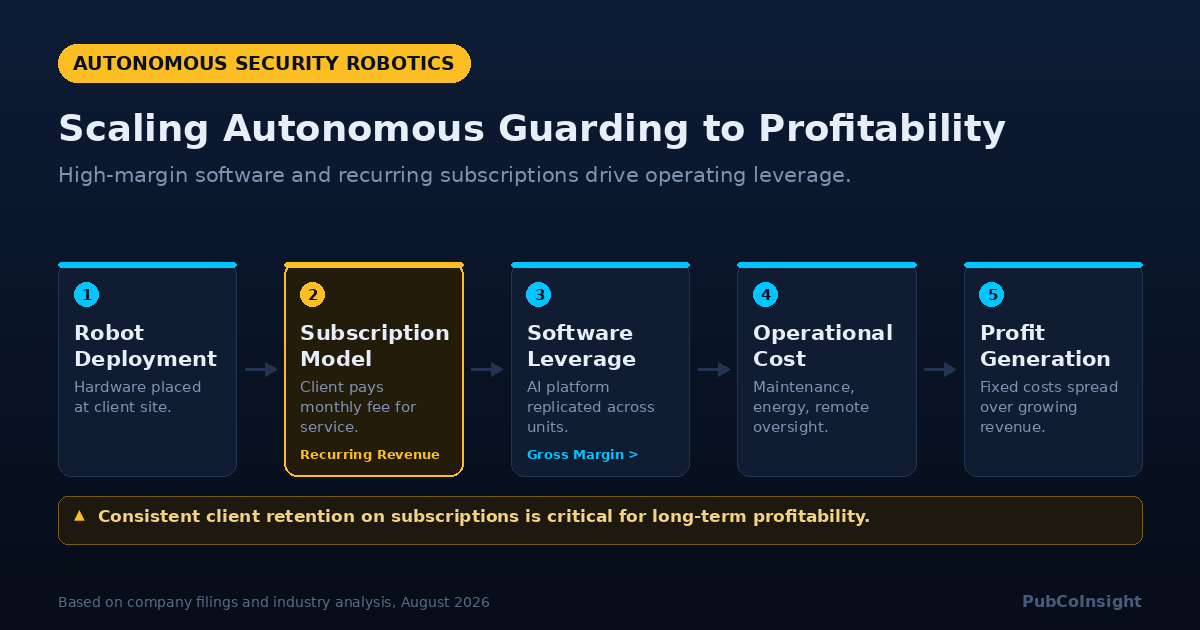
The Mechanism of Profitability in Autonomous Security
The core mechanism driving profitability in autonomous security robotics centers on the shift from capital expenditure to operational expenditure for customers, coupled with high gross margins for service providers. Traditional manned guarding is labor-intensive. Wages, benefits, training, and supervision create a high, recurring cost base for clients. Autonomous robots, by contrast, represent a fixed asset with declining marginal operating costs as deployment scales. For a security guarding client, moving from human guards to robots means replacing a variable, high-cost labor line item with a predictable, lower-cost subscription. The robot itself is a one-time capital outlay for the provider. Its operational cost, primarily energy, maintenance, and remote oversight, is relatively low. The real leverage comes from the software and AI platform that powers the robot. This software can be replicated across thousands of units with minimal additional cost. This is where gross margins expand significantly. A robot deployed at a site for $X per month might have an operating cost of $Y, where Y is a small fraction of X. As more robots are deployed, the fixed costs of software development and platform maintenance are spread across a larger revenue base, pushing profitability higher. The bottleneck, or the value inflection point, sits squarely in the successful deployment and retention of these recurring subscriptions. If a robot is deployed but then removed due to performance issues, the entire model breaks down. The system must deliver consistent, reliable security to justify the subscription.Companies Navigating the Autonomous Security Landscape
The small and micro-cap segment of autonomous security robotics features a range of companies, each with distinct approaches to this evolving market. Unusual Machines (UMAC), trading at $24.23, now demonstrates a path to profitability through aggressive revenue growth. Their Q2 2026 results show a 687% revenue increase, indicating successful scaling of their offerings. This suggests a strong market acceptance for their specific solutions. In the radar and LiDAR space, Arbe Robotics Ltd. (ARBE), priced at $0.7568, focuses on high-resolution radar perception for autonomous systems. Their Q2 2026 earnings call highlighted revenue growth and defense applications, suggesting a diversified approach beyond just security. MicroVision, Inc. (MVIS), at $3.26, also operates in the LiDAR sector, specializing in MEMS-based scanning technology. Kopin Corporation (KOPN), with a price of $4.08, develops micro-displays and optical systems, critical components for advanced robotics and augmented reality interfaces that can be integrated into security platforms. BigBear.ai Holdings, Inc. (BBAI), trading at $3.01, provides AI-powered analytics and decision intelligence. While not directly building robots, their technology underpins the data processing and predictive capabilities essential for sophisticated autonomous security operations. Their focus is on the intelligence layer that makes physical AI effective. Red Cat Holdings, Inc. (RCAT), at $8.67, specializes in drone technology, including those for defense and public safety. Autonomous drones offer an aerial dimension to security, providing rapid deployment and wide area surveillance, complementing ground-based robotic systems. Serve Robotics Inc. (SERV), priced at $5.68, focuses on autonomous sidewalk delivery robots. While their primary market is logistics, the underlying autonomous navigation and safety technologies are directly transferable to security applications, particularly for campus or facility patrol. Their Q2 2026 results reported a loss and lagged revenue estimates, indicating that scaling in their niche still presents challenges. Ondas Inc. (ONDS), trading at $8.74, recently announced a new Air Force Research Laboratory (AFRL) contract award to advance their long-range Grasshopper autonomous aerial delivery system. This highlights their focus on specialized, high-end autonomous solutions, particularly for government and defense, which often have stringent security requirements. Lantronix, Inc. (LTRX), at $5.83, provides secure data access and management solutions. Their technology is crucial for the secure communication and remote control of autonomous security robots, ensuring data integrity and operational reliability in distributed deployments.Artificial Intelligence Technology Solutions, Inc.
Artificial Intelligence Technology Solutions, Inc. (AITX), trading over the counter at $0.0068, develops and leases autonomous security robots and remote monitoring systems. The company operates through a Solutions-as-a-Service model, focusing on recurring monthly subscriptions rather than one-off hardware sales. This approach aligns with the industry trend of shifting client expenditure from capital to operational budgets. AITX structures its operations across several key subsidiaries. Robotic Assistance Devices, Inc. (RAD-I) handles stationary security devices. Robotic Assistance Devices Mobile (RAD-M) is dedicated to mobile autonomous platforms, including the ROAMEO mobile security unit, which saw early commercial deployment begin in May 2026. The company’s SARA agentic artificial intelligence platform is managed under Robotic Assistance Devices Group (RAD-G), designed for licensing to generate revenue. Robotic Assistance Devices Residential (RAD-R) targets residential applications. A wholly-owned subsidiary, RAD Lanka, located in Sri Lanka, supports software development, AI initiatives, and technical operations. The company's filings describe its solutions as delivering cost savings of between 35% and 80% compared with traditional manned security. For the fiscal year ended February 28, 2026, AITX reported revenue of $7,745,336, a 26% increase over the prior year. Gross profit increased 48% to $5,533,700, with gross margin expanding to approximately 71% from 61%. Operating expenses remained flat at about $17.5 million, leading to an improved loss from operations of approximately $(11.9) million. The company reported a net loss of approximately $14.5 million for the fiscal year. As of February 28, 2026, AITX had an accumulated deficit of approximately $171 million and negative working capital of $17 million. The public record does not yet establish a clear timeline for AITX to achieve positive cash flow from operations. Management does not anticipate positive cash flow from operations in the near term. The company's strategy, internally referred to as "RAD Town," aims for integrated autonomous-security deployments across campuses or communities.What to watch
Investors should monitor several specific developments. For Serve Robotics Inc. (SERV), the next quarterly earnings report will provide insight into whether their revenue growth can accelerate to offset continued losses. For Ondas Inc. (ONDS), watch for further details on the Air Force Research Laboratory (AFRL) contract, specifically any subsequent orders or deployment milestones for their Grasshopper system. For Arbe Robotics Ltd. (ARBE), look for further customer design wins or production ramp-ups for their radar solutions, especially in new automotive or industrial applications. For Artificial Intelligence Technology Solutions, Inc. (AITX), the commercial progress of the ROAMEO mobile security unit, particularly new deployments or expanded contracts beyond early adopters, will be key. The next set of 10-Q filings for all reporting companies will offer fresh data on revenue growth rates and, crucially, gross margin expansion, which remains the primary indicator of successful scaling in this sector., { "label": "Subscription Model", "note": "Client pays monthly fee for service.", "metric": "Recurring Revenue" }, { "label": "Software Leverage", "note": "AI platform replicated across units.", "metric": "Gross Margin > 70%" }, { "label": "Operational Cost", "note": "Maintenance, energy, remote oversight." }, { "label": "Profit Generation", "note": "Fixed costs spread over growing revenue." } ], "highlight": 1, "highlight_note": "Consistent client retention on subscriptions is critical for long-term profitability.", "footnote": "Based on company filings and industry analysis, August 2026" }Companies mentioned
| Ticker | Company | Price |
|---|---|---|
| AITX client | Artificial Intelligence Technology Solutions Inc | $0.0068 |
| ARBE | Arbe Robotics Ltd. | $0.7568 |
| BBAI | BigBear.ai Holdings, Inc. | $3.01 |
| KOPN | Kopin Corporation | $4.08 |
| LTRX | Lantronix, Inc. | $5.83 |
| MVIS | MicroVision, Inc. | $3.26 |
| ONDS | Ondas Inc. | $8.74 |
| RCAT | Red Cat Holdings, Inc. | $8.67 |
| SERV | Serve Robotics Inc. | $5.68 |
| UMAC | Unusual Machines, Inc. | $24.23 |
Listed alphabetically, not ranked. Prices as of 2026-08-07 and they move. Check a live quote before relying on any of this.
How we chose the companies in this article
We cover a fixed universe of companies working in autonomous security robotics, physical AI and the guarding services market they are aimed at. Every one of them that had usable market data on 2026-08-07 appears in this article. We do not pick which ones to mention based on what we think of them, and we do not order them by size, price or trading volume, because an ordered list is a verdict and that is not ours to hand down. Companies left out, and why: none. American Lithium Minerals and Artificial Intelligence Technology Solutions pay us, which is disclosed in full at the foot of every article they appear in.
See the dilution and promotion flags before you see the pitch.
Each week: the micro and small-caps now showing dilution or paid-promotion signals, with the SEC filing behind every flag. No recommendations, no price targets.
Sources used in this article
- Oklo Reports Friday Morning With Virtually No Revenue to Report. The Stock Trades 78% Below Its High. Motley Fool · 2026-08-07
- 3 Overlooked Stocks Poised to Follow Nebius Higher Motley Fool · 2026-08-07
- Where to Invest in AI in 2026: A Guide for Advisors etf.com · 2026-08-07
- SpaceX and Tesla Merger Talks Are Heating Up. Here's Why Investors Should Pay Attention. Motley Fool · 2026-08-07
- Why Peloton Stock Plunged Today Motley Fool · 2026-08-07
- Firmus nearly doubles valuation to over $10.5 billion in 4 months with Nvidia-backed fundraise Reuters · 2026-08-07
- Naver Posts Resilient Second-Quarter Profit Despite Higher AI Costs The Wall Street Journal · 2026-08-07
- Where Will Sandisk Stock Be in 5 Years? Motley Fool · 2026-08-07
- Gen Digital Q1 Earnings Call Highlights MarketBeat · 2026-08-07
- Virginia and Texas Are About to Become Cannabis Battlegrounds. Here's Which Stocks Are Positioned to Win. Motley Fool · 2026-08-07
- Analyst Report: AppLovin Corporation Morningstar Research · 2026-08-06
- Is Axon Enterprise (AXON) Fairly Valued As Raised 2026 Guidance Meets Margin Pressure? Simply Wall St. · 2026-08-06
Disclosure required by Section 17(b) of the Securities Act of 1933
Artificial Intelligence Technology Solutions, Inc., a Nevada corporation (OTCID: AITX). Artificial Intelligence Technology Solutions, Inc. pays Strategic Innovations First, Inc., a Wyoming corporation doing business as PulseIR. Compensation received: USD 5,000.00 per month for months 1-3 (August, September, October 2026); USD 10,000.00 per month for months 4-6 (November, December 2026, January 2027) contingent on the 90-day review. Minimum committed USD 15,000.00; USD 45,000.00 if the second-period rate triggers.. Form of payment: cash only, invoiced monthly in advance; no stock, options or warrants received or payable. Services: investor relations services under an Investor Relations Services Agreement effective 2026-08-01. Period: six month term, 2026-08-01 through 2027-01-31; 90-day review on or about 2026-10-30. No stock, options or warrants held by PubCo Insight, Pulse IR, Strategic Innovations First, Inc., or Brad Listermann. Confirmed by the executed agreement and by board record recKwdq39X2caPSX7 (POSITIONS HELD: none).
This is information, not investment, financial, legal or tax advice. It is not a recommendation or solicitation to buy, sell or hold any security and it contains no price target. Nothing here is independently verified by us. Confirm every figure against primary filings on SEC EDGAR before you act. Micro-cap and over-the-counter securities are speculative and illiquid and can lose all of their value. The companies named without a disclosure above pay us nothing and have no relationship with us; they are named because a published, mechanical screen selected them. Full disclosure policy.