Autonomous Security Robotics Faces Valuation Recalibration After Serve Robotics Q2
Oppenheimer's sharp price target cut for Serve Robotics highlights a sector-wide re-evaluation of growth versus profitability in physical AI.
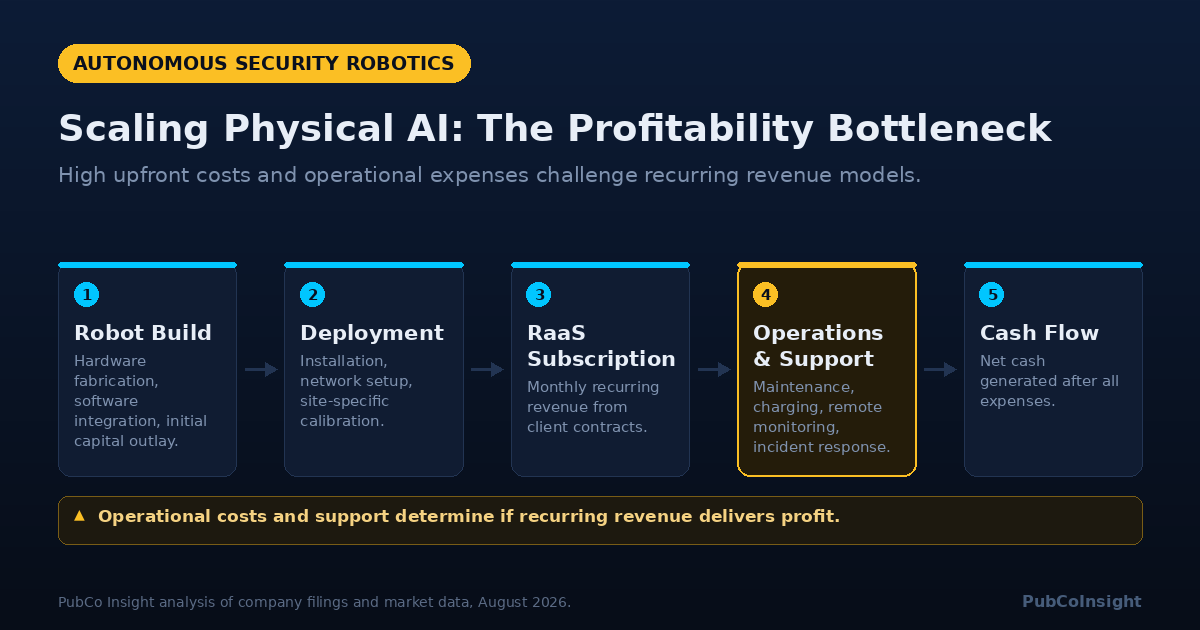
The Economics of Robotic Guarding
Autonomous security robotics aims to replace or augment human guarding services, a market estimated at $50 billion in the United States alone. The core value proposition is cost reduction, with companies citing savings between 35% and 80% compared to traditional manned security. This saving comes from eliminating human labor costs, which include wages, benefits, training, and supervision. Robots do not require breaks, do not get sick, and can operate 24/7 in conditions often unsafe or undesirable for humans. The mechanism involves a combination of stationary and mobile AI-driven devices, integrated with software and remote monitoring platforms. Stationary units, like those from RAD-I, provide persistent surveillance and deterrence in fixed locations. Mobile autonomous platforms, such as RAD-M's ROAMEO unit, extend coverage across larger campuses or jurisdictions, performing patrol routes, incident response, and environmental monitoring. The AI component processes sensor data, identifies anomalies, and triggers alerts or autonomous actions. This requires robust machine vision, natural language processing for human interaction, and predictive analytics to anticipate threats. The economic challenge lies in the deployment model. A one-off hardware sale generates immediate revenue but requires continuous sales to grow. A "Solutions-as-a-Service" (SaaS) or "Robotics-as-a-Service" (RaaS) model, which many in this sector favor, generates recurring monthly revenue. This model smooths revenue streams and builds a sticky customer base, but it also means the provider bears the upfront capital expenditure for the robots. Achieving profitability then depends on a high gross margin on those recurring subscriptions, low churn rates, and efficient scaling of operations and maintenance. The bottleneck often sits in the cost of deployment and ongoing support, particularly for mobile units that require charging infrastructure, periodic maintenance, and sometimes human intervention for complex scenarios. If the average monthly recurring revenue per unit cannot cover the amortized hardware cost, software development, and operational overhead within a reasonable timeframe, then growth can outpace profitability, leading to wider losses. The market is now demanding clearer evidence that these recurring revenue streams can indeed support positive cash flow at scale, beyond initial pilot programs.Companies Navigating the Autonomous Security Landscape
Several companies are active in the autonomous security robotics and physical AI space, each with distinct approaches to the market. **Serve Robotics Inc. (SERV)**, currently trading at $5.085, focuses on last-mile delivery robots, a segment that shares core AI and autonomous navigation technologies with security robotics. The recent Q2 results, with a wider loss than expected, underscore the capital intensity and operational challenges in scaling autonomous fleets. Oppenheimer's price target adjustment reflects this. **Ondas Inc. (ONDS)**, trading at $9.11, operates through its Ondas Networks and American Robotics subsidiaries. Ondas Networks provides wireless data platforms for critical infrastructure, while American Robotics develops autonomous drone systems. The company recently secured a contract to provide counter-drone protection for Jacksonville Jaguars NFL home games and an Air Force Research Laboratory (AFRL) award for its Grasshopper Autonomous Aerial Delivery System. These defense and infrastructure applications demonstrate a focus on high-security, specialized environments. **Unusual Machines, Inc. (UMAC)**, at $26.11, reported Q2 losses. The company's focus appears to be on advanced manufacturing and robotics, though specific security applications are less detailed in public news. The market is assessing whether its technological capabilities translate into viable commercial products within the security sector. **Red Cat Holdings, Inc. (RCAT)**, trading at $9.21, specializes in drone technology, including solutions for defense and public safety. Their focus on tactical drones for reconnaissance and surveillance aligns with broader security applications, though their primary market is not specifically autonomous ground-based security. **Arbe Robotics Ltd. (ARBE)**, at $0.768, develops 4D imaging radar solutions for autonomous vehicles. While not directly a security robot provider, its radar technology is critical for advanced perception in any autonomous system, including security robots that require robust environmental awareness in all weather conditions. **MicroVision, Inc. (MVIS)**, priced at $3.39, develops lidar technology for automotive safety and autonomous driving. Like Arbe, its core technology is an enabling component for autonomous security robots, providing high-resolution 3D sensing. **Lantronix, Inc. (LTRX)**, at $5.97, provides secure data access and management solutions for IoT and IT assets. Their technology could be crucial for the secure communication and remote management of autonomous security robot fleets. **Kopin Corporation (KOPN)**, trading at $4.27, develops micro-displays and optical solutions. These components could be integrated into advanced sensor arrays or user interfaces for security robots and their human operators. **BigBear.ai Holdings, Inc. (BBAI)**, at $3.27, offers AI-powered analytics and decision intelligence. Their software capabilities could enhance the predictive and analytical functions of autonomous security platforms, moving beyond simple surveillance to proactive threat assessment.Artificial Intelligence Technology Solutions, Inc.
Artificial Intelligence Technology Solutions, Inc. (AITX), trading over the counter at $0.0069, focuses on developing and leasing AI-driven autonomous security robots and remote monitoring systems. The company employs a recurring monthly subscription model for its offerings, rather than outright hardware sales. This "Solutions-as-a-Service" approach aims to provide cost savings to clients in the security and guarding services industry, which AITX estimates to be a $50 billion market in the United States. AITX operates through several subsidiaries. Robotic Assistance Devices, Inc. (RAD-I) markets stationary security devices. Robotic Assistance Devices Mobile (RAD-M) develops mobile autonomous platforms, including the ROAMEO mobile security unit, which began early commercial deployment in May 2026. Robotic Assistance Devices Group (RAD-G) is focused on the SARA agentic artificial intelligence platform, which the company intends to license for substantial revenue. RAD Lanka, a wholly owned subsidiary in Sri Lanka, handles software development, AI initiatives, and technical operations. The company's long-term vision is an integrated autonomous-security deployment across a campus, community, or jurisdiction, referred to internally as "RAD Town." For the fiscal year ended February 28, 2026, AITX reported revenue of $7,745,336, a 26% increase year-over-year. Gross profit rose 48% to $5,533,700, expanding the gross margin to approximately 71% from 61%. Operating expenses remained largely flat at about $17,477,097, leading to an improved loss from operations of $(11,943,397). The net loss for the year was approximately $14.5 million, with an accumulated deficit of approximately $171 million as of February 28, 2026. The company had negative cash flow from operating activities of $9,344,534 for the same period. The independent registered public accounting firm included an explanatory paragraph in its report on AITX's consolidated financial statements, expressing substantial doubt about the company's ability to continue as a going concern. While AITX states that RAD-I's recurring revenue and gross margin could, on a standalone basis, support positive cash flow operations, and that RAD-M will surpass RAD-I's monthly recurring revenue contribution at some future point, the public record does not yet establish the consistent cash flow generation required to resolve the going concern qualification. Management anticipates that subscription gross margin will exceed 75% and outright-sale gross margin will exceed 50%, based on average bill of materials costs and market-accepted pricing.What to watch
Investors in autonomous security robotics should monitor several concrete indicators. Look for Q3 earnings reports from companies in the sector, specifically focusing on gross margins for recurring revenue streams and cash flow from operations. Serve Robotics' next quarterly update will be particularly scrutinized for any shifts in its outlook or operational efficiency. Watch for new contract announcements, particularly multi-year deployments that demonstrate client confidence and scalability. Ondas Inc.'s progress on its AFRL contract and any further expansion of its counter-drone services will be key. Permitting for broader autonomous robot deployments in new jurisdictions, especially for mobile units like AITX's ROAMEO, will signal market acceptance and regulatory progress. Finally, observe any changes in capital raise strategies across the sector, as companies adapt to a more demanding valuation environment., { "label": "Deployment", "note": "Installation, network setup, site-specific calibration." }, { "label": "RaaS Subscription", "note": "Monthly recurring revenue from client contracts." }, { "label": "Operations & Support", "note": "Maintenance, charging, remote monitoring, incident response." }, { "label": "Cash Flow", "note": "Net cash generated after all expenses." } ], "highlight": 3, "highlight_note": "Operational costs and support determine if recurring revenue delivers profit.", "footnote": "PubCo Insight analysis of company filings and market data, August 2026." }Companies mentioned
| Ticker | Company | Price |
|---|---|---|
| AITX client | Artificial Intelligence Technology Solutions Inc | $0.0069 |
| ARBE | Arbe Robotics Ltd. | $0.768 |
| BBAI | BigBear.ai Holdings, Inc. | $3.27 |
| KOPN | Kopin Corporation | $4.27 |
| LTRX | Lantronix, Inc. | $5.97 |
| MVIS | MicroVision, Inc. | $3.39 |
| ONDS | Ondas Inc. | $9.11 |
| RCAT | Red Cat Holdings, Inc. | $9.21 |
| SERV | Serve Robotics Inc. | $5.085 |
| UMAC | Unusual Machines, Inc. | $26.11 |
Listed alphabetically, not ranked. Prices as of 2026-08-10 and they move. Check a live quote before relying on any of this.
How we chose the companies in this article
We cover a fixed universe of companies working in autonomous security robotics, physical AI and the guarding services market they are aimed at. Every one of them that had usable market data on 2026-08-10 appears in this article. We do not pick which ones to mention based on what we think of them, and we do not order them by size, price or trading volume, because an ordered list is a verdict and that is not ours to hand down. Companies left out, and why: none. American Lithium Minerals and Artificial Intelligence Technology Solutions pay us, which is disclosed in full at the foot of every article they appear in.
See the dilution and promotion flags before you see the pitch.
Each week: the micro and small-caps now showing dilution or paid-promotion signals, with the SEC filing behind every flag. No recommendations, no price targets.
Sources used in this article
- Dow Jones Futures Fall As Market Bulls Rule; Cisco, Lumentum Earnings Ahead Investor's Business Daily · 2026-08-10
- SpaceX vs. Quantinuum: Which Recent IPO Stock Is a Better Buy? Motley Fool · 2026-08-10
- Meet the High-Yield Dividend Stock Bill Ackman Has Owned for Over a Decade. Here's Why It's a Great Buy in August. Motley Fool · 2026-08-10
- 1 Nasdaq 100 Stock for Long-Term Investors and 2 We Question StockStory · 2026-08-09
- SK Hynix and Samsung Just Sent a Major Warning to Micron Investors Motley Fool · 2026-08-09
- The Federal Reserve Just Released Its August Inflation Forecast, and It Could Put the FOMC on a Collision Course for Its September Meeting Motley Fool · 2026-08-09
- Why QXO, Inc. Fell Over 20% in July Motley Fool · 2026-08-09
- Sezzle Beat on Revenue and Raised Guidance. Its Stock Lost a Third of Its Value in a Day. Motley Fool · 2026-08-09
- If a Stock Market Crash Is Coming, History Says This Investing Strategy Has Never Once Failed Motley Fool · 2026-08-09
- Apple CEO Tim Cook Just Passed His Successor a Mess Motley Fool · 2026-08-09
- Prediction: This Cryptocurrency Could Go Parabolic After the 2026 Midterm Elections Motley Fool · 2026-08-09
- Unusual Machines Q2 Earnings Call Highlights MarketBeat · 2026-08-09
Disclosure required by Section 17(b) of the Securities Act of 1933
Artificial Intelligence Technology Solutions, Inc., a Nevada corporation (OTCID: AITX). Artificial Intelligence Technology Solutions, Inc. pays Strategic Innovations First, Inc., a Wyoming corporation doing business as PulseIR. Compensation received: USD 5,000.00 per month for months 1-3 (August, September, October 2026); USD 10,000.00 per month for months 4-6 (November, December 2026, January 2027) contingent on the 90-day review. Minimum committed USD 15,000.00; USD 45,000.00 if the second-period rate triggers.. Form of payment: cash only, invoiced monthly in advance; no stock, options or warrants received or payable. Services: investor relations services under an Investor Relations Services Agreement effective 2026-08-01. Period: six month term, 2026-08-01 through 2027-01-31; 90-day review on or about 2026-10-30. No stock, options or warrants held by PubCo Insight, Pulse IR, Strategic Innovations First, Inc., or Brad Listermann. Confirmed by the executed agreement and by board record recKwdq39X2caPSX7 (POSITIONS HELD: none).
This is information, not investment, financial, legal or tax advice. It is not a recommendation or solicitation to buy, sell or hold any security and it contains no price target. Nothing here is independently verified by us. Confirm every figure against primary filings on SEC EDGAR before you act. Micro-cap and over-the-counter securities are speculative and illiquid and can lose all of their value. The companies named without a disclosure above pay us nothing and have no relationship with us; they are named because a published, mechanical screen selected them. Full disclosure policy.