Serve Robotics Guidance Cut Highlights Sector Growth Headwinds
Serve Robotics' recent guidance cut, despite new Grubhub and DoorDash partnerships, points to underlying challenges in scaling revenue and achieving profitability across the autonomous security robotics industry.
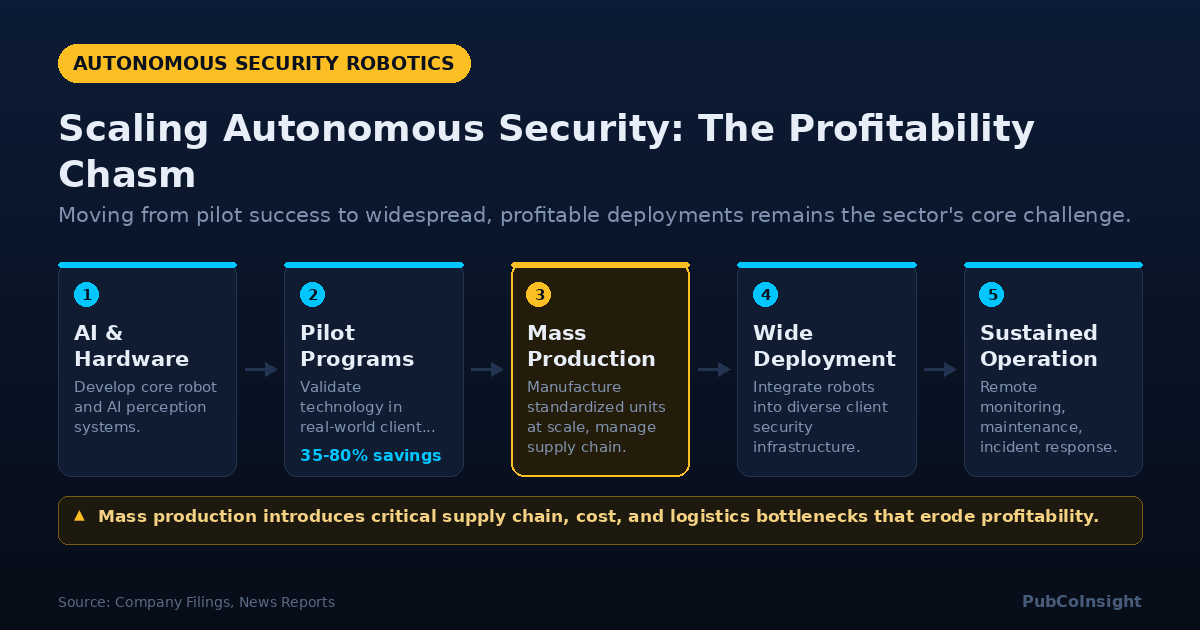
The Mechanism of Scaling Autonomous Security
Scaling autonomous security robotics involves a multi-stage process, each with its own bottlenecks. First, a company develops the core AI and robotic hardware. This initial stage demands significant R&D investment. The next step is proving the concept, often through pilot programs with early-adopter clients. These pilots validate the technology’s effectiveness in real-world scenarios, like patrolling a corporate campus or monitoring a construction site. The critical transition occurs after successful pilots. This is where companies must move from bespoke solutions to standardized, mass-producible units. Manufacturing at scale introduces supply chain complexities, component sourcing issues, and quality control challenges. For example, specialized sensors or robust chassis components can face availability constraints or price volatility. Once manufactured, deployment requires trained technicians, site-specific mapping, and integration with existing security infrastructure, often involving proprietary client systems. Finally, ongoing operation demands remote monitoring, predictive maintenance, and rapid response capabilities for any incidents or malfunctions. The cost efficiency argument, the primary value proposition, hinges on minimizing downtime and maximizing operational autonomy. A single robot needing frequent human intervention erodes the cost savings quickly.Companies Operating in This Sector
Several companies are navigating these waters, each with a distinct approach. Ondas Inc. (ONDS), trading at $9.06, recently moved to acquire Aran Defense for $33 million, strengthening its position in defense-related drone technology. Their focus appears to be on specialized, high-value applications, including military and critical infrastructure, where the cost-benefit analysis of autonomous systems differs significantly from general security. Ondas’ Swarmer’s SkyKnight platform suggests a networked, aerial approach to security and surveillance. Red Cat Holdings, Inc. (RCAT), priced at $10.205, also operates in the drone space. Their strategy often involves providing drone-based solutions for various industries, including defense and public safety, where rapid deployment and aerial perspective offer unique advantages. Arbe Robotics Ltd. (ARBE), at $0.814, specializes in high-resolution radar perception for autonomous vehicles, which is a foundational technology for many mobile robotic platforms. Their focus on the sensor layer addresses a core requirement for safe and effective autonomous navigation in complex environments. MicroVision, Inc. (MVIS), trading at $1.80, develops lidar technology, another crucial sensor for autonomous navigation. Like Arbe, MicroVision is primarily a component provider, essential for the broader adoption of autonomous systems, but not directly involved in the end-user security robotics market. Kopin Corporation (KOPN), priced at $5.04, recently announced a joint steering committee with Fabric.AI, led by Kopin CEO Michael Murray, to expand Neural I/o™ industry engagement. Kopin focuses on micro-displays and optical solutions, which are vital for human-robot interaction interfaces and augmented reality applications in field operations. BigBear.ai Holdings, Inc. (BBAI), at $3.12, provides AI-powered analytics and decision intelligence. While not a direct robotics manufacturer, their software platforms can be crucial for processing the vast amounts of data generated by autonomous security robots, enabling more intelligent threat detection and response. Lantronix, Inc. (LTRX), trading at $6.28, offers secure data access and management solutions. Their technology is critical for ensuring reliable communication and data integrity for autonomous robots, especially in remote monitoring and control scenarios. Unusual Machines, Inc. (UMAC), at $30.58, is a newer entrant, recently participating in Sidoti Events' August Micro-Cap Virtual Conference. Their specific offerings in autonomous security robotics are still emerging, but their presence suggests growing interest in specialized machine applications. Serve Robotics Inc. (SERV), currently at $4.55, focuses on last-mile autonomous delivery robots. Their recent guidance cut, despite growing partnerships with Grubhub and DoorDash, highlights the capital intensity and operational challenges of scaling a fleet of mobile robots across urban environments. The company's expansion with Wonder and the rollout of Moxi 2.0 by its Diligent Robotics subsidiary demonstrate ongoing product development and deployment efforts.Artificial Intelligence Technology Solutions, Inc.
Artificial Intelligence Technology Solutions, Inc. (AITX), trading at $0.0053, operates through a "Solutions-as-a-Service" model within the security and guarding services industry. The company estimates this market to be approximately $50 billion in the United States. AITX aims to deliver significant cost savings, between 35% and 80%, compared to traditional manned security. This is achieved through a suite of stationary and mobile devices, integrated with their proprietary software and monitoring platforms. AITX structures its operations across three main pillars. Robotic Assistance Devices, Inc. (RAD-I) handles stationary security devices. Robotic Assistance Devices Mobile (RAD-M) focuses on mobile autonomous platforms, including the ROAMEO mobile security unit, which began early commercial deployment in May 2026. The company’s SARA agentic artificial intelligence platform falls under Robotic Assistance Devices Group (RAD-G). A wholly owned subsidiary in Sri Lanka, RAD Lanka, supports software development, AI initiatives, and technical operations. The company’s stated long-term vision is an integrated autonomous-security deployment across a campus or community, referred to internally as "RAD Town." For the fiscal year ended February 28, 2026, AITX reported revenue of $7,745,336, a 26% increase year-over-year. Gross profit increased 48% to $5,533,700, with gross margin expanding to approximately 71% from 61%. Operating expenses remained flat at around $17,477,097, leading to an improved loss from operations of $(11,943,397). The net loss for the year was approximately $14.5 million, with an accumulated deficit of approximately $171 million as of that date. The company had negative cash flow from operating activities of $9,344,534 for the same period. While AITX has articulated a clear strategy for revenue growth and margin expansion, the public record does not yet establish consistent positive cash flow from operations. The company’s most recent filings, including an S-1 dated July 16, 2026, detail these financial results and outline forward-looking statements regarding potential revenue and gross margin, and the planned introduction of additional stationary solutions. AITX secured a third ROSA order from a property management client on August 18, 2026, indicating continued client expansion for its stationary security units.What to watch
The coming months will offer several checkpoints for the autonomous security robotics sector. Look for Serve Robotics' next quarterly earnings report to see if they provide more granular detail on the factors behind the recent guidance cut and how the Grubhub and DoorDash partnerships are translating into deployable units and revenue. For Ondas, the integration of Aran Defense will be key; watch for announcements regarding new contracts or expanded capabilities stemming from this acquisition. Artificial Intelligence Technology Solutions (AITX) has frequent 8-K filings; these often detail new client orders or deployment milestones for its RAD-I and RAD-M units. Specifically, watch for any updates on the commercial deployment progress of the ROAMEO mobile security unit, which began in May 2026, and any further expansion of the SARA platform licensing. For all players, pay attention to any shifts in component pricing or supply chain stability, as these directly impact the cost of scaling and ultimately, profitability., { "label": "Pilot Programs", "note": "Validate technology in real-world client environments.", "metric": "35-80% savings" }, { "label": "Mass Production", "note": "Manufacture standardized units at scale, manage supply chain." }, { "label": "Wide Deployment", "note": "Integrate robots into diverse client security infrastructure." }, { "label": "Sustained Operation", "note": "Remote monitoring, maintenance, incident response." } ], "highlight": 2, "highlight_note": "Mass production introduces critical supply chain, cost, and logistics bottlenecks that erode profitability.", "footnote": "Source: Company Filings, News Reports" }Companies mentioned
| Ticker | Company | Price |
|---|---|---|
| AITX client | Artificial Intelligence Technology Solutions Inc | $0.0053 |
| ARBE | Arbe Robotics Ltd. | $0.814 |
| BBAI | BigBear.ai Holdings, Inc. | $3.12 |
| KOPN | Kopin Corporation | $5.04 |
| LTRX | Lantronix, Inc. | $6.28 |
| MVIS | MicroVision, Inc. | $1.8 |
| ONDS | Ondas Inc. | $9.06 |
| RCAT | Red Cat Holdings, Inc. | $10.205 |
| SERV | Serve Robotics Inc. | $4.55 |
| UMAC | Unusual Machines, Inc. | $30.58 |
Listed alphabetically, not ranked. Prices as of 2026-08-19 and they move. Check a live quote before relying on any of this.
How we chose the companies in this article
We cover a fixed universe of companies working in autonomous security robotics, physical AI and the guarding services market they are aimed at. Every one of them that had usable market data on 2026-08-19 appears in this article. We do not pick which ones to mention based on what we think of them, and we do not order them by size, price or trading volume, because an ordered list is a verdict and that is not ours to hand down. Companies left out, and why: none. American Lithium Minerals and Artificial Intelligence Technology Solutions pay us, which is disclosed in full at the foot of every article they appear in.
See the dilution and promotion flags before you see the pitch.
Each week: the micro and small-caps now showing dilution or paid-promotion signals, with the SEC filing behind every flag. No recommendations, no price targets.
Sources used in this article
- Is This a Buy-the-Dip Opportunity for XRP Right Now? Motley Fool · 2026-08-19
- 3 High-Yield Dividend Stocks I'd Buy With $5,000 Right Now Motley Fool · 2026-08-19
- Opendoor Is Down 86% From Its High. Is the Housing Recovery Story Still Intact? Motley Fool · 2026-08-19
- Micron Is Trading at About 7 Times Next Year's Earnings Estimate Even After Crossing $1 Trillion in Market Cap. Here's Why That Multiple Looks Nothing Like Nvidia's. Motley Fool · 2026-08-19
- Nvidia credit risk gauge hits new peak as SoftBank readies record bond issue Investing.com · 2026-08-19
- 88% of Nvidia's Portfolio Is Invested in These 3 Artificial Intelligence (AI) Stocks Motley Fool · 2026-08-19
- Einride AB Will Deploy 500 Tesla Semi Trucks This Year. Here's What That Means for Tesla Stock. Motley Fool · 2026-08-19
- 3 Stocks That Warren Buffett's Successor, Greg Abel, Bought (Besides Alphabet). Should You? Motley Fool · 2026-08-19
- This 3X Tech ETN Owns the Market’s Biggest Winners and Lost 87% the Last Time They Stumbled 24/7 Wall St. · 2026-08-19
- Palantir Stock Investors Just Got Good News From CEO Alex Karp. Wall Street Says It's Time to Buy. Motley Fool · 2026-08-19
- Ondas’ Defense Push Gets Another Vote Of Confidence – Roth Capital Sees 44% Upside Stocktwits · 2026-08-19
- Drone Stocks See Limited Losses Tuesday During Nasdaq Sell-Off: Red Cat, Ondas Flat While AeroVironment Tumbles 24/7 Wall St. · 2026-08-19
Disclosure required by Section 17(b) of the Securities Act of 1933
Artificial Intelligence Technology Solutions, Inc., a Nevada corporation (OTCID: AITX). Artificial Intelligence Technology Solutions, Inc. pays Strategic Innovations First, Inc., a Wyoming corporation doing business as PulseIR. Compensation received: USD 5,000.00 per month for months 1-3 (August, September, October 2026); USD 10,000.00 per month for months 4-6 (November, December 2026, January 2027) contingent on the 90-day review. Minimum committed USD 15,000.00; USD 45,000.00 if the second-period rate triggers.. Form of payment: cash only, invoiced monthly in advance; no stock, options or warrants received or payable. Services: investor relations services under an Investor Relations Services Agreement effective 2026-08-01. Period: six month term, 2026-08-01 through 2027-01-31; 90-day review on or about 2026-10-30. No stock, options or warrants held by PubCo Insight, Pulse IR, Strategic Innovations First, Inc., or Brad Listermann. Confirmed by the executed agreement and by board record recKwdq39X2caPSX7 (POSITIONS HELD: none).
This is information, not investment, financial, legal or tax advice. It is not a recommendation or solicitation to buy, sell or hold any security and it contains no price target. Nothing here is independently verified by us. Confirm every figure against primary filings on SEC EDGAR before you act. Micro-cap and over-the-counter securities are speculative and illiquid and can lose all of their value. The companies named without a disclosure above pay us nothing and have no relationship with us; they are named because a published, mechanical screen selected them. Full disclosure policy.