Serve Robotics Sees 31% Short Interest Amidst $240 Million Deal
A recent Barchart report highlights significant short interest in Serve Robotics, drawing attention to the mechanics of short squeezes in the autonomous security robotics sector.
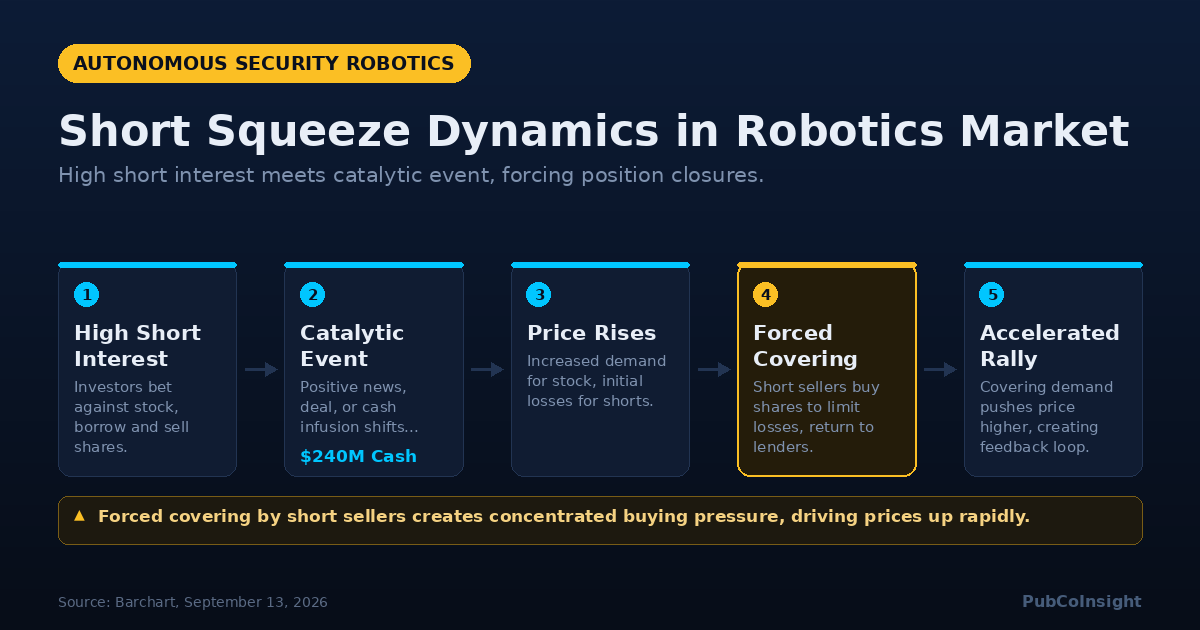
The Mechanics of a Short Squeeze
A short squeeze occurs when a stock's price rises sharply, forcing short sellers to buy back shares to cover their positions. This buying activity further pushes the price up, creating a feedback loop. Short selling involves borrowing shares and selling them, with the expectation that the price will fall, allowing the seller to buy them back at a lower price and return them to the lender, profiting from the difference. High short interest, like the 31% reported for Serve Robotics, indicates a large number of investors betting against the stock. When positive news or a significant event, such as a "Wonder Deal" or a substantial cash injection, shifts market sentiment, these short sellers face increasing losses. To limit their exposure, they must purchase shares, often at market prices, to close their positions. This demand, concentrated over a short period, can overwhelm available supply, causing a rapid price ascent. The key constraint here is the availability of shares to cover. If the float is small, or if a large portion of the shares are held by long-term investors unwilling to sell, the squeeze can be more intense. The "Wonder Deal" and $240 million cash infusion for Serve Robotics represent the kind of catalysts that can trigger such a covering scramble, by fundamentally changing the perceived risk profile of the company.Companies Navigating Autonomous Security Robotics
The autonomous security robotics and physical AI market attracts a diverse set of operators, each with distinct approaches to technology and market penetration. These companies are pushing the boundaries of what automated systems can achieve in guarding services. Arbe Robotics Ltd. (ARBE), trading at $0.784, focuses on high-resolution 4D imaging radar solutions. Their technology is critical for autonomous perception, providing detailed environmental understanding that goes beyond traditional camera or lidar systems. This precision is vital for robots operating in complex, dynamic environments, ensuring accurate object detection and classification in all weather conditions. Arbe's recent selection by one of the world's largest automotive groups for a Level 3 program across multiple brands indicates a strong push into advanced autonomy, a field with direct implications for robust security robot navigation. Kopin Corporation (KOPN), priced at $4.56, supplies critical microdisplay technologies. Their OLED microdisplays are used in thermal weapon sights and other defense applications, as evidenced by a recent $2.4 million order for an international thermal weapon sight program. While not directly building security robots, Kopin's advanced display components are integral to the visual interfaces and augmented reality overlays that human operators use to interact with and monitor autonomous security systems, particularly in demanding outdoor or low-light conditions. Lantronix, Inc. (LTRX), at $5.24, provides secure data access and management solutions for the Internet of Things (IoT). Their embedded computing and networking products are foundational for connecting autonomous robots to central command centers, enabling real-time data transfer, remote control, and over-the-air updates. This infrastructure is essential for the reliable operation and scalability of any robot fleet. MicroVision, Inc. (MVIS), trading at $1.64, develops lidar technology for automotive safety and autonomous driving. Their lidar sensors provide precise 3D mapping of environments, a core capability for autonomous navigation and obstacle avoidance in security robots. The accuracy of their point cloud data allows robots to understand their surroundings with high fidelity, a non-negotiable requirement for effective patrol and incident response. BigBear.ai Holdings, Inc. (BBAI), at $2.87, specializes in AI-powered analytics and decision intelligence. While not a hardware manufacturer, their software platforms analyze vast datasets generated by security systems, identifying patterns, predicting threats, and optimizing patrol routes for autonomous robots. This back-end intelligence layer extracts maximum value from the data collected by physical AI deployments. Ondas Inc. (ONDS), currently at $7.23, operates in the industrial drone and private wireless network space. Their FullMAX platform provides secure, reliable communication for critical infrastructure, which is vital for drone-based security operations and larger autonomous ground vehicle deployments where public networks may be unreliable or insecure. Ondas raising its 2026 revenue view, with a surging backlog, suggests increasing demand for their specialized communication solutions in these critical applications. Red Cat Holdings, Inc. (RCAT), priced at $7.96, focuses on drone technology, including hardware and software for defense and public safety. Their solutions often involve advanced aerial reconnaissance and surveillance, complementing ground-based autonomous security robots by providing an elevated perspective and rapid response capabilities for larger areas or complex incidents. Unusual Machines, Inc. (UMAC), trading at $22.95, recently made a significant $20 million investment in XTEND AI Robotics, bringing their total investment to $27.5 million. This move signals a direct and substantial commitment to the development and deployment of advanced AI robotics. Unusual Machines' focus appears to be on integrating sophisticated AI into physical platforms, potentially targeting niche or high-value applications within the security sector. Serve Robotics Inc. (SERV), at $4.48, is directly in the spotlight with its recent short interest and "Wonder Deal." The company deploys autonomous robots for last-mile delivery, a market with direct parallels to campus security and patrol, where robots navigate public and semi-public spaces. Their operational experience in real-world environments, managing fleets and overcoming logistical challenges, provides valuable insights for the broader autonomous security market. Zacks reported on September 11, 2026, on SERV's revenue diversification efforts to offset weaker Uber deliveries, indicating a strategic pivot or expansion of their service offerings beyond a single client.Artificial Intelligence Technology Solutions, Inc.
Artificial Intelligence Technology Solutions, Inc. (AITX), trading at $0.0036 on the OTCID tier, develops and leases AI-driven security robots and remote monitoring systems. The company employs a "Solutions-as-a-Service" model, focusing on recurring monthly subscriptions rather than one-off hardware sales. This approach targets the estimated $50 billion U.S. security and guarding services market, aiming to deliver substantial cost savings compared to traditional manned security. AITX operates through several subsidiaries, each with a specific focus. Robotic Assistance Devices, Inc. (RAD-I) handles stationary security devices. Robotic Assistance Devices Mobile (RAD-M) is dedicated to mobile autonomous platforms, including the ROAMEO mobile security unit, which began early commercial deployment in May 2026. The company states RAD-M represents a higher revenue ceiling than stationary solutions. Robotic Assistance Devices Group (RAD-G) manages the SARA agentic artificial intelligence platform, which AITX believes will generate substantial revenue through licensing. Robotic Assistance Devices Residential (RAD-R) focuses on residential applications. Finally, RAD Lanka, a wholly-owned subsidiary in Sri Lanka operating under Port City Colombo status, provides software development, AI initiatives, and technical operations support across the company's various segments. AITX's internal long-term strategy, referred to as "RAD Town," envisions integrated autonomous security deployments across entire campuses, communities, or jurisdictions. The company reported revenue of $7,745,336 for the fiscal year ended February 28, 2026, a 26% increase over the prior year. Gross profit rose 48% to $5,533,700, with gross margin expanding to approximately 71% from 61%. Operating expenses remained flat at around $17,477,097, leading to an improved operating loss of approximately $(11,943,397). The company reported a net loss of approximately $14.5 million for that fiscal year and an accumulated deficit of approximately $171 million as of February 28, 2026. Cash flow from operating activities for the year was negative $9,344,534. The public record does not yet establish a clear timeline for achieving positive cash flow from operations, despite management's characterization that RAD-I could support positive cash flow on a standalone basis. AITX continues to issue 8-K filings frequently, detailing various operational updates and corporate actions. On September 10, 2026, AITX announced RAD and Circadian Risk are bringing continuous intelligence to physical risk assessment. Earlier, on September 9, 2026, AITX reported expanding orders across its RIO, ROSA, and SARA platforms. The company also announced spending reductions on September 8, 2026, aimed at accelerating its path to positive monthly cash flow.What to watch
Investors should monitor several specific developments. For Serve Robotics (SERV), watch for further details on the "Wonder Deal" and any associated financial disclosures. The actual terms of this deal will clarify its impact on the company's valuation and its ability to sustain operations. Keep an eye on the short interest figures, as any significant reduction could indicate short covering. For Ondas (ONDS), the company's ability to deliver on its raised 2026 revenue view and the required H2 ramp will be a key indicator. Any new contracts or deployments for their counter-UAS systems will also be important. Unusual Machines (UMAC) investors should look for updates on their $20 million investment in XTEND AI Robotics, specifically how this capital is being deployed and what new products or services emerge from this collaboration. For Artificial Intelligence Technology Solutions (AITX), the frequency and content of their 8-K filings remain central. Look for specific announcements regarding new deployments of their ROAMEO mobile security units, substantial SARA platform licensing agreements, and concrete progress towards positive monthly cash flow., { "label": "Catalytic Event", "note": "Positive news, deal, or cash infusion shifts sentiment.", "metric": "$240M Cash" }, { "label": "Price Rises", "note": "Increased demand for stock, initial losses for shorts." }, { "label": "Forced Covering", "note": "Short sellers buy shares to limit losses, return to lenders." }, { "label": "Accelerated Rally", "note": "Covering demand pushes price higher, creating feedback loop." } ], "highlight": 3, "highlight_note": "Forced covering by short sellers creates concentrated buying pressure, driving prices up rapidly.", "footnote": "Source: Barchart, September 13, 2026" }Companies mentioned
| Ticker | Company | Price |
|---|---|---|
| AITX client | Artificial Intelligence Technology Solutions Inc | $0.0036 |
| ARBE | Arbe Robotics Ltd. | $0.784 |
| BBAI | BigBear.ai Holdings, Inc. | $2.87 |
| KOPN | Kopin Corporation | $4.56 |
| LTRX | Lantronix, Inc. | $5.24 |
| MVIS | MicroVision, Inc. | $1.64 |
| ONDS | Ondas Inc. | $7.23 |
| RCAT | Red Cat Holdings, Inc. | $7.96 |
| SERV | Serve Robotics Inc. | $4.48 |
| UMAC | Unusual Machines, Inc. | $22.95 |
Listed alphabetically, not ranked. Prices as of 2026-09-14 and they move. Check a live quote before relying on any of this.
How we chose the companies in this article
We cover a fixed universe of companies working in autonomous security robotics, physical AI and the guarding services market they are aimed at. Every one of them that had usable market data on 2026-09-14 appears in this article. We do not pick which ones to mention based on what we think of them, and we do not order them by size, price or trading volume, because an ordered list is a verdict and that is not ours to hand down. Companies left out, and why: none. American Lithium Minerals and Artificial Intelligence Technology Solutions pay us, which is disclosed in full at the foot of every article they appear in.
See the dilution and promotion flags before you see the pitch.
Each week: the micro and small-caps now showing dilution or paid-promotion signals, with the SEC filing behind every flag. No recommendations, no price targets.
Sources used in this article
- This 1 Move Could Make or Break Your Investing Strategy, According to Warren Buffett Motley Fool · 2026-09-14
- Coinbase CEO Brian Armstrong Says $400,000 Is Within Reach for Bitcoin. Here's Why He's Right. Motley Fool · 2026-09-14
- Netflix Stock Will Be Worth More by 2028: My Case for Buying NFLX Now Motley Fool · 2026-09-13
- Prediction: ServiceNow's AI Business Triples Before 2029 Motley Fool · 2026-09-13
- 2 Monster Stocks to Buy and Hold for at Least the Next 5 Years Motley Fool · 2026-09-13
- SpaceX vs. Apple: Wall Street Sees Strong Upside for One of These Stocks and Remains Neutral On the Other Motley Fool · 2026-09-13
- Berkshire Hathaway Stock Is Trailing the S&P 500 by About 10 Points This Year. History Says That Usually Doesn't Last. Motley Fool · 2026-09-13
- Down 50% Over the Past Year, Is It Time to Back Up the Truck and Buy Oracle Stock as Revenue Surges? Motley Fool · 2026-09-13
- Cybersecurity Is the Next Big Market for Artificial Intelligence (AI), According to Jensen Huang. This Super Stock-Split Stock Is the One to Own. Motley Fool · 2026-09-13
- A $100 Monthly Investment in VGT Could Grow Into This Over 20 Years Motley Fool · 2026-09-13
- Wonder Deal, $240M Cash, and 31% Short Interest. A Short Squeeze Could Be Brewing in Serve Robotics Stock. Barchart · 2026-09-13
- Can SERV's Revenue Diversification Offset Weaker Uber Deliveries? Zacks · 2026-09-11
Disclosure required by Section 17(b) of the Securities Act of 1933
Artificial Intelligence Technology Solutions, Inc., a Nevada corporation (OTCID: AITX). Artificial Intelligence Technology Solutions, Inc. pays Strategic Innovations First, Inc., a Wyoming corporation doing business as PulseIR. Compensation received: USD 5,000.00 per month for months 1-3 (August, September, October 2026); USD 10,000.00 per month for months 4-6 (November, December 2026, January 2027) contingent on the 90-day review. Minimum committed USD 15,000.00; USD 45,000.00 if the second-period rate triggers.. Form of payment: cash only, invoiced monthly in advance; no stock, options or warrants received or payable. Services: investor relations services under an Investor Relations Services Agreement effective 2026-08-01. Period: six month term, 2026-08-01 through 2027-01-31; 90-day review on or about 2026-10-30. No stock, options or warrants held by PubCo Insight, Pulse IR, Strategic Innovations First, Inc., or Brad Listermann. Confirmed by the executed agreement and by board record recKwdq39X2caPSX7 (POSITIONS HELD: none).
This is information, not investment, financial, legal or tax advice. It is not a recommendation or solicitation to buy, sell or hold any security and it contains no price target. Nothing here is independently verified by us. Confirm every figure against primary filings on SEC EDGAR before you act. Micro-cap and over-the-counter securities are speculative and illiquid and can lose all of their value. The companies named without a disclosure above pay us nothing and have no relationship with us; they are named because a published, mechanical screen selected them. Full disclosure policy.