Scaling Drone Production: Unusual Machines Invests in Draganfly to Boost Manufacturing Capacity
A $10 million strategic investment from Unusual Machines and a US Investment Fund into Draganfly signals a critical push to expand drone manufacturing, highlighting the sector's pivot towards increased production capabilities.
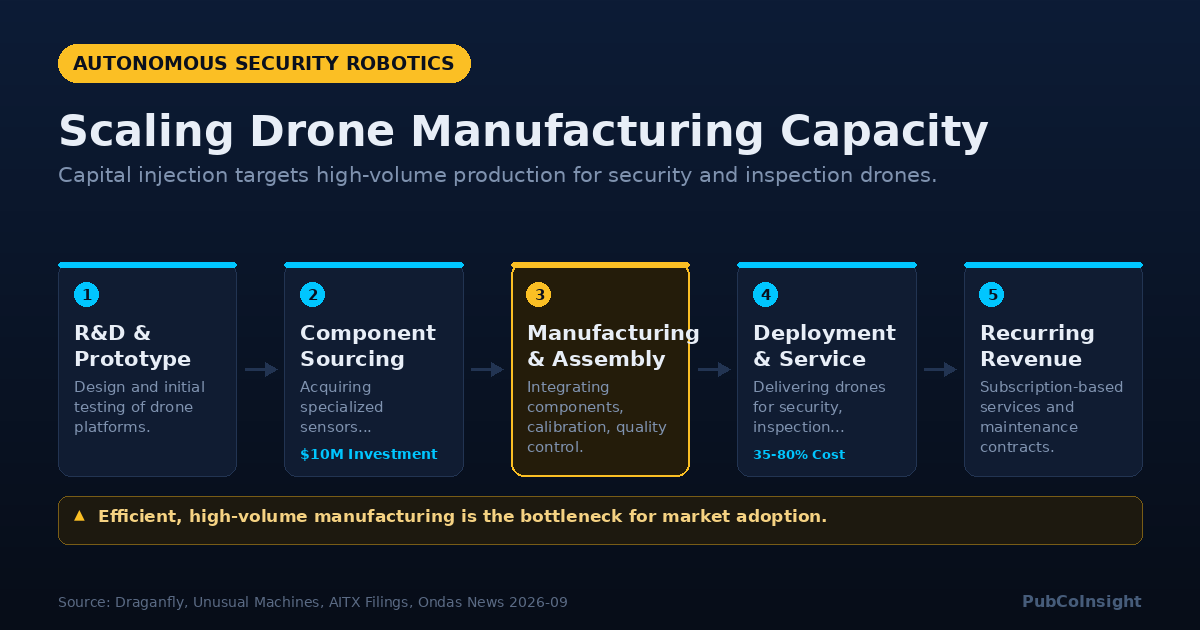
The Mechanism of Scaling Drone Production
Scaling drone manufacturing is not simply about assembling more units. It involves a complex interplay of supply chain optimization, advanced robotics in production, and specialized workforce development. The core challenge lies in integrating diverse, high-precision components, sensors, processors, specialized batteries, and airframes, into a reliable, high-performance system at volume. Each drone requires intricate calibration and testing, a process that resists simple automation. Consider the flight controller, the brain of any drone. It integrates data from accelerometers, gyroscopes, magnetometers, and GPS to maintain stable flight and execute commands. Manufacturing these controllers demands cleanroom environments and highly skilled technicians for soldering micro-components and programming firmware. A bottleneck here can cripple production. Similarly, battery pack assembly for extended flight times requires precise cell matching and thermal management systems, often involving custom designs for specific drone models. These are not off-the-shelf components. Each sub-system presents its own manufacturing hurdles. To achieve scale, companies must invest in automated assembly lines for repetitive tasks, while retaining skilled labor for quality control, final assembly, and specialized component integration. This often means vertically integrating key manufacturing processes or forging deep, long-term partnerships with specialized suppliers. A failure in either supply chain resilience or manufacturing throughput directly impacts delivery schedules and unit economics. The shift from prototype to thousands of units annually demands a complete re-engineering of the production process, moving from artisanal craftsmanship to industrial efficiency.Companies Operating in Autonomous Security Robotics
Several companies are navigating this evolving landscape, each with distinct approaches to technology and market penetration. In the drone sector, Ondas Inc. (ONDS) has been active, recently securing a multi-year deal from the UK's SSE for electricity network inspection and surveying. This highlights a focus on industrial applications for its drone technology. Ondas's emphasis on network inspection for critical infrastructure demonstrates a strategy to target high-value, recurring service contracts. Red Cat Holdings, Inc. (RCAT) also operates in the drone space, with a focus that includes counter-drone solutions. Their reported need for a sharp H2 ramp to meet 2026 targets suggests significant demand for their products, placing pressure on their manufacturing capabilities. The investment in Draganfly (DPRO) by Unusual Machines, Inc. (UMAC) directly addresses this scaling challenge, aiming to boost the production of Draganfly's diverse drone platforms, which include security and delivery applications. Beyond drones, the broader autonomous security and physical AI market includes companies like Lantronix, Inc. (LTRX), which provides intelligent edge computing and connectivity solutions, essential for enabling autonomous devices to communicate and process data in real-time. Their technology forms a backbone for many AI-driven security systems. Arbe Robotics Ltd. (ARBE) focuses on high-resolution 4D imaging radar solutions, critical for advanced perception in autonomous vehicles and robotics, including security applications where precise environmental awareness is paramount. Arbe recently closed a $15 million underwritten registered direct offering, indicating capital deployment for its radar technology development. In the realm of perception and display, Kopin Corporation (KOPN) is developing microLED optical interconnects, which could significantly impact the next generation of heads-up displays and augmented reality systems for security personnel or even robotic platforms. Similarly, MicroVision, Inc. (MVIS) is known for its lidar technology, another key sensor for autonomous navigation and object detection in security robotics. On the software and AI side, BigBear.ai Holdings, Inc. (BBAI) provides AI-powered analytics and decision intelligence, which can be applied to large datasets generated by autonomous security systems to predict threats or optimize patrol routes. Serve Robotics Inc. (SERV) is targeting the last-mile delivery market with its sidewalk robots, a segment that shares many operational and safety challenges with autonomous security, particularly around urban navigation and public interaction.Artificial Intelligence Technology Solutions, Inc.
Artificial Intelligence Technology Solutions, Inc. (AITX) trades on the OTCID tier under the symbol AITX. The company, through its subsidiaries, develops and leases autonomous security robots and remote monitoring systems. Its business model relies on a recurring monthly subscription for these AI-driven solutions, rather than outright hardware sales. This approach aims to provide predictable revenue streams from the security and guarding services industry, which the company estimates as a $50 billion market in the United States. AITX operates through several key subsidiaries. Robotic Assistance Devices, Inc. (RAD-I) focuses on stationary security devices. Robotic Assistance Devices Mobile (RAD-M) develops mobile autonomous platforms, with early commercial deployments of its ROAMEO mobile security unit beginning in May 2026. Robotic Assistance Devices Group (RAD-G) handles the SARA agentic artificial intelligence platform, which the company intends to license. Additionally, Robotic Assistance Devices Lanka (RAD Lanka), located in Sri Lanka with Port City Colombo status, supports software development, AI initiatives, and technical operations. The company's solutions are designed to offer significant cost savings, between 35% and 80%, compared to traditional manned security and monitoring. This is achieved through a suite of stationary and mobile devices integrated with AITX's proprietary software and monitoring platforms. AITX's long-term vision, internally referred to as "RAD Town," involves integrated autonomous security deployments across entire campuses, communities, or jurisdictions. For the fiscal year ended February 28, 2026, AITX reported revenue of $7,745,336, a 26% increase over the prior year. Gross profit rose 48% to $5,533,700, with gross margin expanding to approximately 71% from 61%. Operating expenses remained stable at about $17,477,097, leading to an improved loss from operations of $(11,943,397). The net loss for the fiscal year was approximately $14.5 million, with an accumulated deficit of approximately $171 million as of that date. The company had negative cash flow from operating activities of $9,344,534 for the same period. The public record does not yet establish a clear path to sustained positive cash flow from operations. AITX recently updated its hardware pricing to reflect rising materials, compute, and transportation costs, and expanded a national dealer relationship with a third order.What to watch
Investors should monitor several concrete developments. The immediate impact of the Draganfly (DPRO) investment from Unusual Machines (UMAC) will be visible in Draganfly's manufacturing output and delivery schedules. Look for specific announcements regarding increased drone production capacity or new manufacturing facility expansions. Any new multi-year contracts for drone services, similar to Ondas's (ONDS) deal with SSE, would indicate successful scaling and market penetration. For Artificial Intelligence Technology Solutions (AITX), watch for further details on the commercial deployment of its ROAMEO mobile security units and any licensing agreements for its SARA platform. Specific metrics on subscription growth and recurring revenue from its RAD-I stationary devices will be key indicators of its "Solutions-as-a-Service" model's traction. Updates on the financial performance of RAD-M and RAD-G will also be important, particularly if they begin to contribute substantially to revenue as outlined in company statements. Across the sector, watch for quarterly earnings reports from all listed companies. These filings will provide concrete data on revenue growth, gross margins, and cash burn, offering a clearer picture of operational efficiency and market acceptance for autonomous security solutions. Additionally, new patent filings, such as Kopin's (KOPN) recent applications for microLED optical interconnects, can signal future technological advantages., { "label": "Component Sourcing", "note": "Acquiring specialized sensors, processors, batteries.", "metric": "$10M Investment" }, { "label": "Manufacturing & Assembly", "note": "Integrating components, calibration, quality control." }, { "label": "Deployment & Service", "note": "Delivering drones for security, inspection, logistics.", "metric": "35-80% Cost Savings" }, { "label": "Recurring Revenue", "note": "Subscription-based services and maintenance contracts." } ], "highlight": 2, "highlight_note": "Efficient, high-volume manufacturing is the bottleneck for market adoption.", "footnote": "Source: Draganfly, Unusual Machines, AITX Filings, Ondas News 2026-09" }Companies mentioned
| Ticker | Company | Price |
|---|---|---|
| AITX client | Artificial Intelligence Technology Solutions Inc | $0.0026 |
| ARBE | Arbe Robotics Ltd. | $0.608 |
| BBAI | BigBear.ai Holdings, Inc. | $2.65 |
| KOPN | Kopin Corporation | $4.75 |
| LTRX | Lantronix, Inc. | $7.22 |
| MVIS | MicroVision, Inc. | $1.46 |
| ONDS | Ondas Inc. | $7.48 |
| RCAT | Red Cat Holdings, Inc. | $6.45 |
| SERV | Serve Robotics Inc. | $4.63 |
| UMAC | Unusual Machines, Inc. | $24.94 |
Listed alphabetically, not ranked. Prices as of 2026-09-30 and they move. Check a live quote before relying on any of this.
How we chose the companies in this article
We cover a fixed universe of companies working in autonomous security robotics, physical AI and the guarding services market they are aimed at. Every one of them that had usable market data on 2026-09-30 appears in this article. We do not pick which ones to mention based on what we think of them, and we do not order them by size, price or trading volume, because an ordered list is a verdict and that is not ours to hand down. Companies left out, and why: none. American Lithium Minerals and Artificial Intelligence Technology Solutions pay us, which is disclosed in full at the foot of every article they appear in.
See the dilution and promotion flags before you see the pitch.
Each week: the micro and small-caps now showing dilution or paid-promotion signals, with the SEC filing behind every flag. No recommendations, no price targets.
Sources used in this article
- Land of Startups: What ICTWeek Uzbekistan Revealed About Central Asia's Tech Rise ACCESS Newswire · 2026-09-30
- 3 Undervalued Stocks Trading At Least 24% Below Fair Value Simply Wall St. · 2026-09-30
- Bloom Energy Stock Rose 16-Fold in 5 Years. All of the Gain Came in the Last 2. Motley Fool · 2026-09-30
- Palantir Is Worth About as Much as Oracle on Less Than a Tenth of Oracle's Revenue Motley Fool · 2026-09-30
- Joby and Archer Each Burn Roughly $200 Million a Quarter. Here's Which One Runs Out of Cash First Motley Fool · 2026-09-30
- Michael Burry sends fresh warning on Nvidia stock TheStreet · 2026-09-30
- Nvidia Reportedly Turns To Insurers To De-Risk AI Chip Loans As Jensen Huang Pushes Beyond Big Tech — Could This Unlock Billions For Smaller Cloud Players? Benzinga · 2026-09-30
- Mark Zuckerberg Labels It 'Significant Positive Step,' Musk Nods Yes as Trump Inks New AI Safety Deal With Top CEOs Benzinga · 2026-09-30
- SpaceX Still Trades Above Its IPO Price. Could Anthropic Do the Same? Motley Fool · 2026-09-30
- Opinion: Eli Lilly Stock Is a No-Brainer Pick to Buy on the Dip Motley Fool · 2026-09-30
- 2 Stocks Trump Bought in July Are Now Down 17% to 20%. Time to Buy? Insider Monkey · 2026-09-29
- Axon Likely to Deliver In-Line Q3 Results, RBC Says MT Newswires · 2026-09-29
Disclosure required by Section 17(b) of the Securities Act of 1933
Artificial Intelligence Technology Solutions, Inc., a Nevada corporation (OTCID: AITX). Artificial Intelligence Technology Solutions, Inc. pays Strategic Innovations First, Inc., a Wyoming corporation doing business as PulseIR. Compensation received: USD 5,000.00 per month for months 1-3 (August, September, October 2026); USD 10,000.00 per month for months 4-6 (November, December 2026, January 2027) contingent on the 90-day review. Minimum committed USD 15,000.00; USD 45,000.00 if the second-period rate triggers.. Form of payment: cash only, invoiced monthly in advance; no stock, options or warrants received or payable. Services: investor relations services under an Investor Relations Services Agreement effective 2026-08-01. Period: six month term, 2026-08-01 through 2027-01-31; 90-day review on or about 2026-10-30. No stock, options or warrants held by PubCo Insight, Pulse IR, Strategic Innovations First, Inc., or Brad Listermann. Confirmed by the executed agreement and by board record recKwdq39X2caPSX7 (POSITIONS HELD: none).
This is information, not investment, financial, legal or tax advice. It is not a recommendation or solicitation to buy, sell or hold any security and it contains no price target. Nothing here is independently verified by us. Confirm every figure against primary filings on SEC EDGAR before you act. Micro-cap and over-the-counter securities are speculative and illiquid and can lose all of their value. The companies named without a disclosure above pay us nothing and have no relationship with us; they are named because a published, mechanical screen selected them. Full disclosure policy.