Supply Chain Intelligence Becomes a Differentiator for Autonomous Security Robotics
Unusual Machines' partnership with Altana on September 3, 2026, highlights a shift in focus toward resilient component sourcing, a critical factor for scaling physical AI deployments.
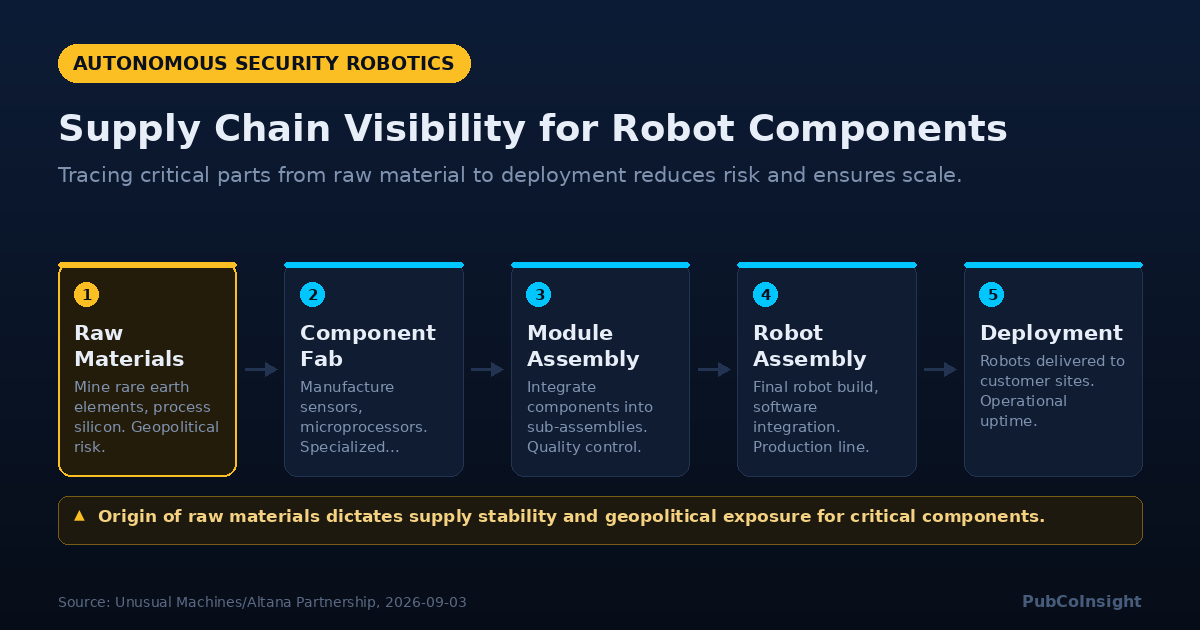
The Mechanism of Supply Chain Intelligence
Supply chain intelligence, in this context, means mapping the entire journey of a component, from raw material extraction through manufacturing, assembly, and delivery. It involves more than just knowing who your direct supplier is. It means understanding their suppliers, and their suppliers' suppliers, down to the origin of critical raw materials. For drone components, this includes specialized sensors, microprocessors, battery cells, and advanced composite materials for airframes. Consider a critical sensor for an autonomous security robot, perhaps a millimeter-wave radar unit. A traditional supply chain might track the sensor from the final assembly plant. Supply chain intelligence, however, would trace the semiconductor chips inside that sensor back to their fabrication facility, then to the silicon wafer manufacturer, and further, to the source of the high-purity silicon itself. It would also track the rare earth elements used in permanent magnets within the radar's antenna, identifying their mine of origin, the separation and refining facilities, and the geopolitical stability of those regions. The difficulty in separating rare earth oxides lies in their chemical similarity. These elements often occur together in mineral deposits. Conventional methods involve complex, multi-stage solvent extraction processes, where specific organic solvents selectively bind to one rare earth ion over another. This requires precise chemical control, significant energy input, and careful waste management, making the supply chain for these materials inherently complex and vulnerable to disruption. By gaining this deep visibility, companies can identify single points of failure, anticipate potential disruptions from geopolitical events, natural disasters, or even labor disputes, and proactively develop alternative sourcing strategies. This reduces lead times, improves component quality assurance, and ultimately ensures a more reliable and scalable production pipeline for autonomous systems. Without this granular understanding, a single overlooked sub-component from a distant, unmonitored supplier can halt an entire production line.Companies Navigating This Sector
Several companies are operating in the autonomous security robotics and physical AI space, each with distinct approaches to hardware, software, and market penetration. The emphasis on supply chain resilience from Unusual Machines (UMAC) highlights a broader industry challenge. Unusual Machines, trading at $23.76, is focused on drone technology, and its collaboration with Altana directly addresses the intricate nature of drone component supply. Ondas Inc. (ONDS), priced at $7.62, operates in the industrial drone and private wireless network space. Its subsidiary, Ondas Networks, develops mission-critical IoT platforms, while American Robotics focuses on autonomous drone solutions for data collection. Their operational model relies on robust hardware, making supply chain stability a foundational element for their service delivery. Ondas has seen recent volatility, dropping 6% on September 1, 2026, then rising 6% on September 27, 2026, reflecting market sensitivity to broader drone sector sentiment. Red Cat Holdings, Inc. (RCAT), at $8.37, is involved in drone technology, including hardware and software for defense and commercial applications. Their focus on tactical drones and enterprise solutions means that reliable component sourcing is crucial for meeting demanding performance specifications and delivery schedules. Red Cat also saw a 5% slide on August 28, 2026, amidst broader drone stock declines. Serve Robotics Inc. (SERV), trading at $4.945, deploys autonomous sidewalk delivery robots. Their business model depends on the continuous operation and scalability of their robotic fleet. While their form factor differs from aerial drones, the underlying need for resilient component supply for their navigation, power, and sensing systems remains critical. Serve Robotics recently had its $240 million liquidity cushion discussed, which could fund its robot ambitions. Beyond the direct drone and delivery robot manufacturers, companies providing critical sub-components and AI processing power also play a role. Arbe Robotics Ltd. (ARBE), at $0.636, develops high-resolution 4D imaging radar solutions, a key sensor technology for autonomous systems. Kopin Corporation (KOPN), priced at $4.28, provides micro-displays and optical modules for augmented reality and virtual reality devices, which could find applications in advanced human-robot interfaces or remote operation systems. MicroVision, Inc. (MVIS), at $1.65, is another player in lidar technology, a crucial sensing method for environmental mapping and obstacle avoidance in autonomous robots. Lantronix, Inc. (LTRX), trading at $5.22, offers secure data access and management solutions for IoT devices, including those found in autonomous systems. Their technology ensures reliable communication and data flow, which is essential for remote monitoring and control of security robots. BigBear.ai Holdings, Inc. (BBAI), at $2.92, provides AI-powered analytics and decision intelligence, which can be integrated into the operational backend of autonomous security deployments, optimizing patrol routes or threat detection algorithms.Artificial Intelligence Technology Solutions, Inc.
Artificial Intelligence Technology Solutions, Inc. (AITX), trading over the counter at $0.0044, operates primarily through its wholly-owned subsidiary, Robotic Assistance Devices (RAD). AITX builds and leases autonomous security robots and remote monitoring systems. The company's business model centers on recurring monthly subscriptions for its hardware and software services, rather than one-off hardware sales. This subscription-based approach means that consistent robot uptime and reliable performance are directly tied to revenue generation and customer retention. AITX's product line includes stationary and mobile autonomous security solutions. The company's public filings, including numerous 8-K reports filed throughout August and September 2026, detail specific order intakes and deployment updates. For example, AITX's RAD recorded a 32-unit August order intake across five solutions, as announced on August 31, 2026. This was followed by a 14-unit order intake across five customer relationships on August 27, 2026, which the company described as its most diverse 24-hour order intake in history. These filings provide concrete data points on the company's operational activity and market traction. The company's strategy involves expanding its footprint through direct sales and channel partners, aiming to displace traditional manned guarding services with autonomous alternatives. Its solutions are designed for a range of applications, including corporate campuses, logistics facilities, and critical infrastructure. The recurring revenue model necessitates a robust support infrastructure and a reliable supply of components for both initial deployments and ongoing maintenance. While AITX's filings detail order intake and operational updates, the public record does not consistently establish the average monthly recurring revenue per unit across its entire deployed fleet. The company continues to provide investor updates, including an "Ask Me Anything" session on September 3, 2026, where CEO Steve Reinharz addressed questions regarding AITX and PURSUON, another company initiative. AITX's RAD is also slated to reach GSX 2026 attendees from three points on the show floor, indicating a continued focus on market visibility and customer engagement.What to watch
Investors should monitor specific, checkable developments. Watch for further details from Unusual Machines (UMAC) regarding the tangible benefits and metrics emerging from its Altana partnership, particularly any reported improvements in component lead times or supply chain resilience. Look for specific contract wins or expanded deployments where this strengthened supply chain is cited as a competitive advantage. For Ondas Inc. (ONDS) and Red Cat Holdings, Inc. (RCAT), observe their quarterly filings for any commentary on supply chain stability, component costs, or inventory management, especially given the recent volatility in drone stock prices. Any announcements of new manufacturing partnerships or component sourcing agreements would be significant. For Artificial Intelligence Technology Solutions, Inc. (AITX), track the reported unit deployments and order intakes in their 8-K filings. Look for any disclosures that break down recurring revenue per unit or provide greater clarity on fleet utilization rates. The upcoming GSX 2026 event should offer insights into new product introductions or expanded market strategies. Finally, keep an eye on broader geopolitical developments that could impact the supply of critical raw materials, particularly rare earth elements and specialized semiconductors. These external factors can quickly ripple through the component supply chains for all companies in the autonomous security robotics sector., { "label": "Component Fab", "note": "Manufacture sensors, microprocessors. Specialized facilities." }, { "label": "Module Assembly", "note": "Integrate components into sub-assemblies. Quality control." }, { "label": "Robot Assembly", "note": "Final robot build, software integration. Production line." }, { "label": "Deployment", "note": "Robots delivered to customer sites. Operational uptime." } ], "highlight": 0, "highlight_note": "Origin of raw materials dictates supply stability and geopolitical exposure for critical components.", "footnote": "Source: Unusual Machines/Altana Partnership, 2026-09-03" }Companies mentioned
| Ticker | Company | Price |
|---|---|---|
| AITX client | Artificial Intelligence Technology Solutions Inc | $0.0044 |
| ARBE | Arbe Robotics Ltd. | $0.636 |
| BBAI | BigBear.ai Holdings, Inc. | $2.92 |
| KOPN | Kopin Corporation | $4.28 |
| LTRX | Lantronix, Inc. | $5.22 |
| MVIS | MicroVision, Inc. | $1.65 |
| ONDS | Ondas Inc. | $7.62 |
| RCAT | Red Cat Holdings, Inc. | $8.37 |
| SERV | Serve Robotics Inc. | $4.945 |
| UMAC | Unusual Machines, Inc. | $23.76 |
Listed alphabetically, not ranked. Prices as of 2026-09-06 and they move. Check a live quote before relying on any of this.
How we chose the companies in this article
We cover a fixed universe of companies working in autonomous security robotics, physical AI and the guarding services market they are aimed at. Every one of them that had usable market data on 2026-09-06 appears in this article. We do not pick which ones to mention based on what we think of them, and we do not order them by size, price or trading volume, because an ordered list is a verdict and that is not ours to hand down. Companies left out, and why: none. American Lithium Minerals and Artificial Intelligence Technology Solutions pay us, which is disclosed in full at the foot of every article they appear in.
See the dilution and promotion flags before you see the pitch.
Each week: the micro and small-caps now showing dilution or paid-promotion signals, with the SEC filing behind every flag. No recommendations, no price targets.
Sources used in this article
- August Job Gains Blew Past Estimates. Here's What It Means for the Fed. Motley Fool · 2026-09-06
- Elon Musk Says His New Foundry Can Get Gas Turbines Online 18 Months Faster. Here's What This "Profound Game Changer" Would Mean for SpaceX and Tesla. Motley Fool · 2026-09-06
- Why Innodata Stock Tumbled by 10% Last Month Motley Fool · 2026-09-06
- This Little-Known Altcoin Powering Robinhood's New Blockchain Just Soared By 45%. Is ARB a Buy, Sell, or Hold? Motley Fool · 2026-09-06
- Greg Abel Says Berkshire Will Serve the Hyperscalers Only If Its Other Customers Don't Pay for It Motley Fool · 2026-09-06
- Viking Therapeutics Trades Well Below Its Wall Street Targets. Here's the Skeptics' Case. Motley Fool · 2026-09-06
- CrowdStrike (CRWD) Unveiled A Broad AI Security Platform Push Simply Wall St. · 2026-09-06
- Bill Gates Says He Still Won't Invest in Crypto, Calls It a "Pure Mania-Driven Asset." Here's Why He's Right. Motley Fool · 2026-09-05
- Cerebras Has a $25.4 Billion Backlog, and One OpenAI Agreement Is Behind Much of It Motley Fool · 2026-09-05
- IonQ vs. Rigetti Computing: Which Pure-Play Quantum Pioneer Has the Stronger Technology Advantage? Motley Fool · 2026-09-05
- Unusual Machines CFO Brian Hoff Sells 11,413 Shares Motley Fool · 2026-09-05
- Why Is Axon (AXON) Up 3% Since Last Earnings Report? Zacks · 2026-09-04
Disclosure required by Section 17(b) of the Securities Act of 1933
Artificial Intelligence Technology Solutions, Inc., a Nevada corporation (OTCID: AITX). Artificial Intelligence Technology Solutions, Inc. pays Strategic Innovations First, Inc., a Wyoming corporation doing business as PulseIR. Compensation received: USD 5,000.00 per month for months 1-3 (August, September, October 2026); USD 10,000.00 per month for months 4-6 (November, December 2026, January 2027) contingent on the 90-day review. Minimum committed USD 15,000.00; USD 45,000.00 if the second-period rate triggers.. Form of payment: cash only, invoiced monthly in advance; no stock, options or warrants received or payable. Services: investor relations services under an Investor Relations Services Agreement effective 2026-08-01. Period: six month term, 2026-08-01 through 2027-01-31; 90-day review on or about 2026-10-30. No stock, options or warrants held by PubCo Insight, Pulse IR, Strategic Innovations First, Inc., or Brad Listermann. Confirmed by the executed agreement and by board record recKwdq39X2caPSX7 (POSITIONS HELD: none).
This is information, not investment, financial, legal or tax advice. It is not a recommendation or solicitation to buy, sell or hold any security and it contains no price target. Nothing here is independently verified by us. Confirm every figure against primary filings on SEC EDGAR before you act. Micro-cap and over-the-counter securities are speculative and illiquid and can lose all of their value. The companies named without a disclosure above pay us nothing and have no relationship with us; they are named because a published, mechanical screen selected them. Full disclosure policy.