US Drone Tariffs Reshape Autonomous Security Robotics Supply Chains
The 100% tariff on drone imports, effective September 3, 2026, has immediately shifted the economics of autonomous security robotics, forcing a re-evaluation of domestic manufacturing and component sourcing.
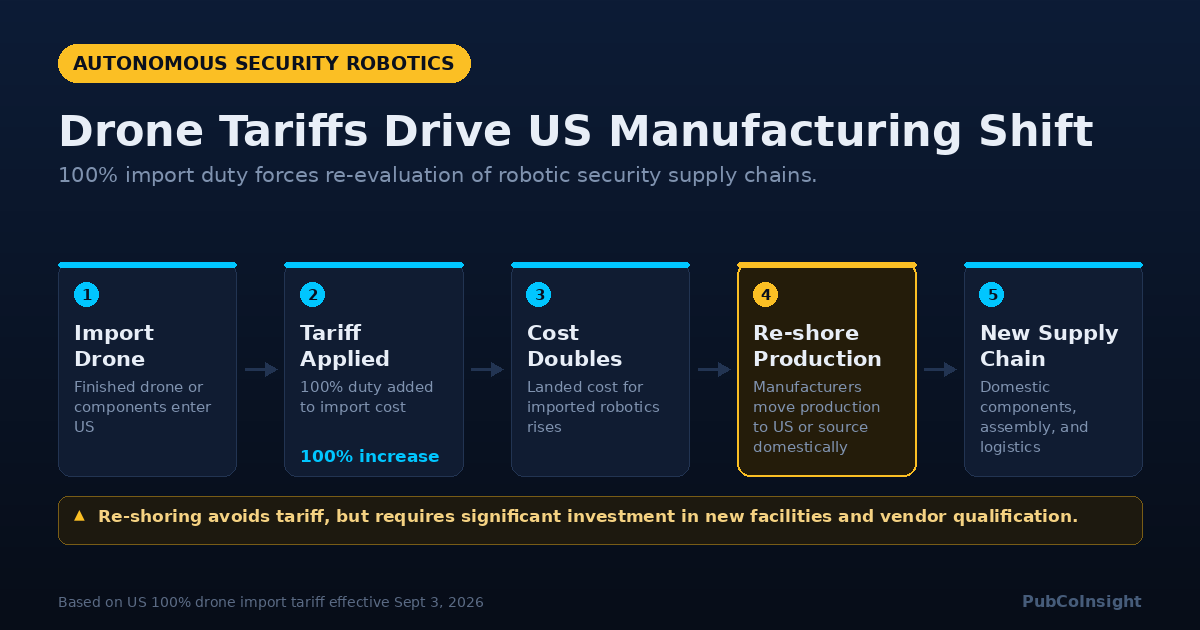
The Mechanism of Supply Chain Re-shoring
The 100% tariff applies to finished drone units and specific sub-assemblies. This means a company importing a complete autonomous security robot, if it falls under the designated tariff codes, now pays double the declared value in duties. The critical detail lies in the classification of components. Many autonomous security robots, particularly those designed for ground-based patrol or stationary monitoring, incorporate drone technology for aerial surveillance or rapid deployment. If these aerial components are imported, they are subject to the tariff. Manufacturers now face a stark choice: absorb the tariff, pass it to customers, or re-shore production. Re-shoring involves establishing manufacturing facilities within the US or sourcing components from US-based suppliers. This process is complex. It requires investment in new production lines, securing domestic raw materials, and qualifying new vendors. The advantage, however, is clear: exemption from the 100% tariff. The bottleneck often sits not in final assembly, but in the specialized components: flight controllers, high-performance motors, and advanced sensor arrays, which historically have had concentrated manufacturing bases outside the US. Proving this wrong would involve a rapid, widespread shift to domestic component manufacturing that bypasses the tariff's impact on finished goods.Companies Navigating the New Landscape
The tariff creates a distinct advantage for companies with existing US manufacturing capabilities or those quickly establishing them. Unusual Machines (UMAC), trading at $23.55, saw its stock price climb following the tariff's implementation. The company recently announced collaborations with Altana to improve its drone component manufacturing supply chain, a move that directly addresses the new tariff environment by focusing on supply chain intelligence. This suggests a strategic effort to identify and secure domestic or tariff-exempt component sources. Other players in the autonomous security robotics space are also affected. Ondas Inc. (ONDS), at $7.61, and Red Cat Holdings, Inc. (RCAT), at $8.32, both operate in the drone sector. Their strategies for adapting to the tariff will be crucial. Whether they pivot to US-based production, redesign products to use tariff-exempt components, or focus on software and service offerings that are less hardware-dependent remains to be seen. Serve Robotics Inc. (SERV), trading at $4.87, focuses on ground-based delivery robots, which may have a different tariff exposure depending on component classification, but still faces broader supply chain pressures. Companies like Arbe Robotics Ltd. (ARBE) at $0.63, Kopin Corporation (KOPN) at $4.29, and MicroVision, Inc. (MVIS) at $1.65, provide critical sensor and imaging technologies that are often integrated into autonomous platforms. While not direct drone manufacturers, their customers will demand tariff-compliant solutions. Lantronix, Inc. (LTRX) at $5.26, provides IoT solutions that enable connectivity for these robots, and will see demand shifts based on the hardware choices of its clients. BigBear.ai Holdings, Inc. (BBAI) at $2.95, focuses on AI-powered analytics, a software layer that becomes more valuable as hardware costs fluctuate, as it can optimize the deployment of existing or more expensive robotic assets.Artificial Intelligence Technology Solutions, Inc.
Artificial Intelligence Technology Solutions, Inc. (AITX), trading over the counter at $0.0043, operates through its subsidiaries, focusing on building and leasing autonomous security robots and remote monitoring systems. The company employs a recurring monthly subscription model for its offerings, rather than one-off hardware sales. This model means that the impact of tariffs on hardware costs could be spread over the life of a lease, but it also means AITX must manage those upfront costs carefully. AITX's recent filings show a consistent stream of 8-K reports, with filings on September 3, September 1, August 31, August 27, and August 26, 2026. These filings detail operational developments. For example, the August 31 8-K reported a 32-unit order intake across five solutions, and the August 27 8-K noted a 14-unit order intake across five customer relationships, described as the most diverse 24-hour order intake in company history. The company's RAD division plans to reach attendees at GSX 2026 from three points on the show floor, indicating a focus on market presence and customer acquisition. AITX's CEO, Steve Reinharz, recently addressed investor questions in an "Ask Me Anything" session, as reported on September 3, 2026. The public record does not yet establish the specific breakdown of AITX's component sourcing by country of origin, which will be a key factor in assessing its direct exposure to the new drone tariffs. The company's strategy, as outlined in filings and public statements, centers on expanding its deployed fleet and recurring revenue base.What to watch
Investors should monitor the Q3 2026 earnings reports from drone and robotics companies for specific disclosures on tariff impacts and supply chain adjustments. Watch for announcements regarding new domestic manufacturing partnerships or facility expansions, particularly from Unusual Machines (UMAC) and other drone hardware providers. Regulatory filings detailing changes in cost of goods sold or capital expenditures related to re-shoring efforts will be critical. Any waivers or exemptions granted for specific drone categories or components could also alter the landscape. Finally, observe customer acquisition trends and pricing adjustments in the guarding services market, as these will reflect how tariff costs are being absorbed or passed on., { "label": "Tariff Applied", "note": "100% duty added to import cost", "metric": "100% increase" }, { "label": "Cost Doubles", "note": "Landed cost for imported robotics rises" }, { "label": "Re-shore Production", "note": "Manufacturers move production to US or source domestically" }, { "label": "New Supply Chain", "note": "Domestic components, assembly, and logistics" } ], "highlight": 3, "highlight_note": "Re-shoring avoids tariff, but requires significant investment in new facilities and vendor qualification.", "footnote": "Based on US 100% drone import tariff effective Sept 3, 2026" }Companies mentioned
| Ticker | Company | Price |
|---|---|---|
| AITX client | Artificial Intelligence Technology Solutions Inc | $0.0043 |
| ARBE | Arbe Robotics Ltd. | $0.63 |
| BBAI | BigBear.ai Holdings, Inc. | $2.95 |
| KOPN | Kopin Corporation | $4.29 |
| LTRX | Lantronix, Inc. | $5.26 |
| MVIS | MicroVision, Inc. | $1.65 |
| ONDS | Ondas Inc. | $7.61 |
| RCAT | Red Cat Holdings, Inc. | $8.32 |
| SERV | Serve Robotics Inc. | $4.87 |
| UMAC | Unusual Machines, Inc. | $23.55 |
Listed alphabetically, not ranked. Prices as of 2026-09-04 and they move. Check a live quote before relying on any of this.
How we chose the companies in this article
We cover a fixed universe of companies working in autonomous security robotics, physical AI and the guarding services market they are aimed at. Every one of them that had usable market data on 2026-09-04 appears in this article. We do not pick which ones to mention based on what we think of them, and we do not order them by size, price or trading volume, because an ordered list is a verdict and that is not ours to hand down. Companies left out, and why: none. American Lithium Minerals and Artificial Intelligence Technology Solutions pay us, which is disclosed in full at the foot of every article they appear in.
See the dilution and promotion flags before you see the pitch.
Each week: the micro and small-caps now showing dilution or paid-promotion signals, with the SEC filing behind every flag. No recommendations, no price targets.
Sources used in this article
- Insider Alert: Axon President Sells $9.6 Million in Stock Motley Fool · 2026-09-04
- Opinion: TSMC Is a Better Buy Than Any of the "Magnificent Seven" Stocks Right Now Motley Fool · 2026-09-04
- Dow Jones Futures Await Jobs Report After Bullish Market Move; Tesla Cybercabs Hit The Road Investor's Business Daily · 2026-09-04
- Robinhood Now Runs 13 Revenue Lines Above $100 Million a Year. A 2-Month-Old Network Could Be Next. Motley Fool · 2026-09-04
- The ‘Deeply Nerdy’ Founders Behind Nvidia’s $13 Billion Bet on Hugging Face The Wall Street Journal · 2026-09-04
- If Democrats Win the Midterms and Take Back the White House, What Happens to Bitcoin? VanEck Says Bitcoin Investors Don't Need to Worry. Motley Fool · 2026-09-04
- Why Robinhood Stock Rocketed Higher Today Motley Fool · 2026-09-04
- Should You Invest in the Stock Market Right Now or Wait? History Offers a Clear Answer. Motley Fool · 2026-09-04
- NVIDIA (NVDA)’s Hugging Face Deal Tests the Next Phase of its AI Strategy Insider Monkey · 2026-09-04
- Wall Street sees nearly 40% upside for one AI chip giant TheStreet · 2026-09-04
- Nvidia Made a 57-Year-Old Oregon Couple Rich. Now One Stock Is the Biggest Risk to Their Retirement 24/7 Wall St. · 2026-09-04
- Argus Adjusts Price Target on Axon Enterprise to $600 From $460, Keeps Buy Rating MT Newswires · 2026-09-03
Disclosure required by Section 17(b) of the Securities Act of 1933
Artificial Intelligence Technology Solutions, Inc., a Nevada corporation (OTCID: AITX). Artificial Intelligence Technology Solutions, Inc. pays Strategic Innovations First, Inc., a Wyoming corporation doing business as PulseIR. Compensation received: USD 5,000.00 per month for months 1-3 (August, September, October 2026); USD 10,000.00 per month for months 4-6 (November, December 2026, January 2027) contingent on the 90-day review. Minimum committed USD 15,000.00; USD 45,000.00 if the second-period rate triggers.. Form of payment: cash only, invoiced monthly in advance; no stock, options or warrants received or payable. Services: investor relations services under an Investor Relations Services Agreement effective 2026-08-01. Period: six month term, 2026-08-01 through 2027-01-31; 90-day review on or about 2026-10-30. No stock, options or warrants held by PubCo Insight, Pulse IR, Strategic Innovations First, Inc., or Brad Listermann. Confirmed by the executed agreement and by board record recKwdq39X2caPSX7 (POSITIONS HELD: none).
This is information, not investment, financial, legal or tax advice. It is not a recommendation or solicitation to buy, sell or hold any security and it contains no price target. Nothing here is independently verified by us. Confirm every figure against primary filings on SEC EDGAR before you act. Micro-cap and over-the-counter securities are speculative and illiquid and can lose all of their value. The companies named without a disclosure above pay us nothing and have no relationship with us; they are named because a published, mechanical screen selected them. Full disclosure policy.