Uber's Serve Robotics Exit: A Shift in Big Tech's Autonomous Security Strategy
Uber's recent divestment from Serve Robotics signals a re-evaluation of direct tech giant involvement in physical AI, pushing the sector toward specialized operators and refined service models.
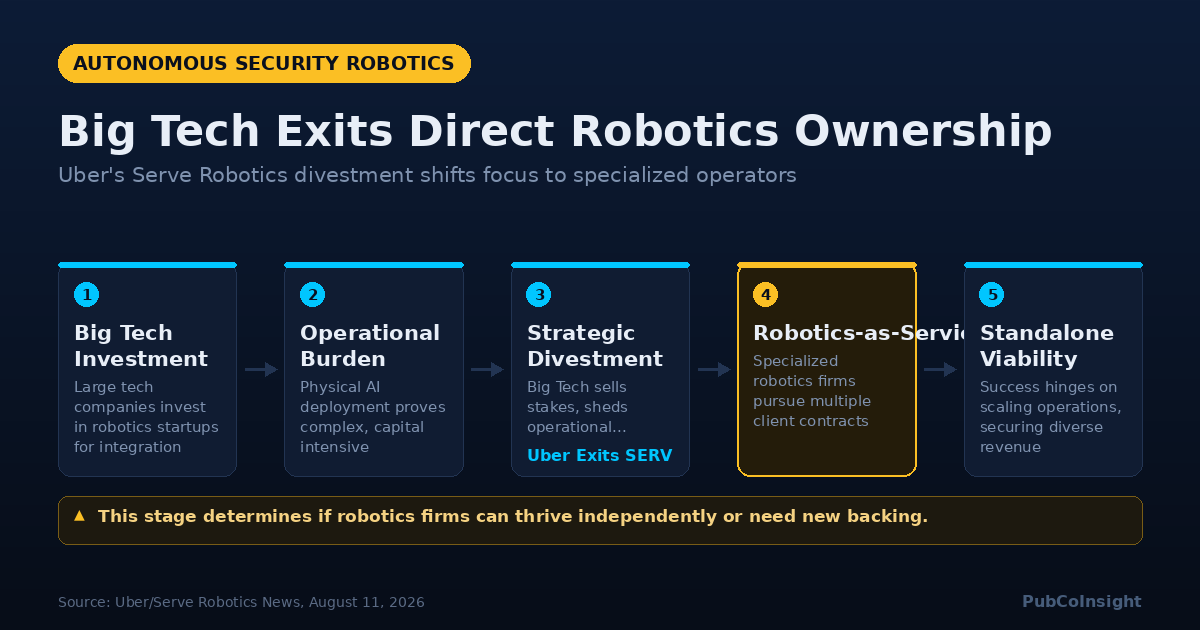
The Mechanism of Disintermediation
The core mechanism at play here is disintermediation, specifically the removal of a large, vertically integrated player from the direct ownership chain of a specialized robotics firm. Initially, companies like Uber invested in robotics startups, providing capital and a potential captive market. This model implied a future where the robotics technology would be absorbed or exclusively utilized by the larger parent. The assumption was that operational synergies and proprietary data would justify direct ownership. However, operating physical AI, especially autonomous robots in public or semi-public spaces, involves complex challenges. These include navigating diverse regulatory environments, managing hardware maintenance and deployment logistics across varied terrains, and handling liability. A tech giant whose primary business is software platforms or ride-hailing may find these operational complexities dilute their core focus and capital efficiency. By divesting, Uber sheds the operational burden and the capital expenditure associated with scaling a physical robotics fleet. For the robotics companies, this means a wider field for partnerships. Instead of being tied to one large backer, they can now offer their "robotics-as-a-service" to multiple clients, including former parent companies, without ownership constraints. This broadens their addressable market and diversifies their revenue streams. The challenge, then, shifts to proving the economic viability of their service model on a standalone basis, demonstrating clear cost savings or efficiency gains for a diverse client base. The success or failure of this disintermediation hinges on the robotics company's ability to scale its operational footprint and secure multiple, non-exclusive service contracts. If a robot company can demonstrate consistent, profitable deployment across various clients, the disintermediation is a net positive. If it struggles to find new clients or scale operations without the initial big tech backing, it signals a deeper issue with the underlying service model.Companies Operating in Autonomous Security and Physical AI
The shift impacts a range of companies developing and deploying autonomous security robotics and physical AI. Some focus on the hardware, others on the AI, and many on a combination delivered as a service. Arbe Robotics Ltd. (ARBE), for example, is pushing its 4D imaging radar technology beyond automotive into defense, drones, and robotaxis. Their focus on advanced sensor perception is critical for any autonomous system, whether it’s a security robot or a delivery drone. The quality of real-time environmental data directly impacts robot safety and operational efficiency. Kopin Corporation (KOPN), while not directly a robotics operator, develops microLED displays and optical interconnects, including a recent MicroLED development award. Their Fabric.AI neural I/O microLED optical interconnect, slated for a CES 2027 demonstration, is foundational for advanced human-machine interfaces and high-bandwidth data transfer within complex AI systems, which could enhance the operational capabilities of future robots. In the drone space, Ondas Inc. (ONDS) recently secured a "Digital Bat" Israel drone tender for military tactical attack drones and an NFL counter-drone deal to protect EverBank Stadium. Ondas's vertical integration of drone hardware, software, and mission-specific AI positions them as a full-stack provider, a model that could be attractive to clients seeking complete solutions without managing multiple vendors. The broader AI software plays, such as BigBear.ai Holdings, Inc. (BBAI), provide analytics and decision intelligence. While not directly building robots, their platforms can process the vast amounts of data generated by autonomous security systems, turning raw sensor input into actionable intelligence for human operators. Companies like Lantronix, Inc. (LTRX) and MicroVision, Inc. (MVIS) provide critical components and technologies that enable autonomous operations. Lantronix focuses on intelligent edge computing and secure connectivity, essential for robots operating in distributed environments. MicroVision develops lidar technology, a key sensor for autonomous navigation and object detection in complex security scenarios. Unusual Machines, Inc. (UMAC), a newer entrant, focuses on specialized autonomous machines. Their recent Q2 earnings call highlighted capacity expansion ahead of Q3 growth, indicating a focus on scaling their manufacturing and deployment capabilities. This emphasis on physical production and rollout is a direct response to the need for robust, deployable units. Finally, Red Cat Holdings, Inc. (RCAT) operates in the drone sector, providing hardware and software for defense and commercial applications. Their focus on modular, adaptable drone systems for various mission profiles, including reconnaissance and security, positions them in a market segment that often intersects with ground-based autonomous security.Artificial Intelligence Technology Solutions, Inc.
Artificial Intelligence Technology Solutions, Inc. (AITX) trades on the OTC Markets under the symbol AITX. The company, through its subsidiaries, focuses on building and leasing autonomous security robots and remote monitoring systems. Their business model emphasizes a recurring monthly subscription, moving away from one-off hardware sales. This "Solutions-as-a-Service" approach is central to their strategy in the security and guarding services industry, which they estimate as a $50 billion market in the United States. AITX describes its operations across three main pillars: stationary security devices (RAD-I), mobile autonomous platforms (RAD-M), and the SARA agentic artificial intelligence platform (RAD-G). The RAD-I subsidiary markets AI-driven solutions to the security sector, aiming to deliver cost savings of 35% to 80% compared to traditional manned security. These solutions integrate stationary and mobile devices with the company's proprietary software and monitoring platforms. The RAD-M segment focuses on mobile autonomous platforms, including the ROAMEO mobile security unit, which began early commercial deployment in May 2026. The company states that RAD-M is expected to surpass RAD-I's monthly recurring revenue contribution at some future point. RAD-G is intended to generate revenue through SARA platform licensing. AITX also operates RAD Lanka, a wholly-owned subsidiary in Sri Lanka, which supports software development, AI initiatives, and technical operations across the company's various units. The long-term vision, internally referred to as "RAD Town," involves integrated autonomous security deployments across campuses, communities, or jurisdictions. For the fiscal year ended February 28, 2026, AITX reported revenue of $7,745,336, a 26% increase year-over-year. Gross profit rose 48% to $5,533,700, with gross margin expanding to approximately 71%. Operating expenses remained relatively flat at $17,477,097, leading to an improved loss from operations of $(11,943,397). The company reported a net loss of approximately $14.5 million for the fiscal year and an accumulated deficit of approximately $171 million as of that date. The public record does not yet establish a clear path to sustained positive cash flow from operations for the company. Management does not anticipate having positive cash flow from operations in the near term. The company had negative cash flow from operating activities of $9,344,534 for the fiscal year ended February 28, 2026, and negative working capital of $17,017,745.What to watch
The market will be watching for several key developments following Uber's Serve Robotics exit. First, look for new partnership announcements from Serve Robotics (SERV) and other last-mile delivery robot companies. The ability to secure multiple, significant commercial contracts with other logistics providers will demonstrate their standalone viability. For Ondas (ONDS), the Israel drone tender for military tactical attack drones and the NFL counter-drone deal for EverBank Stadium are specific projects to track. Progress reports on these deployments, including operational metrics and expansion plans, will be important. Kopin (KOPN) has a specific timeline with its Fabric.AI neural I/O MicroLED optical interconnect demonstration at CES 2027. This event will be a direct test of their technology's readiness and potential market impact. Artificial Intelligence Technology Solutions (AITX) has stated that its RAD-M mobile autonomous platforms, including the ROAMEO unit, began early commercial deployment in May 2026. Updates on the scale and revenue contribution from these deployments, particularly whether RAD-M begins to approach RAD-I's monthly recurring revenue, will be a direct measure of progress. The company's filings will continue to provide details on revenue, subscription counts, and cash position, which are critical for assessing its operational trajectory. The broader trend of big tech divestment from robotics could also lead to increased M&A activity among specialized robotics firms, as smaller players consolidate or seek new strategic partners. Any new financing structures, beyond traditional equity, emerging for capital-intensive robotics deployments will also be worth noting., { "label": "Operational Burden", "note": "Physical AI deployment proves complex, capital intensive" }, { "label": "Strategic Divestment", "note": "Big Tech sells stakes, sheds operational overhead", "metric": "Uber Exits SERV" }, { "label": "Robotics-as-Service", "note": "Specialized robotics firms pursue multiple client contracts" }, { "label": "Standalone Viability", "note": "Success hinges on scaling operations, securing diverse revenue" } ], "highlight": 3, "highlight_note": "This stage determines if robotics firms can thrive independently or need new backing.", "footnote": "Source: Uber/Serve Robotics News, August 11, 2026" }Companies mentioned
| Ticker | Company | Price |
|---|---|---|
| AITX client | Artificial Intelligence Technology Solutions Inc | $0.0065 |
| ARBE | Arbe Robotics Ltd. | $0.7564 |
| BBAI | BigBear.ai Holdings, Inc. | $3.33 |
| KOPN | Kopin Corporation | $5.2 |
| LTRX | Lantronix, Inc. | $5.91 |
| MVIS | MicroVision, Inc. | $3.64 |
| ONDS | Ondas Inc. | $9.74 |
| RCAT | Red Cat Holdings, Inc. | $10.66 |
| SERV | Serve Robotics Inc. | $4.9 |
| UMAC | Unusual Machines, Inc. | $25.97 |
Listed alphabetically, not ranked. Prices as of 2026-08-12 and they move. Check a live quote before relying on any of this.
How we chose the companies in this article
We cover a fixed universe of companies working in autonomous security robotics, physical AI and the guarding services market they are aimed at. Every one of them that had usable market data on 2026-08-12 appears in this article. We do not pick which ones to mention based on what we think of them, and we do not order them by size, price or trading volume, because an ordered list is a verdict and that is not ours to hand down. Companies left out, and why: none. American Lithium Minerals and Artificial Intelligence Technology Solutions pay us, which is disclosed in full at the foot of every article they appear in.
See the dilution and promotion flags before you see the pitch.
Each week: the micro and small-caps now showing dilution or paid-promotion signals, with the SEC filing behind every flag. No recommendations, no price targets.
Sources used in this article
- BofA sends strong message on Nvidia's weak spot TheStreet · 2026-08-12
- Nvidia's $500 Billion Financing Plan Is 20 Times What the Telecom Bubble Ran On Motley Fool · 2026-08-12
- Dow Jones Futures: 3 Nvidia Partners Lead Earnings Movers; CPI Inflation Data Due Investor's Business Daily · 2026-08-12
- Boomers Are Getting Rich and Retiring Early. 1 No-Brainer Stock To Buy Now Motley Fool · 2026-08-12
- Want to Read the Market Like Cramer? Ask These 3 Questions BeInCrypto · 2026-08-12
- CoreWeave Stock Surges Nearly 16% After Earnings, Analyst Says Old Nvidia GPUs Can 'Still Generate Revenue Nearly a Decade Later' Benzinga · 2026-08-12
- Why Plug Power Stock Popped Today Motley Fool · 2026-08-12
- Cathie Wood Has Been Selling Palantir Into Every Rally Since Its 29% Earnings Pop Motley Fool · 2026-08-12
- Why Wall Street and Nvidia Are Building an Exotic Money Pipeline for the AI Boom The Wall Street Journal · 2026-08-12
- Mark Zuckerberg Published His Superintelligence Manifesto Monday Morning. Meta Still Trades at 18 Times Forward Earnings. Motley Fool · 2026-08-12
- Axon Jumps After Earnings Beat and Analyst Target Hikes: Here’s The Next Catalyst Investors Are Waiting On 24/7 Wall St. · 2026-08-11
- Northcoast Research Adjusts PT on Axon Enterprise to $680 From $650, Keeps Buy Rating MT Newswires · 2026-08-11
Disclosure required by Section 17(b) of the Securities Act of 1933
Artificial Intelligence Technology Solutions, Inc., a Nevada corporation (OTCID: AITX). Artificial Intelligence Technology Solutions, Inc. pays Strategic Innovations First, Inc., a Wyoming corporation doing business as PulseIR. Compensation received: USD 5,000.00 per month for months 1-3 (August, September, October 2026); USD 10,000.00 per month for months 4-6 (November, December 2026, January 2027) contingent on the 90-day review. Minimum committed USD 15,000.00; USD 45,000.00 if the second-period rate triggers.. Form of payment: cash only, invoiced monthly in advance; no stock, options or warrants received or payable. Services: investor relations services under an Investor Relations Services Agreement effective 2026-08-01. Period: six month term, 2026-08-01 through 2027-01-31; 90-day review on or about 2026-10-30. No stock, options or warrants held by PubCo Insight, Pulse IR, Strategic Innovations First, Inc., or Brad Listermann. Confirmed by the executed agreement and by board record recKwdq39X2caPSX7 (POSITIONS HELD: none).
This is information, not investment, financial, legal or tax advice. It is not a recommendation or solicitation to buy, sell or hold any security and it contains no price target. Nothing here is independently verified by us. Confirm every figure against primary filings on SEC EDGAR before you act. Micro-cap and over-the-counter securities are speculative and illiquid and can lose all of their value. The companies named without a disclosure above pay us nothing and have no relationship with us; they are named because a published, mechanical screen selected them. Full disclosure policy.