Unusual Machines Ups XTEND AI Robotics Stake to $27.5 Million, Signaling Focus on Autonomous Drones
Unusual Machines’ latest investment in XTEND AI Robotics, totaling $27.5 million, highlights a growing industry focus on drone-based autonomous security solutions and the underlying AI that powers them.
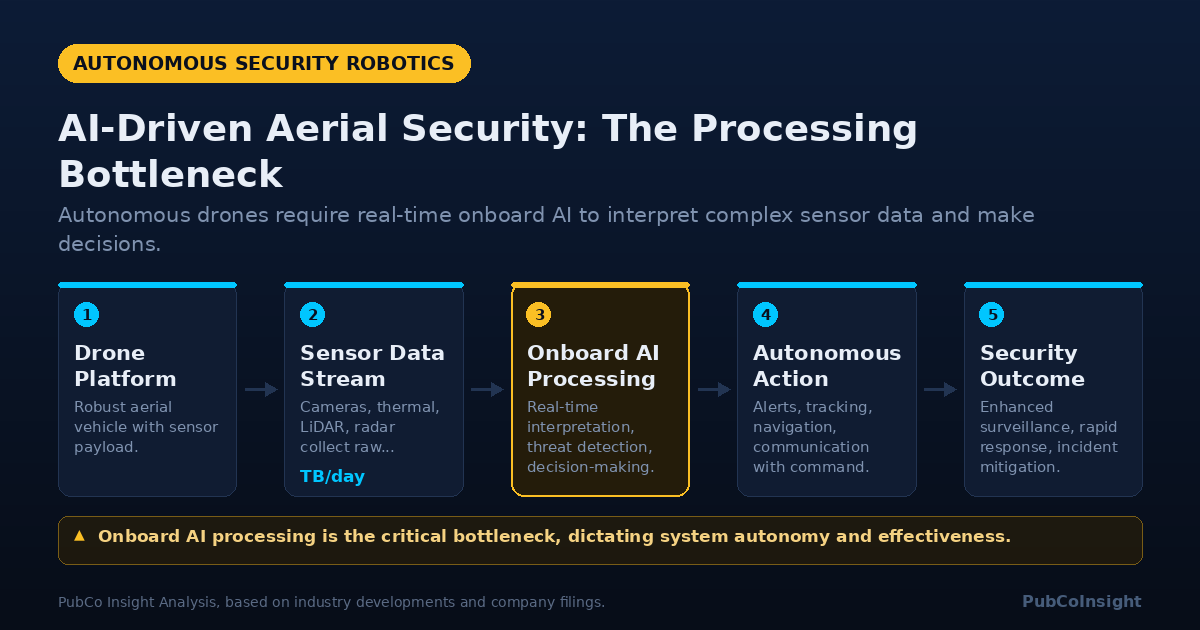
The Mechanism of Autonomous Aerial Security
Autonomous aerial security relies on a tightly integrated stack of hardware and software, where each component’s performance dictates the system’s overall effectiveness. At the base, robust drone platforms provide flight stability and payload capacity. These platforms carry an array of sensors: high-resolution cameras for visual data, thermal cameras for night operations, and LiDAR or radar for precise mapping and obstacle avoidance. The raw data streams from these sensors are immense. The critical bottleneck, and where the value truly sits, is the onboard AI processing unit. This unit must ingest, filter, and interpret sensor data in real-time, often under strict power and weight constraints. It performs tasks like identifying anomalies, tracking intruders, and distinguishing between legitimate personnel and threats. This requires specialized neural networks trained on vast datasets of security incidents and environmental conditions. The AI then makes decisions: initiating an alert, following a target, or returning to base. These decisions are not pre-programmed scripts; they are dynamic responses based on learned patterns and current sensor input. The system must also manage communication with a central command, securely transmitting critical data while maintaining resilience against jamming or spoofing. A failure in any part of this chain, from sensor degradation to AI misinterpretation, compromises the entire security posture.Companies Operating in Autonomous Security Robotics
The sector is diverse, with companies tackling different facets of autonomous security, from ground-based units to advanced aerial platforms and the underlying AI. Unusual Machines, Inc. (UMAC, $22.95) has made a significant commitment to aerial robotics with its investment in XTEND AI Robotics. This move suggests UMAC is positioning itself to leverage drone technology for broader security applications. The company's focus appears to be on integrating these advanced aerial systems into comprehensive solutions, potentially targeting large-scale industrial or governmental clients where wide-area surveillance and rapid response are critical. Ondas Inc. (ONDS, $7.23) is a key player in the drone space, particularly with its American Robotics subsidiary. American Robotics specializes in fully autonomous drone systems for industrial inspection and security, operating under FAA waivers for beyond visual line of sight (BVLOS) operations without human operators on site. This capability is crucial for scaling autonomous aerial security deployments. Ondas has also been active in the counter-UAS market, indicating a dual focus on both deploying and defending against drone technology. Red Cat Holdings, Inc. (RCAT, $7.96) focuses on drone solutions for defense and public safety. Their Teal Drones subsidiary produces small, high-performance drones designed for reconnaissance and surveillance. Red Cat's emphasis on robust, secure platforms capable of operating in challenging environments aligns with the needs of advanced autonomous security systems, particularly those requiring rapid deployment and data integrity. Serve Robotics Inc. (SERV, $4.48) operates in the last-mile delivery sector, utilizing autonomous sidewalk robots. While distinct from security, Serve's operational experience with autonomous ground vehicles in urban environments, including navigation, obstacle avoidance, and public interaction, provides valuable insights into the challenges and solutions for physical AI deployment. Arbe Robotics Ltd. (ARBE, $0.784) develops high-resolution 4D imaging radar solutions. While primarily aimed at the automotive sector for autonomous driving, this technology is highly relevant for autonomous security robotics. High-resolution radar can provide precise object detection and tracking in adverse weather conditions, complementing visual sensors and enhancing the situational awareness of both ground and aerial autonomous platforms. Kopin Corporation (KOPN, $4.56) specializes in microdisplays and optical systems. These components are essential for the advanced visual interfaces used by human operators monitoring autonomous systems, or for augmented reality applications that overlay data onto real-world views. Their OLED microdisplays, for example, are used in thermal weapon sight programs, demonstrating their capability in high-performance imaging for critical applications. Lantronix, Inc. (LTRX, $5.24) provides secure data access and management solutions for the Internet of Things (IoT). For autonomous security robots, secure connectivity is paramount. Lantronix's offerings enable reliable and protected communication between robots, cloud platforms, and control centers, which is vital for data transmission, remote monitoring, and software updates. MicroVision, Inc. (MVIS, $1.64) develops LiDAR technology for automotive safety and autonomous driving. Like Arbe, MicroVision's expertise in precise distance measurement and 3D mapping is directly transferable to autonomous security applications. LiDAR provides accurate environmental data, crucial for navigation, obstacle avoidance, and creating detailed maps for robot operation. BigBear.ai Holdings, Inc. (BBAI, $2.87) offers AI-powered analytics and decision intelligence solutions, primarily for government and defense clients. Their platforms process vast amounts of data to provide actionable insights. In the context of autonomous security, BigBear.ai's capabilities could be used to analyze data streams from multiple robots, identify patterns, predict threats, and optimize deployment strategies across a large-scale security operation.Artificial Intelligence Technology Solutions, Inc.
Artificial Intelligence Technology Solutions, Inc. (AITX, $0.0036) operates through subsidiaries like Robotic Assistance Devices, Inc. (RAD-I), Robotic Assistance Devices Mobile (RAD-M), and Robotic Assistance Devices Group (RAD-G). The company focuses on developing and leasing AI-driven security robots and remote monitoring systems. AITX employs a "Solutions-as-a-Service" model, offering its devices on a recurring monthly subscription basis to the security and guarding services industry. RAD-I, the primary subsidiary, markets stationary security devices. The company states its solutions are designed to deliver cost savings of 35% to 80% compared to traditional manned security. RAD-M develops mobile autonomous platforms, including the ROAMEO mobile security unit, which began early commercial deployment in May 2026. RAD-G focuses on the SARA agentic artificial intelligence platform, which AITX intends to license for substantial revenue. AITX also operates RAD Lanka in Sri Lanka, a wholly owned subsidiary supporting software development and AI initiatives. The company's stated long-term strategy is "RAD Town," an integrated autonomous-security deployment across a campus or community. For the fiscal year ended February 28, 2026, AITX reported revenue of $7,745,336, a 26% increase year-over-year. Gross profit rose 48% to $5,533,700, with gross margin expanding to approximately 71%. Operating expenses remained flat at around $17,477,097, leading to an improved loss from operations of approximately $(11,943,397). The company reported a net loss of approximately $14.5 million for the fiscal year and an accumulated deficit of approximately $171 million as of that date. The public record does not yet establish a clear path to sustained positive cash flow from operations. AITX’s filings indicate negative cash flow from operating activities of $9,344,534 for the year ended February 28, 2026, and negative working capital of $17,017,745 as of the same date. The company's independent registered public accounting firm has included an explanatory paragraph in its report expressing substantial doubt about AITX's ability to continue as a going concern.What to watch
Investors should monitor several specific developments. Unusual Machines' integration strategy for XTEND AI Robotics will be key. Details on how XTEND's aerial platforms will be deployed, what specific use cases UMAC targets, and the timelines for commercial availability will provide clarity. Watch for any new FAA waivers or regulatory approvals for BVLOS operations, which are critical for scaling autonomous drone security services. Ondas Inc. has raised its 2026 revenue view; tracking whether they deliver on the required second-half ramp will be important. For Artificial Intelligence Technology Solutions, Inc., watch for updates on ROAMEO deployments and subscription growth figures in upcoming filings, particularly how these contribute to their stated goal of achieving positive monthly cash flow. Specific customer announcements for AITX’s RAD-I, ROSA, and SARA platforms, as mentioned in their September 9, 2026, news, will provide concrete evidence of market penetration. Finally, the broader availability and cost reduction of high-performance AI chips, like those from Nvidia, will impact the entire sector's ability to deploy more sophisticated and affordable autonomous systems., { "label": "Sensor Data Stream", "note": "Cameras, thermal, LiDAR, radar collect raw environmental data.", "metric": "TB/day" }, { "label": "Onboard AI Processing", "note": "Real-time interpretation, threat detection, decision-making." }, { "label": "Autonomous Action", "note": "Alerts, tracking, navigation, communication with command." }, { "label": "Security Outcome", "note": "Enhanced surveillance, rapid response, incident mitigation." } ], "highlight": 2, "highlight_note": "Onboard AI processing is the critical bottleneck, dictating system autonomy and effectiveness.", "footnote": "PubCo Insight Analysis, based on industry developments and company filings." }Companies mentioned
| Ticker | Company | Price |
|---|---|---|
| AITX client | Artificial Intelligence Technology Solutions Inc | $0.0036 |
| ARBE | Arbe Robotics Ltd. | $0.784 |
| BBAI | BigBear.ai Holdings, Inc. | $2.87 |
| KOPN | Kopin Corporation | $4.56 |
| LTRX | Lantronix, Inc. | $5.24 |
| MVIS | MicroVision, Inc. | $1.64 |
| ONDS | Ondas Inc. | $7.23 |
| RCAT | Red Cat Holdings, Inc. | $7.96 |
| SERV | Serve Robotics Inc. | $4.48 |
| UMAC | Unusual Machines, Inc. | $22.95 |
Listed alphabetically, not ranked. Prices as of 2026-09-13 and they move. Check a live quote before relying on any of this.
How we chose the companies in this article
We cover a fixed universe of companies working in autonomous security robotics, physical AI and the guarding services market they are aimed at. Every one of them that had usable market data on 2026-09-13 appears in this article. We do not pick which ones to mention based on what we think of them, and we do not order them by size, price or trading volume, because an ordered list is a verdict and that is not ours to hand down. Companies left out, and why: none. American Lithium Minerals and Artificial Intelligence Technology Solutions pay us, which is disclosed in full at the foot of every article they appear in.
See the dilution and promotion flags before you see the pitch.
Each week: the micro and small-caps now showing dilution or paid-promotion signals, with the SEC filing behind every flag. No recommendations, no price targets.
Sources used in this article
- Oracle's AI Chips Ran 97.9% Utilized Last Quarter. For Nvidia, That Is What a Shortage Looks Like. Motley Fool · 2026-09-13
- Realty Income Has a New Revenue Stream, and It's Growing Fast Motley Fool · 2026-09-13
- Futures Traders Just Dramatically Repriced the Chances of a Fed Hike Next Week Motley Fool · 2026-09-13
- 3 Reasons SpaceX Stock Could Crash in Q4 -- and 1 Reason It Won't Motley Fool · 2026-09-13
- Joby Aviation Could Deliver 10x Returns for Patient Investors Motley Fool · 2026-09-13
- Dell Booked More AI Server Orders in 3 Months Than It Recorded in Total Revenue Motley Fool · 2026-09-13
- Is Nu Holdings Stock a Buy, Sell, or Hold With Shares 20% Below Their 52-Week High? Motley Fool · 2026-09-13
- Hyundai Motor Group Accelerates Autonomous Driving Innovation with AI-Powered Data Flywheel CNW Group · 2026-09-13
- $10,000 in Tesla When It Joined the S&P 500 Would Be About $15,700 Today. An Index Fund Would Have Done Better. Motley Fool · 2026-09-12
- Not Nvidia. Not Micron. This Dirt Cheap “Magnificent Seven” Stock Could Be the Biggest Winner of the Trillion-Dollar AI Race – Here’s the Case. Motley Fool · 2026-09-12
- Can SERV's Revenue Diversification Offset Weaker Uber Deliveries? Zacks · 2026-09-11
- Will Counter-UAS Demand Sustain Ondas' Momentum Into 2027? Zacks · 2026-09-11
Disclosure required by Section 17(b) of the Securities Act of 1933
Artificial Intelligence Technology Solutions, Inc., a Nevada corporation (OTCID: AITX). Artificial Intelligence Technology Solutions, Inc. pays Strategic Innovations First, Inc., a Wyoming corporation doing business as PulseIR. Compensation received: USD 5,000.00 per month for months 1-3 (August, September, October 2026); USD 10,000.00 per month for months 4-6 (November, December 2026, January 2027) contingent on the 90-day review. Minimum committed USD 15,000.00; USD 45,000.00 if the second-period rate triggers.. Form of payment: cash only, invoiced monthly in advance; no stock, options or warrants received or payable. Services: investor relations services under an Investor Relations Services Agreement effective 2026-08-01. Period: six month term, 2026-08-01 through 2027-01-31; 90-day review on or about 2026-10-30. No stock, options or warrants held by PubCo Insight, Pulse IR, Strategic Innovations First, Inc., or Brad Listermann. Confirmed by the executed agreement and by board record recKwdq39X2caPSX7 (POSITIONS HELD: none).
This is information, not investment, financial, legal or tax advice. It is not a recommendation or solicitation to buy, sell or hold any security and it contains no price target. Nothing here is independently verified by us. Confirm every figure against primary filings on SEC EDGAR before you act. Micro-cap and over-the-counter securities are speculative and illiquid and can lose all of their value. The companies named without a disclosure above pay us nothing and have no relationship with us; they are named because a published, mechanical screen selected them. Full disclosure policy.