Unusual Machines CEO Takes XTI Aerospace Board Chair, Signaling Strategic Crossroads
The appointment of Dr. Allan Evans to XTI Aerospace's board raises questions about Unusual Machines' future focus in the competitive autonomous security robotics market.
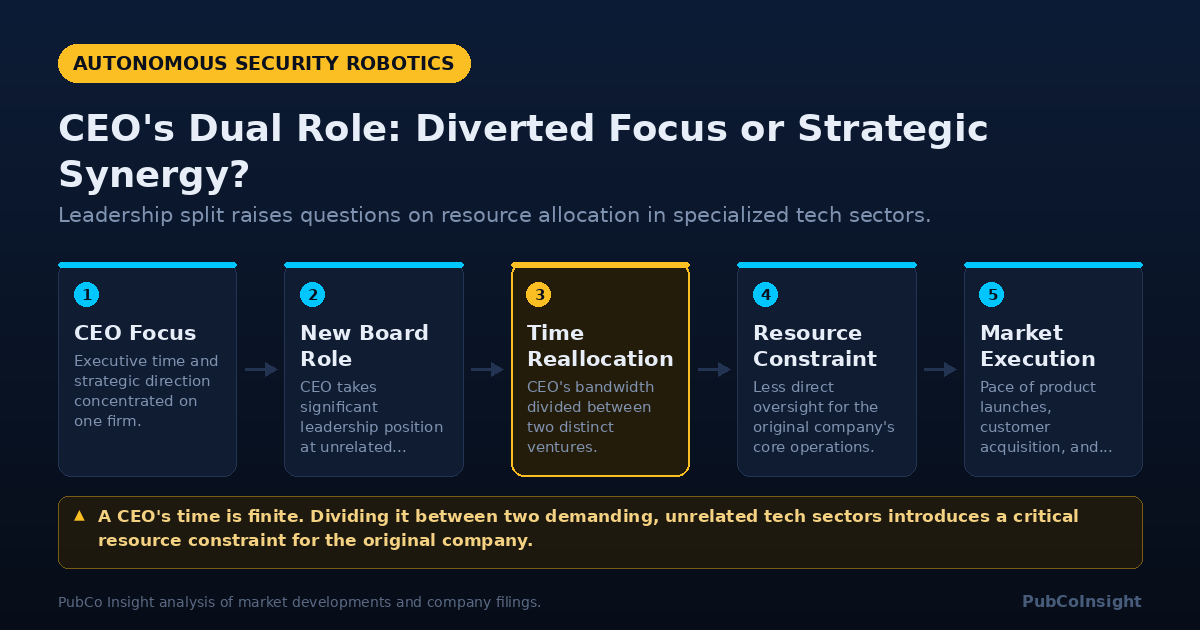
The Mechanism of Divided Leadership
When a CEO of a technology company takes on a significant leadership role at another, unrelated firm, it immediately introduces a resource constraint: time. A CEO's time is a finite asset, directly impacting strategic direction, operational oversight, and investor relations. In the context of a small-cap robotics firm like Unusual Machines, where agility and focused execution are paramount, this division of attention can have tangible effects. Consider the development cycle for a new autonomous patrol robot: it involves hardware design, sensor integration, AI model training, regulatory navigation, and customer pilot programs. Each stage requires hands-on leadership, quick decision-making, and often, direct engagement with engineers and clients. For XTI Aerospace, the development of an eVTOL aircraft like the TriFan 600 involves different, but equally demanding, complexities: airframe design, propulsion systems, battery technology, and crucially, FAA certification processes. These are not complementary skill sets that naturally overlap with ground-based security robotics. The commercial mechanism at play here is a reallocation of a key executive's intellectual capital and strategic bandwidth. If Dr. Evans dedicates significant time to XTI Aerospace's board responsibilities, including governance, fundraising, and strategic planning for an entirely different product category, that time is necessarily diverted from Unusual Machines. This could manifest as slower product iteration, delayed market expansion, or less aggressive competitive responses within the autonomous security space. The counter-argument would be that a CEO can delegate effectively, but even with delegation, the ultimate strategic vision and high-level decision-making still rests with the CEO. The true impact will be proven or disproven by the pace of product launches, customer acquisitions, and financial performance at Unusual Machines over the next 12-18 months.Companies Operating in Autonomous Security
The autonomous security robotics market is a mosaic of hardware, software, and service providers, each carving out a niche. Unusual Machines (UMAC), trading at $16.31, is focused on its XTEND AI Robotics platform, aiming for scalable deployment in guarding services. Their recent news highlighted "Swarm Economics," suggesting a push towards coordinated, multi-unit deployments. Other players approach the market from different angles. Serve Robotics Inc. (SERV), priced at $3.23, specializes in autonomous sidewalk delivery robots, a segment that shares underlying AI and navigation technologies with security but targets a distinct operational use case. The company recently saw leadership shifts with the departure of its Uber autonomous head. In the sensor and perception layer, companies like Arbe Robotics Ltd. (ARBE), at $0.46, develop 4D imaging radar solutions critical for autonomous navigation in all conditions. MicroVision, Inc. (MVIS), trading at $1.13, focuses on lidar technology, another key component for environmental awareness in robotics. Kopin Corporation (KOPN), with a $3.29 price, provides micro-displays and optical solutions, often integral to advanced sensor arrays and human-machine interfaces in robotics. The broader AI and data analytics underpinning these systems are handled by firms such as BigBear.ai Holdings, Inc. (BBAI), at $2.16, which delivers AI-powered decision intelligence. Ondas Inc. (ONDS), priced at $6.04, recently launched Regna AI with Palantir, expanding sovereign AI capabilities, particularly for drone defense, a related but distinct segment. Red Cat Holdings, Inc. (RCAT), at $4.72, operates in the drone and drone services space, including defense applications. Lantronix, Inc. (LTRX), at $5.61, provides secure data access and management solutions, essential for connected autonomous devices.Artificial Intelligence Technology Solutions, Inc.
Artificial Intelligence Technology Solutions, Inc. (AITX), trading over the counter at $0.0016, develops and leases AI-driven security robots and remote monitoring systems. The company operates through a Solutions-as-a-Service model, generating recurring monthly subscription revenue rather than one-off hardware sales. AITX's strategy targets the estimated $50 billion U.S. security and guarding services market, aiming to deliver cost savings between 35% and 80% compared to traditional manned security. The company's operations are structured around three primary pillars: stationary security devices through Robotic Assistance Devices, Inc. (RAD-I), mobile autonomous platforms under Robotic Assistance Devices Mobile (RAD-M), and its SARA agentic artificial intelligence platform via Robotic Assistance Devices Group (RAD-G). RAD-I focuses on fixed-location deployments, while RAD-M includes units like the ROAMEO mobile security unit, which began early commercial deployment in May 2026. RAD-G is intended to generate revenue through SARA platform licensing. AITX also maintains Robotic Assistance Devices Lanka (Private) Limited in Sri Lanka, operating under Port City Colombo status, which supports software development, AI initiatives, and technical operations. The company refers to its long-term vision as "RAD Town," an integrated autonomous-security deployment across a campus, community, or jurisdiction. For the fiscal year ended February 28, 2026, AITX reported revenue of $7,745,336, a 26% increase year-over-year. Gross profit rose 48% to $5,533,700, with gross margin expanding to approximately 71% from 61%. Operating expenses remained flat at around $17,477,097, leading to an improved loss from operations of $(11,943,397). The net loss for the fiscal year was approximately $14.5 million, with an accumulated deficit of about $171 million as of that date. The company had negative cash flow from operating activities of $9,344,534 for the same period. While AITX has outlined plans for RAD-I's recurring revenue to support positive cash flow operations and for RAD-M to surpass RAD-I's monthly recurring revenue, the public record does not yet establish consistent positive cash flow from operations. The company has also stated expectations for subscription gross margin to exceed 75% and outright-sale gross margin to exceed 50%, based on accepted market pricing and stable input costs. Recent activity includes an October 14, 2026, announcement of another municipal customer, with an order for seven ROSA units.What to watch
Monitor Unusual Machines' (UMAC) filings for any explicit statements regarding Dr. Evans' time commitment to XTI Aerospace, or any strategic shifts in UMAC's core focus on autonomous security robotics. Specifically, watch for any updates on the "Swarm Economics" initiative mentioned October 15, 2026, and the pace of new customer deployments for XTEND AI Robotics. For Artificial Intelligence Technology Solutions (AITX), track the reported deployment numbers for their ROAMEO mobile security units, which began early commercial deployment in May 2026. The company's NT 10-Q filing due October 15, 2026, would provide updated financial metrics. Observe any further announcements from Ondas (ONDS) regarding the Regna AI joint venture with Palantir, particularly concerning specific defense contracts or platform integrations, following the October 16, 2026, launch announcement. Finally, keep an eye on federal contract awards for Axon (AXON), which reported significant momentum across the federal sector as the U.S. government fiscal year closed on October 15, 2026., { "label": "New Board Role", "note": "CEO takes significant leadership position at unrelated company." }, { "label": "Time Reallocation", "note": "CEO's bandwidth divided between two distinct ventures." }, { "label": "Resource Constraint", "note": "Less direct oversight for the original company's core operations." }, { "label": "Market Execution", "note": "Pace of product launches, customer acquisition, and growth affected." } ], "highlight": 2, "highlight_note": "A CEO's time is finite. Dividing it between two demanding, unrelated tech sectors introduces a critical resource constraint for the original company.", "footnote": "PubCo Insight analysis of market developments and company filings." }Companies mentioned
| Ticker | Company | Price |
|---|---|---|
| AITX client | Artificial Intelligence Technology Solutions Inc | $0.0016 |
| ARBE | Arbe Robotics Ltd. | $0.46 |
| BBAI | BigBear.ai Holdings, Inc. | $2.16 |
| KOPN | Kopin Corporation | $3.29 |
| LTRX | Lantronix, Inc. | $5.61 |
| MVIS | MicroVision, Inc. | $1.13 |
| ONDS | Ondas Inc. | $6.04 |
| RCAT | Red Cat Holdings, Inc. | $4.72 |
| SERV | Serve Robotics Inc. | $3.23 |
| UMAC | Unusual Machines, Inc. | $16.31 |
Listed alphabetically, not ranked. Prices as of 2026-10-18 and they move. Check a live quote before relying on any of this.
How we chose the companies in this article
We cover a fixed universe of companies working in autonomous security robotics, physical AI and the guarding services market they are aimed at. Every one of them that had usable market data on 2026-10-18 appears in this article. We do not pick which ones to mention based on what we think of them, and we do not order them by size, price or trading volume, because an ordered list is a verdict and that is not ours to hand down. Companies left out, and why: none. American Lithium Minerals and Artificial Intelligence Technology Solutions pay us, which is disclosed in full at the foot of every article they appear in.
See the dilution and promotion flags before you see the pitch.
Each week: the micro and small-caps now showing dilution or paid-promotion signals, with the SEC filing behind every flag. No recommendations, no price targets.
Sources used in this article
- Kraken Robotics Stock in 3 Years: Boom, Bust, or Quietly Crushing It? Motley Fool · 2026-10-18
- Cathie Wood Keeps Buying Beam Therapeutics on the Dip. Should You Follow Her Lead? Motley Fool · 2026-10-18
- 35 Analysts Cover SpaceX. Here's Why Their Price Targets Have Almost Nothing to Do With Rockets. Motley Fool · 2026-10-18
- Mark Zuckerberg’s Second Act? Motley Fool · 2026-10-18
- Elon Musk Says Jensen Huang 'Rocks' as SpaceX, Nvidia Team Up on AI Data Centers in Space: ‘Far Better Than Almost Anyone Expects’ Benzinga · 2026-10-18
- How Nvidia Could Make $150 Billion Look Small Motley Fool · 2026-10-18
- $3,000 Split Across Nvidia, Broadcom, and TSMC Could Be Worth This Much by 2030 Motley Fool · 2026-10-18
- Prediction: Oracle Stock Trails the S&P 500 Through 2030 Motley Fool · 2026-10-18
- Axon Stock Fell 6% in a Day and Is Down 31% in 2026. Time to Sell or Load Up? TIKR · 2026-10-17
- Axon Stock In Focus After Federal Contract Wins Simply Wall St. · 2026-10-17
- Costco Wholesale Has Fallen More Than 10% From Its Peak Before. Here's What History Says Happens Next. Motley Fool · 2026-10-17
- Citi Just Downgraded Bill Ackman's Pershing Square Stock to Sell, Citing a $45 Price Target Versus Its $60 Peak. Is PS Stock Overvalued After Its April IPO Rally? Motley Fool · 2026-10-17
Disclosure required by Section 17(b) of the Securities Act of 1933
Artificial Intelligence Technology Solutions, Inc., a Nevada corporation (OTCID: AITX). Artificial Intelligence Technology Solutions, Inc. pays Strategic Innovations First, Inc., a Wyoming corporation doing business as PulseIR. Compensation received: USD 5,000.00 per month for months 1-3 (August, September, October 2026); USD 10,000.00 per month for months 4-6 (November, December 2026, January 2027) contingent on the 90-day review. Minimum committed USD 15,000.00; USD 45,000.00 if the second-period rate triggers.. Form of payment: cash only, invoiced monthly in advance; no stock, options or warrants received or payable. Services: investor relations services under an Investor Relations Services Agreement effective 2026-08-01. Period: six month term, 2026-08-01 through 2027-01-31; 90-day review on or about 2026-10-30. No stock, options or warrants held by PubCo Insight, Pulse IR, Strategic Innovations First, Inc., or Brad Listermann. Confirmed by the executed agreement and by board record recKwdq39X2caPSX7 (POSITIONS HELD: none).
This is information, not investment, financial, legal or tax advice. It is not a recommendation or solicitation to buy, sell or hold any security and it contains no price target. Nothing here is independently verified by us. Confirm every figure against primary filings on SEC EDGAR before you act. Micro-cap and over-the-counter securities are speculative and illiquid and can lose all of their value. The companies named without a disclosure above pay us nothing and have no relationship with us; they are named because a published, mechanical screen selected them. Full disclosure policy.