Pentagon Funding Forges New American Critical Minerals Supply Chains
The U.S. government is pouring hundreds of millions into domestic rare earth and battery material projects, pushing to secure supply and reshape the global critical minerals landscape.
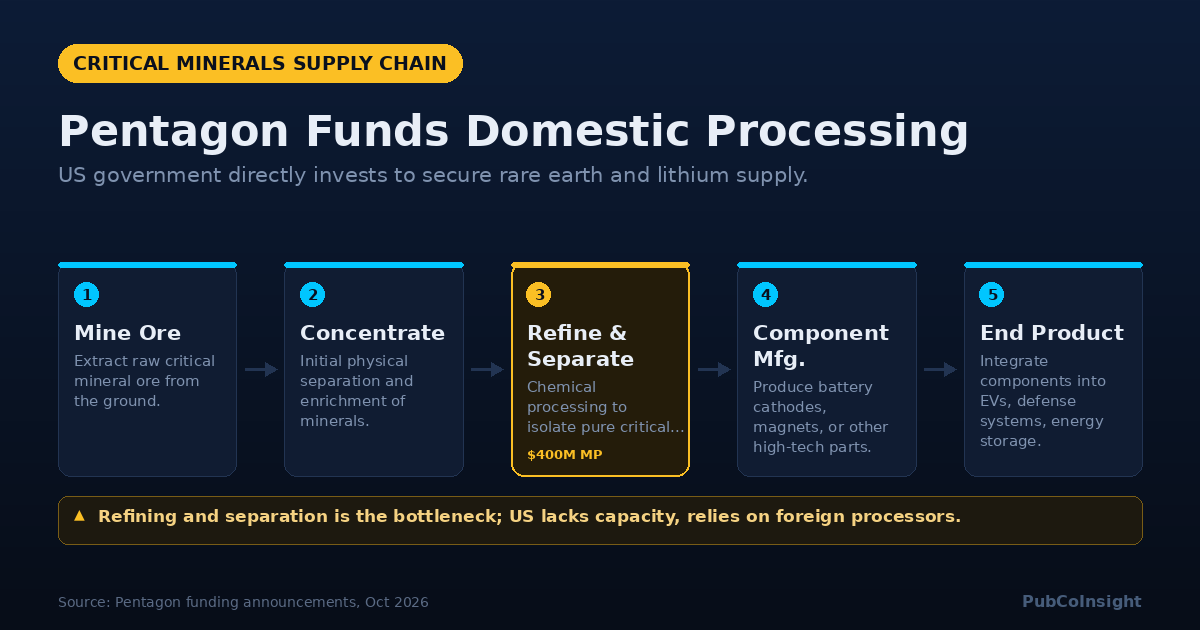
The "Mine-to-Magnet" Bottleneck
The critical minerals supply chain is a multi-stage process, and value concentrates at specific points. Mining the ore is the first step, but it is often the least complex. The real challenge, and where the U.S. seeks to gain ground, lies in processing and refining. Rare earth elements, for example, are not found in pure veins. They occur together in complex mineral assemblages. Separating these individual rare earth oxides, like neodymium and praseodymium, requires sophisticated chemical processing and solvent extraction techniques. This is a capital-intensive, technically challenging, and environmentally sensitive process. Historically, China has dominated this refining capacity, creating a choke point. Without domestic refining, even domestically mined ore still relies on foreign processing, undermining supply chain security. The Pentagon's $400 million commitment to MP Materials, a company focused on rare earth separation, directly targets this bottleneck. Similarly, for lithium, converting raw brine or spodumene concentrate into battery-grade lithium hydroxide or carbonate involves complex chemical engineering. This is where the highest value is added and where the U.S. aims to build capacity.Companies Building Domestic Capacity
Several companies are positioned in this shifting landscape, each with distinct assets and strategies. In the rare earth sector, MP Materials (MP) operates the Mountain Pass mine in California. This facility is the only integrated rare earth mining and processing site in North America. The recent $400 million Pentagon investment directly supports their efforts to expand downstream processing, specifically to produce separated rare earth oxides. This is crucial for magnet manufacturing, a key input for electric vehicles and defense applications. USA Rare Earth, Inc. (USAR) is another player, with its Round Top project in Texas. The company aims for a vertically integrated operation, from mining to processing. NioCorp Developments Ltd. (NB) is developing a niobium, scandium, and titanium project in Elk Creek, Nebraska, which also holds rare earth elements as a co-product. Their focus is on high-value specialty metals, but the rare earth potential adds another dimension. In lithium, companies are pursuing various extraction methods. Albemarle (ALB), a global leader, operates the Silver Peak brine operation in Nevada, the only active lithium mine in the U.S. Its scale and established production make it a benchmark. Lithium Americas Corp. (LAC) is advancing its Thacker Pass project in Nevada, a clay-based lithium deposit. This project has faced permitting challenges but represents a significant potential domestic resource. Standard Lithium Ltd. (SLI) is focused on direct lithium extraction (DLE) from brine resources in Arkansas, aiming to produce battery-grade lithium compounds. Their proposed optional lithium offtake deal progress suggests movement towards commercialization. ioneer Ltd (IONR) is developing the Rhyolite Ridge lithium-boron project in Nevada. This unique deposit offers both critical minerals, aiming for a joint production stream. Atlas Lithium Corporation (ATLX) is developing its Neves project in Brazil, and recent news indicates they are advancing pre-assembly steps for their processing plant, signaling progress towards production readiness. Beyond primary extraction, American Battery Technology Company (ABAT) focuses on lithium-ion battery recycling and primary mineral extraction. Their recent export license for $100 million in black mass highlights their role in the circular economy for battery materials. Critical Metals Corp. (CRML), with its Tanbreez project in Greenland, recently received formal government mining approvals valid through 2050. While not U.S.-based, this project could contribute to Western supply chains for rare earth and other critical minerals.American Lithium Minerals, Inc.
American Lithium Minerals, Inc. (AMLM) operates as an exploration stage company, pre-revenue, focused on lithium and boron properties in Nevada. The company trades over the counter. AMLM's current primary asset is the Sarcobatus Lithium property, comprising 1,780 acres of mining claims in Central Nevada. This project is the stated focus of their lithium exploration activities. The company has also acquired and divested cobalt, nickel, graphite, and rare earth element prospects in the past, including projects in Kingman, Arizona, and Southeast Illinois. AMLM was incorporated in Nevada on March 10, 2005. Its stated plan includes expanding its exploration and acquisition for mineral properties worldwide. The company also states an intention to develop the use of Real World Asset Tokens to provide capital for mining, aiming to create an interoperable ecosystem for asset acquisition, tokenization, and trading. The public record does not yet establish the commercial viability or scale of the Sarcobatus project. A Regulation A offering on Form 1-A was qualified by the SEC on February 4, 2026, covering up to 80,000,000 units, with an additional 120,000,000 shares potentially issuable if attached warrants are fully exercised. Each unit includes one share of common stock and a warrant to purchase 1.5 shares of common stock, exercisable at $0.05 per share until December 31, 2028. The maximum total offering amount is $20,000,000. AMLM's activities since 2009 have primarily centered on lithium exploration in Central Nevada.What to watch
The U.S. government's commitment to critical minerals will manifest in specific, measurable actions. Watch for further Department of Defense or Department of Energy funding announcements targeting downstream processing facilities for rare earths and lithium. Specifically, look for updates from MP Materials regarding the deployment of the $400 million and their progress on separated rare earth oxide production. Any announcements from MP Materials about delivering GM's first rare earth magnets not made in China would be a significant milestone. For lithium, observe permitting progress for major U.S. projects like Lithium Americas' Thacker Pass. A final Record of Decision or significant permit approvals would de-risk these projects. Keep an eye on Standard Lithium's progress towards a 2026 decision for its Arkansas lithium project, as this would signal a move towards commercialization. For American Lithium Minerals, Inc., watch for announcements of exploration results from the Sarcobatus property or any updates on their stated plan to acquire additional mineral properties. Also, monitor the progress of their Real World Asset Token initiative, if any concrete steps are announced. Finally, look for details on specific offtake agreements or supply contracts between U.S. producers and domestic manufacturers, as these deals will solidify the new supply chains., { "label": "Concentrate", "note": "Initial physical separation and enrichment of minerals." }, { "label": "Refine & Separate", "note": "Chemical processing to isolate pure critical mineral compounds.", "metric": "$400M MP Materials" }, { "label": "Component Mfg.", "note": "Produce battery cathodes, magnets, or other high-tech parts." }, { "label": "End Product", "note": "Integrate components into EVs, defense systems, energy storage." } ], "highlight": 2, "highlight_note": "Refining and separation is the bottleneck; US lacks capacity, relies on foreign processors.", "footnote": "Source: Pentagon funding announcements, Oct 2026" }Companies mentioned
| Ticker | Company | Price |
|---|---|---|
| ABAT | American Battery Technology Company | $1.97 |
| AMLM client | American Lithium Minerals, Inc. | $0.0678 |
| ATLX | Atlas Lithium Corporation | $2.29 |
| CRML | Critical Metals Corp. | $6.86 |
| IONR | ioneer Ltd | $2.92 |
| NB | NioCorp Developments Ltd. | $3.37 |
| SLI | Standard Lithium Ltd. | $1.58 |
| USAR | USA Rare Earth, Inc. | $12.56 |
Listed alphabetically, not ranked. Prices as of 2026-10-11 and they move. Check a live quote before relying on any of this.
How we chose the companies in this article
We cover a fixed universe of companies working in lithium, boron and the critical minerals that feed battery and energy-storage supply chains. Every one of them that had usable market data on 2026-10-11 appears in this article. We do not pick which ones to mention based on what we think of them, and we do not order them by size, price or trading volume, because an ordered list is a verdict and that is not ours to hand down. Companies left out, and why: none. American Lithium Minerals and Artificial Intelligence Technology Solutions pay us, which is disclosed in full at the foot of every article they appear in.
See the dilution and promotion flags before you see the pitch.
Each week: the micro and small-caps now showing dilution or paid-promotion signals, with the SEC filing behind every flag. No recommendations, no price targets.
Sources used in this article
- Altius Minerals Heads 3 Canadian Lithium Stocks To Watch Simply Wall St. · 2026-10-09
- Brokers Suggest Investing in Albemarle (ALB): Read This Before Placing a Bet Zacks · 2026-10-08
- Albemarle (ALB) Stock Gets Fair Value Trim As Analysts Turn More Cautious Simply Wall St. · 2026-10-08
- MP Materials Announces Date for Third Quarter 2026 Financial Results and Webcast Business Wire · 2026-10-08
- Can MP Materials Deliver Another Year of Production Growth? Zacks · 2026-10-08
- Washington Is Writing Billion-Dollar Checks for Tungsten CNW Group · 2026-10-08
- Wolfspeed Stock Soars on Financing Deal With Pentagon Barrons.com · 2026-10-08
- Deutsche Bank Adjusts MP Materials Price Target to $53 From $58 MT Newswires · 2026-10-08
- Unveiling October 2026s Premier Rare Earth Stocks Simply Wall St. · 2026-10-08
- Top 3 Lithium Stocks To Watch In October 2026 Simply Wall St. · 2026-10-08
- Here's Why Lithium Americas Corp. (LAC) Fell More Than Broader Market Zacks · 2026-10-07
- Edge Copper Reports Broad Oxide Intercepts at Zonia and Confirms Mineralization Beyond Previously Interpreted Boundaries CNW Group · 2026-10-07
Disclosure required by Section 17(b) of the Securities Act of 1933
American Lithium Minerals, Inc.. American Lithium Minerals, Inc. (issuer) paid Strategic Innovations First, Inc., an affiliate of PubCo Insight and Pulse IR. Compensation received: USD 11,550.00 total, three equal monthly installments of USD 3,850.00. Form of payment: cash only; no stock, options or warrants. Services: investor relations, marketing and content creation under Master Services Agreement dated June 22, 2026. Period: three month initial term, June 2026 through August 2026. No position, options or warrants held by PubCo Insight, Pulse IR, Strategic Innovations First, Inc., or Brad Listermann.
This is information, not investment, financial, legal or tax advice. It is not a recommendation or solicitation to buy, sell or hold any security and it contains no price target. Nothing here is independently verified by us. Confirm every figure against primary filings on SEC EDGAR before you act. Micro-cap and over-the-counter securities are speculative and illiquid and can lose all of their value. The companies named without a disclosure above pay us nothing and have no relationship with us; they are named because a published, mechanical screen selected them. Full disclosure policy.