Washington's Rare Earth Push: Funding Flows as Domestic Supply Chain Takes Shape
The US government is injecting substantial capital into domestic rare earth projects, signaling a clear intent to reduce reliance on foreign supply and reshape the critical minerals landscape.
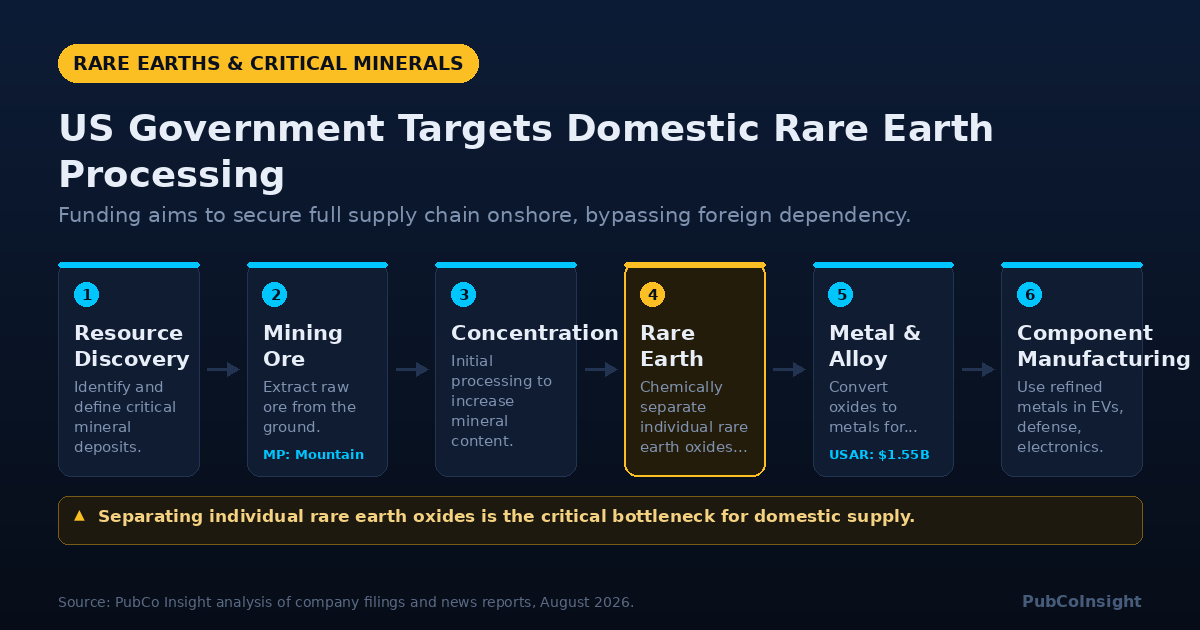
The Mechanism of Domestic Supply
Building a domestic critical minerals supply chain, especially for rare earths, is a multi-stage process. It starts with exploration and resource definition, proving out the geology and economics of a deposit. Next comes mining, extracting the ore from the ground. The critical bottleneck, and often the most technically challenging and capital-intensive step, is processing. Rare earth elements rarely occur in high concentrations and are often commingled with radioactive materials. Separating individual rare earth oxides, like neodymium and praseodymium for magnets, from the mined ore requires complex hydrometallurgical or solvent extraction processes. These processes are energy-intensive, generate significant waste, and demand specialized chemical expertise and infrastructure. Few facilities outside of China possess this full capability. The final stage involves refining these separated oxides into metals and alloys, which then feed into manufacturing components like electric vehicle motors or wind turbine generators. Government funding targets these processing and refining stages specifically, aiming to establish the full value chain onshore. Without domestic processing capacity, raw rare earth concentrates still need to be sent abroad for refinement, defeating the purpose of a secure supply.Companies in the Domestic Critical Minerals Space
Several companies are actively pursuing projects to address the domestic critical minerals challenge. Many focus on the early stages of the supply chain, while others aim for more integrated operations. MP Materials (MP), trading at $17.99, operates the Mountain Pass mine in California, the only integrated rare earth mining and processing site in North America. The company has focused on restarting and optimizing its processing capabilities to produce separated rare earth oxides. News on August 25 highlighted MP Materials' new defense gadolinium deal, indicating progress in securing specialized contracts. The company has also been the subject of discussions regarding its operating cash flow turning positive in Q2, as reported by Zacks on August 25. USA Rare Earth, Inc. (USAR), currently at $17.99, is developing the Round Top project in Texas, which aims to produce a wide range of critical minerals, including heavy and light rare earth elements, lithium, and other high-tech metals. The $1.55 billion in government-backed funding announced on August 24 is a significant development for the company, underscoring the strategic importance of its project to the US government's supply chain initiatives. In the lithium space, Albemarle (ALB), a larger player, has seen its stock discussed by Zacks on August 28 in comparison to SQM. Albemarle's cash strength and potential for higher shareholder returns were highlighted by Zacks on August 20, following a rebound in profits and a higher 2026 outlook noted by Simply Wall St. on August 18. Similarly, Sociedad Química y Minera de Chile (SQM), a major lithium producer, reported strong Q2 earnings, with its lithium outlook raised, as per Insider Monkey on August 25. MarketBeat reported on August 20 that SQM's lithium boom is back. Other companies are advancing specific projects. Lithium Americas Corp. (LAC), which saw a rating upgrade to Buy by Zacks on August 19, is developing the Thacker Pass lithium project in Nevada. Deutsche Bank adjusted its price target for LAC to $4.20 from $5.10 on August 17, while maintaining a Hold rating. ioneer Ltd (IONR), trading at $3.08, is advancing its Rhyolite Ridge lithium-boron project in Nevada. This project is notable for its co-production of both lithium carbonate and boric acid, which could provide diversified revenue streams. Standard Lithium Ltd. (SLI), priced at $2.55, is focused on extracting lithium from brine resources in Arkansas, specifically targeting the Smackover Formation. The company is employing direct lithium extraction (DLE) technologies, which aim to be more environmentally friendly and efficient than traditional evaporation ponds. Critical Metals Corp. (CRML), at $7.12, is in the process of acquiring European Lithium, with a September court date set for the $835 million merger deal, as reported by Stocktwits on August 28. This acquisition would give CRML control over the Wolfsberg Lithium Project in Austria, positioning it as a European lithium producer. The company also provided an update on this proposed acquisition on August 28 via GlobeNewswire. CEO Tony Sage highlighted progress at the Greenland Rare Earth Project on August 17, according to Stocktwits. NioCorp Developments Ltd. (NB), trading at $4.13, is developing the Elk Creek project in Nebraska, which aims to produce niobium, scandium, and titanium, along with rare earth elements. The project is notable for its diverse suite of critical minerals. Atlas Lithium Corporation (ATLX), at $3.15, is an emerging lithium producer with projects in Brazil. While not directly tied to US domestic funding, its progress contributes to the broader global supply picture. American Battery Technology Company (ABAT), priced at $2.57, is focused on lithium-ion battery recycling and primary lithium resource development. The company announced its highest-ever gross profit and a successful appeal for the reinstatement of a $57 million US Department of Energy grant in its Q4 FY2026 financial results on August 20. This grant supports its efforts in battery recycling and potentially domestic lithium production.American Lithium Minerals, Inc.
American Lithium Minerals, Inc. (AMLM), trading over the counter at $0.07, is an exploration-stage company with no current revenue. The company's stated focus is on lithium and boron properties located in Nevada. AMLM was incorporated in Nevada on March 10, 2005. Its primary asset is the Sarcobatus Lithium property, which comprises 1,780 acres of mining claims in Central Nevada. The company has historically acquired and divested cobalt, nickel, and graphite prospects in Central Nevada, as well as rare earth elements projects in Kingman, Arizona, and Southeast Illinois. AMLM's most recent substantive filing, a Regulation A offering circular qualified by the SEC on February 4, 2026, outlines its business plan. The offering covers up to 80,000,000 units, with up to an additional 120,000,000 shares issuable if attached warrants are fully exercised. Each unit includes one share of common stock and a warrant to purchase 1.5 shares of common stock at an exercise price of $0.05 per share until December 31, 2028. The company states its intention to expand exploration and acquisition for mineral properties worldwide and is also developing the use of Real World Asset Tokens to provide capital for mining. The public record does not yet establish any proven or probable reserves for the Sarcobatus Lithium property. The company's activities since 2009 have focused on lithium exploration in Central Nevada. AMLM's long-term vision, as described in its filings, is to create an interoperable ecosystem where assets can be securely acquired, transparently tokenized, and efficiently traded, merging public markets with blockchain technology. The company reports that it does not own any real property such as land, buildings, or physical plants.What to watch
Several key developments will shape the critical minerals landscape in the coming months. The September court date for Critical Metals Corp.'s (CRML) merger with European Lithium is a near-term event that will determine the future of a significant European lithium project. For USA Rare Earth (USAR), the specifics of how the $1.55 billion in government-backed funding will be deployed and the milestones attached to it will be crucial. Watch for updates on construction timelines, permitting, and initial production targets from the Round Top project. For MP Materials (MP), further details on its defense contracts and the expansion of its processing capabilities at Mountain Pass will be important indicators of its strategic trajectory. Across the sector, watch for new government funding announcements, particularly those targeting midstream processing and refining capacity. Permitting decisions for projects like Lithium Americas' (LAC) Thacker Pass and ioneer's (IONR) Rhyolite Ridge will also provide clarity on the speed of domestic resource development. Finally, any new offtake agreements or strategic partnerships announced by smaller players could signal progress towards commercialization., { "label": "Mining Ore", "note": "Extract raw ore from the ground.", "metric": "MP: Mountain Pass" }, { "label": "Concentration", "note": "Initial processing to increase mineral content." }, { "label": "Rare Earth Separation", "note": "Chemically separate individual rare earth oxides (e.g., Nd, Pr)." }, { "label": "Metal & Alloy Refining", "note": "Convert oxides to metals for manufacturing.", "metric": "USAR: $1.55B Funding" }, { "label": "Component Manufacturing", "note": "Use refined metals in EVs, defense, electronics." } ], "highlight": 3, "highlight_note": "Separating individual rare earth oxides is the critical bottleneck for domestic supply.", "footnote": "Source: PubCo Insight analysis of company filings and news reports, August 2026." }Companies mentioned
| Ticker | Company | Price |
|---|---|---|
| ABAT | American Battery Technology Company | $2.57 |
| AMLM client | American Lithium Minerals, Inc. | $0.07 |
| ATLX | Atlas Lithium Corporation | $3.15 |
| CRML | Critical Metals Corp. | $7.12 |
| IONR | ioneer Ltd | $3.08 |
| NB | NioCorp Developments Ltd. | $4.13 |
| SLI | Standard Lithium Ltd. | $2.55 |
| USAR | USA Rare Earth, Inc. | $17.99 |
Listed alphabetically, not ranked. Prices as of 2026-08-31 and they move. Check a live quote before relying on any of this.
How we chose the companies in this article
We cover a fixed universe of companies working in lithium, boron and the critical minerals that feed battery and energy-storage supply chains. Every one of them that had usable market data on 2026-08-31 appears in this article. We do not pick which ones to mention based on what we think of them, and we do not order them by size, price or trading volume, because an ordered list is a verdict and that is not ours to hand down. Companies left out, and why: none. American Lithium Minerals and Artificial Intelligence Technology Solutions pay us, which is disclosed in full at the foot of every article they appear in.
See the dilution and promotion flags before you see the pitch.
Each week: the micro and small-caps now showing dilution or paid-promotion signals, with the SEC filing behind every flag. No recommendations, no price targets.
Sources used in this article
- Could a Chinese Blacklist Be Bullish for Rare-Earth Stocks? Motley Fool · 2026-08-29
- ALB vs. SQM: Which Lithium Stock Should You Bet on Now? Zacks · 2026-08-28
- Critical Metals Corp. Provides Update on Proposed Acquisition of European Lithium GlobeNewswire · 2026-08-28
- CRML Stock Eyes Second Weekly Gain: European Lithium Sets September Court Date For $835M Merger Deal Stocktwits · 2026-08-28
- MP Materials vs. Enterprise Products: Which "Boring" Business Actually Has the Better Growth Case? Motley Fool · 2026-08-27
- SQM Beat Expectations and Raised its Lithium Outlook. Is the Downturn Over? Insider Monkey · 2026-08-25
- CRML Jumps, USAR And MP Advance As Rare-Earth Stocks Catch Government Tailwinds Stocktwits · 2026-08-25
- What MP Materials (MP)'s New Defense Gadolinium Deal Means For Shareholders Simply Wall St. · 2026-08-25
- Critical Metals Spikes 19%, MP Materials and United States Antimony Lag: Is the European Lithium Merger Driving the Move? 24/7 Wall St. · 2026-08-25
- MP's Operating Cash Flow Turns Positive in Q2: More Upside Ahead? Zacks · 2026-08-25
- Critical Metals (CRML) Dropped, So What Is Driving Attention Now? Simply Wall St. · 2026-08-25
- Prediction: MP Materials' Aerospace Deal Is Just the First of Several Motley Fool · 2026-08-24
Disclosure required by Section 17(b) of the Securities Act of 1933
American Lithium Minerals, Inc.. American Lithium Minerals, Inc. (issuer) paid Strategic Innovations First, Inc., an affiliate of PubCo Insight and Pulse IR. Compensation received: USD 11,550.00 total, three equal monthly installments of USD 3,850.00. Form of payment: cash only; no stock, options or warrants. Services: investor relations, marketing and content creation under Master Services Agreement dated June 22, 2026. Period: three month initial term, June 2026 through August 2026. No position, options or warrants held by PubCo Insight, Pulse IR, Strategic Innovations First, Inc., or Brad Listermann.
This is information, not investment, financial, legal or tax advice. It is not a recommendation or solicitation to buy, sell or hold any security and it contains no price target. Nothing here is independently verified by us. Confirm every figure against primary filings on SEC EDGAR before you act. Micro-cap and over-the-counter securities are speculative and illiquid and can lose all of their value. The companies named without a disclosure above pay us nothing and have no relationship with us; they are named because a published, mechanical screen selected them. Full disclosure policy.