US Lithium and Boron: The Race to DLE and the Permitting Gauntlet
Smackover Lithium's PEA and American Battery Technology Company's permit approval highlight the distinct paths and persistent challenges for domestic critical mineral production.
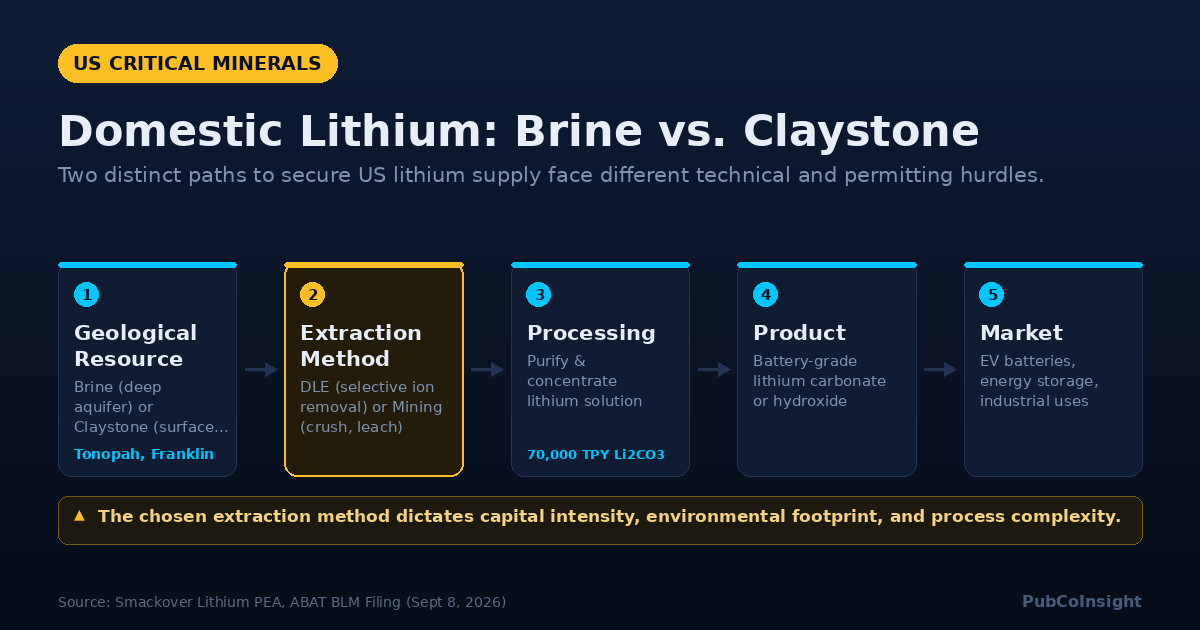
The Mechanism: Direct Lithium Extraction vs. Claystone Processing
The core challenge in lithium production is separating the valuable metal from its host material efficiently and economically. Two primary methods dominate the current domestic development landscape: direct lithium extraction from brines and processing lithium-bearing claystones. Direct lithium extraction (DLE) from brines involves selectively removing lithium ions from underground saline water. Traditional brine operations evaporate vast quantities of water in solar ponds, a process that is slow, land-intensive, and highly dependent on climate. DLE technologies aim to bypass evaporation by using sorbents, ion-exchange resins, or solvent extraction to chemically bind with lithium ions, leaving other dissolved minerals behind. This process promises faster recovery, a smaller environmental footprint, and higher purity products. The catch is scale and selectivity. DLE systems must handle enormous volumes of brine, often with low lithium concentrations, while effectively rejecting competing ions like magnesium and calcium. The sorbent material itself is a critical factor, needing to be robust, reusable, and highly specific to lithium. Lithium from claystone, on the other hand, involves mining and processing solid rock. This typically begins with crushing and grinding the ore, followed by a leaching step where acids or bases dissolve the lithium-bearing minerals. The resulting pregnant leach solution then undergoes purification and concentration to produce lithium carbonate or hydroxide. The main technical hurdle here is energy intensity. Extracting lithium from clay minerals like hectorite or smectite often requires high temperatures or strong reagents, leading to significant operating costs and a larger carbon footprint compared to DLE if not managed carefully. The mineralogy of the clay dictates the specific processing route, and variations can significantly impact recovery rates and reagent consumption.Companies Working in This Part of the Sector
Several companies are actively pursuing these different lithium and critical mineral extraction pathways across the United States. Their strategies vary based on geology, technology, and stage of development. Standard Lithium Ltd. (SLI) is a significant player in DLE from brines, particularly in Arkansas. The company focuses on the Smackover Formation, a geological brine reservoir known for its high lithium concentrations. Its Franklin Project, located in East Texas, is another DLE-focused venture. Smackover Lithium, a joint venture between Standard Lithium and Equinor, recently announced a 10-year lithium offtake deal with LG Energy Solution on August 31, a clear signal of market validation for its DLE approach. American Battery Technology Company (ABAT) is advancing its Tonopah Flats Lithium Project in Nevada, which targets lithium-bearing claystone. The recent acceptance of their plan of operations by the U.S. BLM on September 8 moves them closer to on-site development. ABAT is also engaged in lithium-ion battery recycling, creating a circular economy approach that complements its primary mineral extraction efforts. ioneer Ltd (IONR) is developing the Rhyolite Ridge Lithium-Boron Project in Nevada, a unique deposit that combines both critical minerals. The project involves open-pit mining of a claystone resource, with plans to produce both lithium carbonate and boric acid. The co-production of boron, another critical material for various industrial applications, provides a distinct economic advantage. Atlas Lithium Corporation (ATLX) is primarily focused on hard rock lithium deposits in Brazil, but its activities contribute to the broader critical minerals supply chain discussion. While not directly involved in U.S. DLE or claystone, its progress in developing conventional spodumene resources highlights the global effort to diversify lithium sources. In the rare earth elements space, MP Materials (MP) operates the Mountain Pass mine in California, the only integrated rare earth mining and processing site in North America. The company extracts bastnäsite ore and produces rare earth concentrates, with plans to expand into downstream processing to produce separated rare earth oxides. This separation step is crucial because rare earth elements, while chemically similar, must be isolated from each other to be useful in high-tech applications like magnets for EVs and wind turbines. The difficulty lies in their similar ionic radii, making traditional solvent extraction a complex, multi-stage process requiring precise control. USA Rare Earth, Inc. (USAR) is developing the Round Top heavy rare earth and critical minerals project in West Texas. This project targets a large rhyolite deposit containing a wide array of rare earths, lithium, and other critical minerals. Their approach involves a unique processing method designed to extract these elements efficiently. NioCorp Developments Ltd. (NB) is focused on its Elk Creek Project in Nebraska, which aims to produce niobium, scandium, and titanium, along with rare earth elements. This project represents a multi-mineral approach to critical mineral supply, leveraging a diverse ore body. Critical Metals Corp. (CRML) is primarily focused on European assets, specifically the Wolfsberg Lithium Project in Austria, which targets spodumene. The company announced an update on its proposed acquisition of European Lithium on August 28, indicating its strategy to consolidate lithium assets.American Lithium Minerals, Inc.
American Lithium Minerals, Inc. (AMLM) is an exploration stage company trading over the counter. Its stated focus is lithium and boron properties in Nevada. The company was incorporated in Nevada in March 2005. Its current project is the Sarcobatus Lithium property, comprising 1,780 acres of mining claims in Central Nevada. The company has focused its activities on lithium exploration in Central Nevada since 2009. American Lithium Minerals has also acquired and divested cobalt, nickel, and graphite prospects in Central Nevada, and rare earth elements projects in Kingman, Arizona and Southeast Illinois. The public record does not yet establish a measured, indicated, or inferred resource for the Sarcobatus property. AMLM intends to expand its exploration and acquisition for mineral properties worldwide. The company also states it is developing the use of Real World Asset Tokens to provide capital for mining. A Regulation A offering on Form 1-A was qualified by the SEC on February 4, 2026, covering up to 80,000,000 units. Each unit includes one share of common stock and a warrant to purchase 1.5 shares of common stock, exercisable at $0.05 per share until December 31, 2028. Up to 120,000,000 additional shares are issuable if these warrants are exercised in full. The minimum purchase requirement for the offering is $1,000, though this can be waived. The company does not own any real property such as land or buildings.What to watch
The coming months will bring several checkable developments across the sector. For DLE operators like Standard Lithium, watch for further project updates from the Franklin Project, particularly any movement towards a definitive feasibility study or additional offtake agreements beyond the LG Energy Solution deal. The specific DLE technology chosen and its demonstrated performance at scale will be key. For claystone and hard rock projects, regulatory milestones are paramount. American Battery Technology Company's progress at Tonopah Flats will hinge on subsequent permitting steps following the BLM's acceptance of its plan of operations. Similarly, ioneer Ltd's Rhyolite Ridge project will require continued permitting success and financing to advance. Any updates on the proposed acquisition of European Lithium by Critical Metals Corp. will clarify its strategic direction. In the rare earth space, MP Materials' expansion into downstream processing at Mountain Pass, specifically the production of separated rare earth oxides, remains a critical benchmark. Watch for announcements regarding the commissioning and operational ramp-up of these facilities. For USA Rare Earth, Inc., updates on the processing technology and financing for the Round Top project will be important. NioCorp Developments Ltd. will continue to pursue financing and permitting for its multi-mineral Elk Creek project. The broader geopolitical landscape, particularly regarding U.S.-China relations and critical mineral supply chains, will also influence the pace and funding of domestic projects. Government incentives and strategic partnerships will continue to shape the industry., { "label": "Extraction Method", "note": "DLE (selective ion removal) or Mining (crush, leach)" }, { "label": "Processing", "note": "Purify & concentrate lithium solution", "metric": "70,000 TPY Li2CO3" }, { "label": "Product", "note": "Battery-grade lithium carbonate or hydroxide" }, { "label": "Market", "note": "EV batteries, energy storage, industrial uses" } ], "highlight": 1, "highlight_note": "The chosen extraction method dictates capital intensity, environmental footprint, and process complexity.", "footnote": "Source: Smackover Lithium PEA, ABAT BLM Filing (Sept 8, 2026)" }Companies mentioned
| Ticker | Company | Price |
|---|---|---|
| ABAT | American Battery Technology Company | $2.81 |
| AMLM client | American Lithium Minerals, Inc. | $0.0741 |
| ATLX | Atlas Lithium Corporation | $3.25 |
| CRML | Critical Metals Corp. | $7.32 |
| IONR | ioneer Ltd | $3.02 |
| NB | NioCorp Developments Ltd. | $4.12 |
| SLI | Standard Lithium Ltd. | $2.4 |
| USAR | USA Rare Earth, Inc. | $17.66 |
Listed alphabetically, not ranked. Prices as of 2026-09-09 and they move. Check a live quote before relying on any of this.
How we chose the companies in this article
We cover a fixed universe of companies working in lithium, boron and the critical minerals that feed battery and energy-storage supply chains. Every one of them that had usable market data on 2026-09-09 appears in this article. We do not pick which ones to mention based on what we think of them, and we do not order them by size, price or trading volume, because an ordered list is a verdict and that is not ours to hand down. Companies left out, and why: none. American Lithium Minerals and Artificial Intelligence Technology Solutions pay us, which is disclosed in full at the foot of every article they appear in.
See the dilution and promotion flags before you see the pitch.
Each week: the micro and small-caps now showing dilution or paid-promotion signals, with the SEC filing behind every flag. No recommendations, no price targets.
Sources used in this article
- The U.S.-China Worry List: Here’s What Could Rattle the Fragile Detente Barrons.com · 2026-09-09
- What Does "Reshoring" Actually Mean for Industrial Investors? Motley Fool · 2026-09-08
- An Under the Radar Rare Earth Comment From Elon Musk Could Upend Another Industry Barrons.com · 2026-09-08
- 6 Massive Reasons Standard Lithium Stock Popped 33% in August Motley Fool · 2026-09-08
- Sector Update: Energy Stocks Rise Tuesday Afternoon MT Newswires · 2026-09-08
- Smackover Lithium Estimates Up to 70,000 Tonnes of Annual Lithium Carbonate Output From Texas Project MT Newswires · 2026-09-08
- Smackover Lithium Announces Positive Preliminary Economic Assessment for the Franklin Project, Its First Lithium Project in East Texas GlobeNewswire · 2026-09-08
- American Battery Technology Says Bureau of Land Management Accepts Operations Plan for Nevada Lithium Project MT Newswires · 2026-09-08
- American Battery Technology Company Achieves Major Milestone with U.S. BLM Acceptance of Plan of Operations for Tonopah Flats Lithium Project GlobeNewswire · 2026-09-08
- Albemarle Corporation (ALB) Is a Trending Stock: Facts to Know Before Betting on It Zacks · 2026-09-07
- Albemarle’s Next CEO Inherits A $250 Million Swing Per Dollar Benzinga · 2026-09-05
- Critical Metals Stock And 2 Other Rare Earth Stocks To Own Simply Wall St. · 2026-09-05
Disclosure required by Section 17(b) of the Securities Act of 1933
American Lithium Minerals, Inc.. American Lithium Minerals, Inc. (issuer) paid Strategic Innovations First, Inc., an affiliate of PubCo Insight and Pulse IR. Compensation received: USD 11,550.00 total, three equal monthly installments of USD 3,850.00. Form of payment: cash only; no stock, options or warrants. Services: investor relations, marketing and content creation under Master Services Agreement dated June 22, 2026. Period: three month initial term, June 2026 through August 2026. No position, options or warrants held by PubCo Insight, Pulse IR, Strategic Innovations First, Inc., or Brad Listermann.
This is information, not investment, financial, legal or tax advice. It is not a recommendation or solicitation to buy, sell or hold any security and it contains no price target. Nothing here is independently verified by us. Confirm every figure against primary filings on SEC EDGAR before you act. Micro-cap and over-the-counter securities are speculative and illiquid and can lose all of their value. The companies named without a disclosure above pay us nothing and have no relationship with us; they are named because a published, mechanical screen selected them. Full disclosure policy.