Government Funds Drive Domestic Critical Minerals, But Processing Bottlenecks Persist
The recent $1.55 billion in government-backed funding for USA Rare Earth underscores a strategic pivot toward domestic supply chains, yet the complex physics of mineral separation remain a significant hurdle for producers.
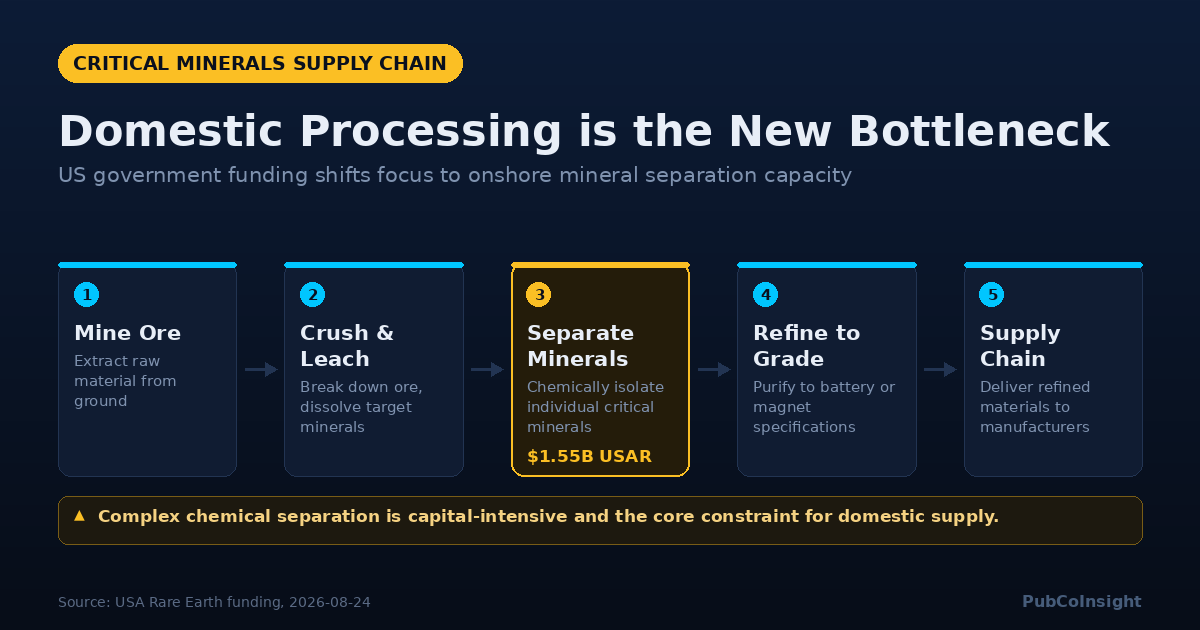
The Mechanism of Separation: From Ore to Usable Material
Extracting critical minerals from ore is a multi-stage chemical and physical process. For rare earth elements, the challenge lies in their chemical similarity. Lanthanides, the core of rare earth elements, all have three valence electrons and similar ionic radii. This makes them behave almost identically in chemical reactions. Separating them requires highly specialized solvent extraction techniques. Ore is first crushed and ground, then leached with strong acids to dissolve the rare earth minerals. The resulting pregnant leach solution, a liquid mixture containing various dissolved metals, then enters a series of solvent extraction circuits. Each circuit uses a specific organic solvent that selectively binds to certain rare earth ions based on subtle differences in their chemical properties. This process is repeated dozens, sometimes hundreds, of times in a counter-current flow system, gradually isolating individual rare earth oxides with high purity. For lithium, especially from brines or clays, the challenge shifts. Brine operations pump lithium-rich water from underground, then use evaporation ponds or direct lithium extraction (DLE) technologies to concentrate the lithium. DLE methods, such as adsorption, ion exchange, or solvent extraction, aim to selectively remove lithium from the brine more quickly and with a smaller environmental footprint than traditional evaporation. Clay-hosted lithium, like that found in Nevada, requires different approaches. The clay must be mined, crushed, and then subjected to roasting or acid leaching to liberate the lithium. Each method, whether for rare earths or lithium, demands precise control over chemical parameters, significant energy input, and often, large quantities of water and reagents. The bottleneck frequently sits not in the initial discovery of a deposit, but in the capital-intensive, technically complex, and environmentally sensitive steps required to produce a battery-grade material.Companies Navigating the Domestic Landscape
Several companies are actively working to establish or expand domestic critical mineral production. USA Rare Earth, Inc. (USAR), trading at $17.85, is a primary beneficiary of the recent government funding. This capital is intended to advance its domestic rare earth projects, aiming to bring more processing capacity online within the United States. The company's focus is on developing a fully integrated supply chain, from mine to magnet. In the lithium space, Standard Lithium Ltd. (SLI), priced at $2.41, recently announced a significant development. On August 31, 2026, its joint venture with Equinor, Smackover Lithium, signed a 10-year lithium offtake deal with LG Energy Solution. This agreement secures supply of US-produced lithium carbonate from Standard Lithium's South West Arkansas Project. This type of long-term offtake agreement is crucial for de-risking project financing and demonstrating market demand for domestic production. American Battery Technology Company (ABAT), trading at $2.79, is focused on both primary mineral extraction and battery recycling. On August 31, 2026, ABAT hosted Department of Energy leadership to showcase its commercial technologies for strengthening US critical minerals supply chains. The company also announced its highest ever gross profit in Q4 FY2026 and a successful appeal for reinstatement of a $57 million Department of Energy grant on August 20, 2026. This indicates progress in both its operational and funding efforts. NioCorp Developments Ltd. (NB), at $4.14, is advancing its Elk Creek project in Nebraska, which aims to produce niobium, scandium, and titanium, along with rare earth elements. The company is working to establish a multi-mineral processing facility. ioneer Ltd (IONR), priced at $3.09, is developing its Rhyolite Ridge lithium-boron project in Nevada. This project is unique for its co-production of both lithium carbonate and boric acid, leveraging a single ore body. Atlas Lithium Corporation (ATLX), trading at $3.22, is developing its lithium projects in Brazil, focusing on hard rock spodumene deposits. While not directly a US-based project, its operations contribute to the broader global supply chain that serves US battery manufacturers. Critical Metals Corp. (CRML), at $7.30, is involved in a proposed acquisition of European Lithium, aiming to develop lithium projects in Europe. On August 28, 2026, Critical Metals Corp. provided an update on this proposed acquisition, with European Lithium setting a September court date for the $835 million merger deal. This expansion into European assets reflects a strategy to diversify geographical exposure for critical minerals.American Lithium Minerals, Inc.
American Lithium Minerals, Inc. (AMLM), trading over the counter at $0.0786, is an exploration stage company with a stated focus on lithium and boron properties in Nevada. The company is pre-revenue. AMLM was incorporated in Nevada on March 10, 2005. Its current project is the Sarcobatus Lithium property, comprising 1,780 acres of mining claims in Central Nevada. The company has stated its intention to expand its exploration and acquisition for mineral properties worldwide. Additionally, AMLM is developing the use of Real World Asset Tokens to provide capital for mining. The company's activities since 2009 have focused on lithium exploration in Central Nevada. It has also acquired and divested cobalt, nickel, and graphite prospects in Central Nevada and rare earth elements projects in Kingman, Arizona, and Southeast Illinois. The company does not own real property such as land or buildings. The public record does not yet establish a measured or indicated resource for the Sarcobatus Lithium property. On February 4, 2026, the SEC qualified a Regulation A offering on Form 1-A, covering up to 80,000,000 units, with up to 120,000,000 shares issuable if attached warrants are exercised in full. Each unit includes one share of common stock and a warrant to purchase 1.5 shares of common stock, exercisable at $0.05 per share until December 31, 2028. The minimum purchase requirement per investor is $1,000, though the company can waive this.What to watch
Several key developments are approaching for companies in this sector. For Critical Metals Corp. (CRML), the September court date for the European Lithium merger deal is a near-term catalyst to watch. A successful merger could significantly alter its operational footprint and asset base. For Standard Lithium Ltd. (SLI), the execution and ramp-up of its South West Arkansas Project, following the LG Energy Solution offtake, will be important. Specific milestones related to construction, permitting, and initial production from this project will provide concrete updates. For American Battery Technology Company (ABAT), further updates on the deployment of its commercial technologies and the progress of its reinstated $57 million DOE grant will be relevant. For USA Rare Earth, Inc. (USAR), the deployment of its $1.55 billion in government-backed funding into tangible project developments, such as facility construction or expanded exploration programs, will be closely monitored. Specific announcements regarding permit approvals or groundbreaking ceremonies will be important. For American Lithium Minerals, Inc. (AMLM), the progress of its Regulation A offering and any subsequent announcements regarding exploration results or resource estimates for its Sarcobatus Lithium property will be key., { "label": "Crush & Leach", "note": "Break down ore, dissolve target minerals" }, { "label": "Separate Minerals", "note": "Chemically isolate individual critical minerals", "metric": "$1.55B USAR" }, { "label": "Refine to Grade", "note": "Purify to battery or magnet specifications" }, { "label": "Supply Chain", "note": "Deliver refined materials to manufacturers" } ], "highlight": 2, "highlight_note": "Complex chemical separation is capital-intensive and the core constraint for domestic supply.", "footnote": "Source: USA Rare Earth funding, 2026-08-24" }Companies mentioned
| Ticker | Company | Price |
|---|---|---|
| ABAT | American Battery Technology Company | $2.79 |
| AMLM client | American Lithium Minerals, Inc. | $0.0786 |
| ATLX | Atlas Lithium Corporation | $3.22 |
| CRML | Critical Metals Corp. | $7.3 |
| IONR | ioneer Ltd | $3.09 |
| NB | NioCorp Developments Ltd. | $4.14 |
| SLI | Standard Lithium Ltd. | $2.41 |
| USAR | USA Rare Earth, Inc. | $17.85 |
Listed alphabetically, not ranked. Prices as of 2026-09-03 and they move. Check a live quote before relying on any of this.
How we chose the companies in this article
We cover a fixed universe of companies working in lithium, boron and the critical minerals that feed battery and energy-storage supply chains. Every one of them that had usable market data on 2026-09-03 appears in this article. We do not pick which ones to mention based on what we think of them, and we do not order them by size, price or trading volume, because an ordered list is a verdict and that is not ours to hand down. Companies left out, and why: none. American Lithium Minerals and Artificial Intelligence Technology Solutions pay us, which is disclosed in full at the foot of every article they appear in.
See the dilution and promotion flags before you see the pitch.
Each week: the micro and small-caps now showing dilution or paid-promotion signals, with the SEC filing behind every flag. No recommendations, no price targets.
Sources used in this article
- MP Materials to Participate in Jefferies 2026 Global Industrials Conference Business Wire · 2026-09-02
- MP Materials' Stock is Surging: Here's Why Motley Fool · 2026-09-02
- United States Antimony Jumps 8%, USA Rare Earth Ticks Up: Is Insider Buying Behind the Move? 24/7 Wall St. · 2026-09-02
- USA Rare Earth Stock Stays Perfect With New Call to Buy Barrons.com · 2026-09-02
- William Blair Says These Stocks Are Must-Own Picks GuruFocus.com · 2026-09-01
- LG Energy signs lithium carbonate deal with Smackover Mining Technology · 2026-09-01
- Energy Fuels' ASM Buy Strengthens Rare Earth Push: What's Next? Zacks · 2026-08-31
- MP vs. NB: Which Critical Minerals Stock is the Better Buy? Zacks · 2026-08-31
- MP Materials Stock: Bull vs. Bear on This Top Rare Earth Bet Motley Fool · 2026-08-31
- Update: Standard Lithium, Equinor JV Signs 10-Year Lithium Offtake Deal With LG Energy Solution; Shares Rise MT Newswires · 2026-08-31
- Standard Lithium, Equinor JV Signs 10-Year Lithium Offtake Deal With LG Energy Solution MT Newswires · 2026-08-31
- Standard Lithium's Smackover Signs Offtake Agreement with LG Energy Solution MT Newswires · 2026-08-31
Disclosure required by Section 17(b) of the Securities Act of 1933
American Lithium Minerals, Inc.. American Lithium Minerals, Inc. (issuer) paid Strategic Innovations First, Inc., an affiliate of PubCo Insight and Pulse IR. Compensation received: USD 11,550.00 total, three equal monthly installments of USD 3,850.00. Form of payment: cash only; no stock, options or warrants. Services: investor relations, marketing and content creation under Master Services Agreement dated June 22, 2026. Period: three month initial term, June 2026 through August 2026. No position, options or warrants held by PubCo Insight, Pulse IR, Strategic Innovations First, Inc., or Brad Listermann.
This is information, not investment, financial, legal or tax advice. It is not a recommendation or solicitation to buy, sell or hold any security and it contains no price target. Nothing here is independently verified by us. Confirm every figure against primary filings on SEC EDGAR before you act. Micro-cap and over-the-counter securities are speculative and illiquid and can lose all of their value. The companies named without a disclosure above pay us nothing and have no relationship with us; they are named because a published, mechanical screen selected them. Full disclosure policy.