MP Materials Accelerates US Rare-Earth Magnet Production
MP Materials’ new magnet initiative signals a direct challenge to China’s dominance in a critical supply chain, shifting focus from raw materials to advanced manufacturing.
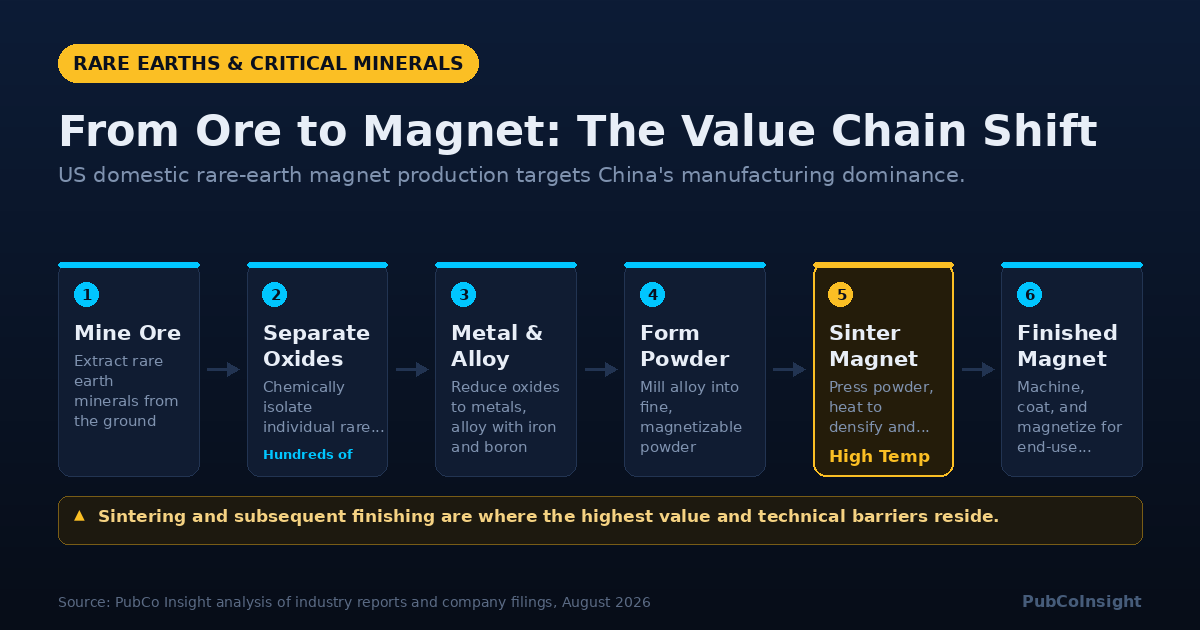
The Mechanism of Magnet Production
Rare earth magnets, specifically Neodymium-Iron-Boron (NdFeB) magnets, are crucial for electric vehicle motors, wind turbines, and defense systems. Their strength and light weight come from the precise alignment of their crystal structure, a process that begins with highly purified rare earth oxides. Separating these oxides is difficult because rare earths share similar chemical properties. Conventional solvent extraction involves hundreds of stages, each a delicate balance of pH and organic solvents, to isolate individual elements like neodymium and praseodymium. Once separated and purified, these oxides are reduced to metals. The metals are then alloyed, typically with iron and boron, and melted. This alloy is then rapidly cooled to form flakes, which are subsequently milled into fine powder. The powder is pressed into shape in a magnetic field, aligning the crystalline grains. This "green" magnet is then sintered, a high-temperature process that densifies the material and further refines its microstructure. Finally, the magnets are machined, coated, and magnetized. The entire sequence, from ore to finished magnet, demands specialized equipment, significant energy, and deep metallurgical expertise. The value accumulates rapidly at each stage, with the finished magnet commanding a substantial premium over the raw oxide.Companies Working in This Part of the Sector
The shift towards downstream processing means different things for different players. Companies focused purely on extraction face a more complex market, while those building out processing capabilities stand to capture more value. MP Materials (MP), with its Mountain Pass mine in California, has been a key domestic source of rare earth concentrates. Their new initiative to produce rare-earth magnets at their Fort Worth, Texas facility, announced on August 5th, represents a vertical integration strategy. This facility aims to produce NdFeB magnets, moving the company into advanced manufacturing. Other companies are also working to establish or expand their roles in the critical minerals supply chain. Critical Metals Corp. (CRML) is advancing its Mrima Hill Rare Earth and Niobium Project in Kenya. While not directly involved in magnet production, securing diverse rare earth sources is a foundational step. CRML's CEO has publicly stated the need to challenge China's REE monopoly, a sentiment that aligns with MP's downstream move. NioCorp Developments Ltd. (NB) is developing its Elk Creek project in Nebraska, targeting niobium, scandium, and titanium, with potential for rare earth elements. These materials are critical for high-strength alloys and advanced applications, though distinct from NdFeB magnets. USA Rare Earth, Inc. (USAR) is working on its Round Top heavy rare earth and critical minerals project in Texas. Their focus includes a wide array of rare earths, which could feed into various downstream applications, including magnet production, should they develop that capability. In the lithium space, companies like Albemarle Corporation (ALB) and Sociedad Química y Minera de Chile (SQM) dominate the global market for lithium chemicals, as evidenced by their strong Q2 results driven by pricing. These large players are focused on the battery cathode supply chain. Smaller, emerging lithium developers are also in play. Lithium Americas Corp. (LAC) is progressing with its Thacker Pass project in Nevada, securing $175 million in financing as construction ramps up. Standard Lithium Ltd. (SLI) is developing its Smackover brine project in Arkansas, focusing on direct lithium extraction technologies. Ioneer Ltd (IONR) is working on the Rhyolite Ridge lithium-boron project in Nevada, which could provide both battery-grade lithium and boron for various industrial uses. Atlas Lithium Corporation (ATLX) is developing its Minas Gerais lithium project in Brazil. American Battery Technology Company (ABAT) is focused on lithium-ion battery recycling and primary lithium hydroxide manufacturing, a different but complementary part of the supply chain.American Lithium Minerals, Inc.
American Lithium Minerals, Inc. (AMLM) operates as an exploration stage company, pre-revenue, with a stated focus on lithium and boron properties in Nevada. The company was incorporated in Nevada on March 10, 2005. Its current primary project is the Sarcobatus Lithium property, comprising 1,780 acres of mining claims in Central Nevada. AMLM’s activities since 2009 have centered on lithium exploration in this region. The company has also acquired and divested cobalt, nickel, and graphite prospects in Central Nevada, and rare earth elements projects in Kingman, Arizona, and Southeast Illinois. The public record does not yet establish a measured or indicated resource for the Sarcobatus project. AMLM intends to expand its exploration and acquisition for mineral properties worldwide and is also developing the use of Real World Asset Tokens to provide capital for mining. The company completed a Regulation A offering, qualified by the SEC on February 4, 2026, covering up to 80,000,000 units, with up to 120,000,000 shares issuable if attached warrants are fully exercised. Each unit in the offering includes one share of common stock and a warrant to purchase 1.5 shares of common stock, exercisable at $0.05 per share until December 31, 2028. The minimum purchase requirement for investors was $1,000, though this could be waived.What to watch
The coming months will bring several key data points. For MP Materials, watch for further details on the Fort Worth magnet facility's construction timeline and initial production targets. Specific announcements regarding magnet types, customer commitments, or pilot production milestones will be important. For Critical Metals Corp., the outcome of the Kenya government tender for the Mrima Hill project, which was in its final round as of July 23rd, will be a significant event. Lithium Americas Corp. will likely continue to provide updates on the progress of construction at Thacker Pass, including permitting milestones and capital expenditure reports. For American Lithium Minerals, Inc., any updates on exploration results from the Sarcobatus Lithium property or progress on their Real World Asset Token initiatives will be notable. The market will also be looking for any further details on the use of proceeds from their recent Regulation A offering., { "label": "Separate Oxides", "note": "Chemically isolate individual rare earth oxides (e.g., Nd, Pr)", "metric": "Hundreds of Stages" }, { "label": "Metal & Alloy", "note": "Reduce oxides to metals, alloy with iron and boron" }, { "label": "Form Powder", "note": "Mill alloy into fine, magnetizable powder" }, { "label": "Sinter Magnet", "note": "Press powder, heat to densify and align crystal structure", "metric": "High Temp" }, { "label": "Finished Magnet", "note": "Machine, coat, and magnetize for end-use applications" } ], "highlight": 4, "highlight_note": "Sintering and subsequent finishing are where the highest value and technical barriers reside.", "footnote": "Source: PubCo Insight analysis of industry reports and company filings, August 2026" }Companies mentioned
| Ticker | Company | Price |
|---|---|---|
| ABAT | American Battery Technology Company | $2.39 |
| AMLM client | American Lithium Minerals, Inc. | $0.0705 |
| ATLX | Atlas Lithium Corporation | $2.97 |
| CRML | Critical Metals Corp. | $6.55 |
| IONR | ioneer Ltd | $3.49 |
| NB | NioCorp Developments Ltd. | $5.06 |
| SLI | Standard Lithium Ltd. | $2.27 |
| USAR | USA Rare Earth, Inc. | $17.41 |
Listed alphabetically, not ranked. Prices as of 2026-08-07 and they move. Check a live quote before relying on any of this.
How we chose the companies in this article
We cover a fixed universe of companies working in lithium, boron and the critical minerals that feed battery and energy-storage supply chains. Every one of them that had usable market data on 2026-08-07 appears in this article. We do not pick which ones to mention based on what we think of them, and we do not order them by size, price or trading volume, because an ordered list is a verdict and that is not ours to hand down. Companies left out, and why: none. American Lithium Minerals and Artificial Intelligence Technology Solutions pay us, which is disclosed in full at the foot of every article they appear in.
See the dilution and promotion flags before you see the pitch.
Each week: the micro and small-caps now showing dilution or paid-promotion signals, with the SEC filing behind every flag. No recommendations, no price targets.
Sources used in this article
- Why MP Materials (MP) Is Up 14.0% After Strong Q2 Results And Project Swarm Progress Simply Wall St. · 2026-08-07
- Analyst Report: Albemarle Corporation Morningstar Research · 2026-08-06
- Albemarle Stock Jumps 8% as Lithium Pricing Triples EBITDA GuruFocus.com · 2026-08-06
- Albemarle Corp (ALB) (Q2 2026) Earnings Call Highlights: Strong Demand and Record EBITDA Amid ... GuruFocus.com · 2026-08-06
- Albemarle Earnings Jump 3,300%. Commodity Prices Helped. Barrons.com · 2026-08-06
- Albemarle Corporation Q2 2026 Earnings Call Summary Moby · 2026-08-06
- ALB Q2 Earnings Beat Estimates on Lithium Pricing Strength Zacks · 2026-08-06
- Barrick Mining to Post Q2 Earnings: What's in the Cards for the Stock? Zacks · 2026-08-06
- Here's Why Lithium Americas Corp. (LAC) Fell More Than Broader Market Zacks · 2026-08-06
- Lithium Americas Further Strengthens Balance Sheet with $175 Million Financing as Thacker Pass Approaches Peak Construction Business Wire · 2026-08-06
- MP Materials Corp. (MP) Reports Q2 Loss, Beats Revenue Estimates Zacks · 2026-08-06
- Forget TMC The Metals Company: This Rare Earth Stock Is the Smarter Bet Right Now Motley Fool · 2026-08-06
Disclosure required by Section 17(b) of the Securities Act of 1933
American Lithium Minerals, Inc.. American Lithium Minerals, Inc. (issuer) paid Strategic Innovations First, Inc., an affiliate of PubCo Insight and Pulse IR. Compensation received: USD 11,550.00 total, three equal monthly installments of USD 3,850.00. Form of payment: cash only; no stock, options or warrants. Services: investor relations, marketing and content creation under Master Services Agreement dated June 22, 2026. Period: three month initial term, June 2026 through August 2026. No position, options or warrants held by PubCo Insight, Pulse IR, Strategic Innovations First, Inc., or Brad Listermann.
This is information, not investment, financial, legal or tax advice. It is not a recommendation or solicitation to buy, sell or hold any security and it contains no price target. Nothing here is independently verified by us. Confirm every figure against primary filings on SEC EDGAR before you act. Micro-cap and over-the-counter securities are speculative and illiquid and can lose all of their value. The companies named without a disclosure above pay us nothing and have no relationship with us; they are named because a published, mechanical screen selected them. Full disclosure policy.