Adia Med, Inc. (ADIA) Reports Going Concern, Frequent 8-Ks
ADIA
Adia Med, Inc. (ADIA) has been busy filing 8-Ks detailing new material agreements and an acquisition, but the most recent 10-Q filing from November 16, 2026, presents a less sanguine picture: management stated there is substantial doubt about the company's ability to continue as a going concern. For a micro-cap company, this is not an uncommon disclosure, but it is always a fundamental risk that warrants attention.
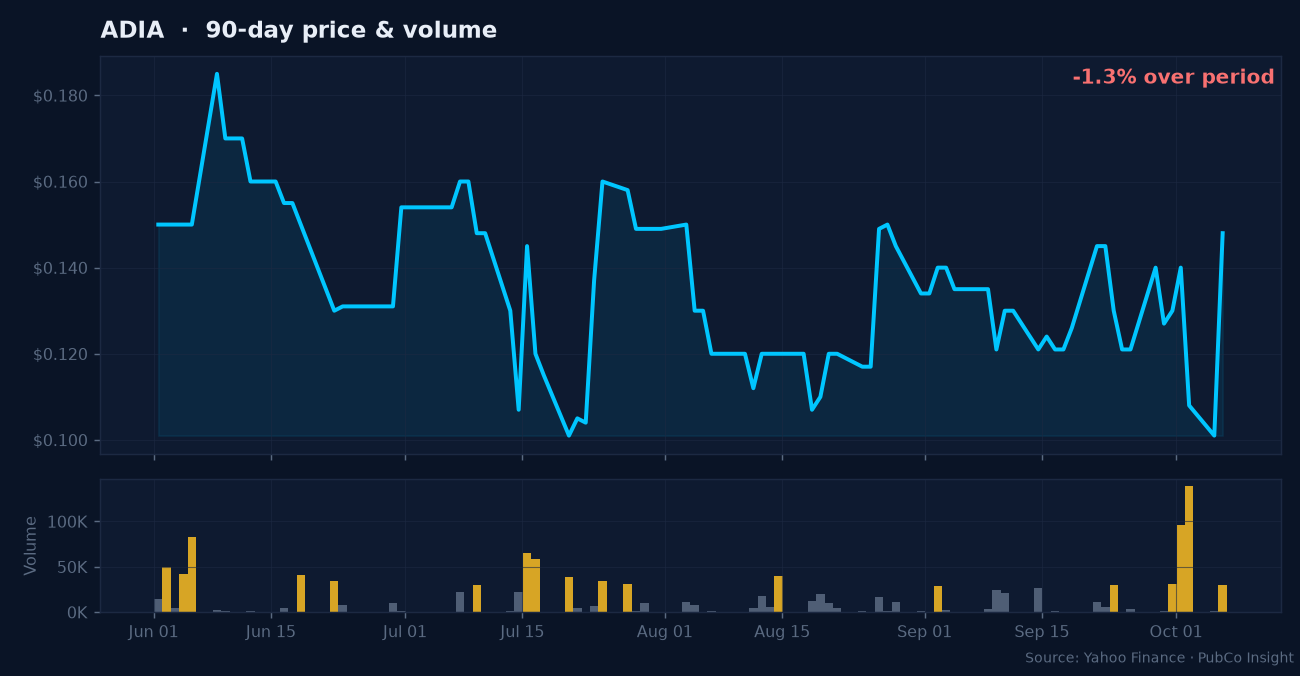
The 10-Q for the period ending September 30, 2026, outlines the financial reality. While the company has engaged in multiple material agreements, as evidenced by 8-K filings on October 19, 2026, October 6, 2026, and August 24, 2026, these activities do not negate the underlying financial challenges. The October 6, 2026, 8-K also detailed an acquisition, which can introduce both opportunities and further financial strain.
Investors should note the frequent 8-K activity. While some might interpret this as a sign of progress or strategic shifts, it is crucial to connect these events back to the company's stated financial condition. An acquisition or new agreement, however promising on paper, needs to be funded, and the going concern flag suggests that funding is a persistent challenge.
The company's market capitalization stands at approximately $11.7 million with 71.9 million shares outstanding. This valuation, combined with the explicit going concern warning, indicates a company operating on a tight rope. Any capital raises to address the going concern issue would likely involve further dilution for existing shareholders, a common outcome for companies in this position. For more on how these financings impact shareholders, see PubCo Insight's dilution risk tool.
Understanding the implications of a going concern warning is paramount. It means that, without additional financing or significant operational changes, the company may not be able to meet its obligations as they become due. For Adia Med, Inc., the flurry of corporate activity in recent months appears to be occurring against a backdrop of fundamental financial instability.
As always, retail investors should approach such situations with a clear understanding of the filings. The 10-Q is not merely a formality; it is a direct communication from management about the company's viability. Owning shares in a company with a going concern warning means acknowledging this inherent, material risk.