Aeon Acquisition I Corp. (AESP) Hits a Late-Filing Snag
AESP
Aeon Acquisition I Corp. (AESP), a blank check company, recently notified the market of a delay in filing its quarterly report. The company filed an NT 10-Q on November 17, 2026, indicating it would not be able to file its 10-Q on time, only to follow up with the actual 10-Q the very next day, November 18, 2026. For a Special Purpose Acquisition Company, or SPAC, such a quick turnaround from a notice of delinquency to a filing might seem reassuring, but the initial delay itself is a flag that merits attention.
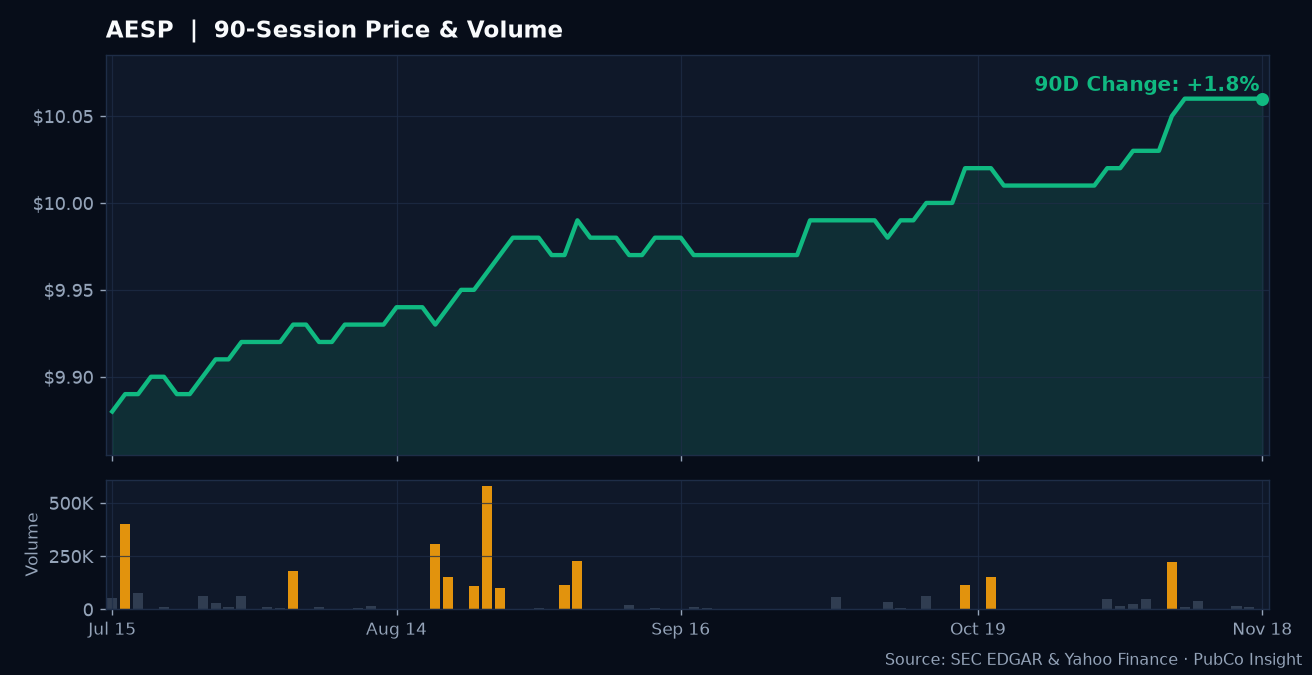
The purpose of a SPAC like AESP is to identify and merge with a private operating company, bringing it public. The market capitalization of Aeon Acquisition I Corp. currently sits at approximately $215 million, with 21.39 million shares outstanding. Given the 'blank check' nature, a SPAC's value is largely tied to its management team's ability to execute a timely and accretive business combination, and its adherence to regulatory schedules.
While the 10-Q ultimately arrived, the sequence of an NT 10-Q followed immediately by the 10-Q suggests a last-minute scramble to meet reporting obligations. This is not the hallmark of a smoothly operating public entity, especially one whose primary function is to inspire confidence in a future acquisition. Timely and transparent financial reporting is a foundational expectation for any public company, and particularly for a SPAC where investors are essentially trusting a management team with a pool of capital.
Investors in blank check companies are essentially buying a promise. That promise includes not just the eventual acquisition, but also the interim stewardship of capital and adherence to public company obligations. A late filing, even a briefly late one, can signal internal control issues or resource constraints that might affect the company's ability to complete its core mission. For shareholders, this kind of procedural misstep can erode confidence in management's operational discipline.
Understanding the implications of such delays is crucial. While AESP avoided becoming a non-current filer for an extended period, the initial NT 10-Q is a formal admission of a reporting problem. Shareholders should always consider the context of such events, especially in a sector where the entire investment thesis hinges on eventual execution and regulatory compliance. Know what you own, and in the case of a blank check company, that includes scrutinizing its procedural integrity as much as its market potential.