AppTech Payments Corp. (APCX) Pairs New Debt Obligations with Fresh Equity Issuance
APCX
When a sub-ten-million-dollar software outfit repeatedly visits the filing desk to log material agreements, debt obligations, and unregistered share issuances all in the same breath, ordinary shareholders ought to pay close attention to the structural cost of keeping the lights on. AppTech Payments Corp. sits on the OTC market with a market capitalization of roughly $7.1 million and 33.28 million shares outstanding, but its recent EDGAR footprint tells a story dominated by balance-sheet maneuvering rather than operational breakthroughs.
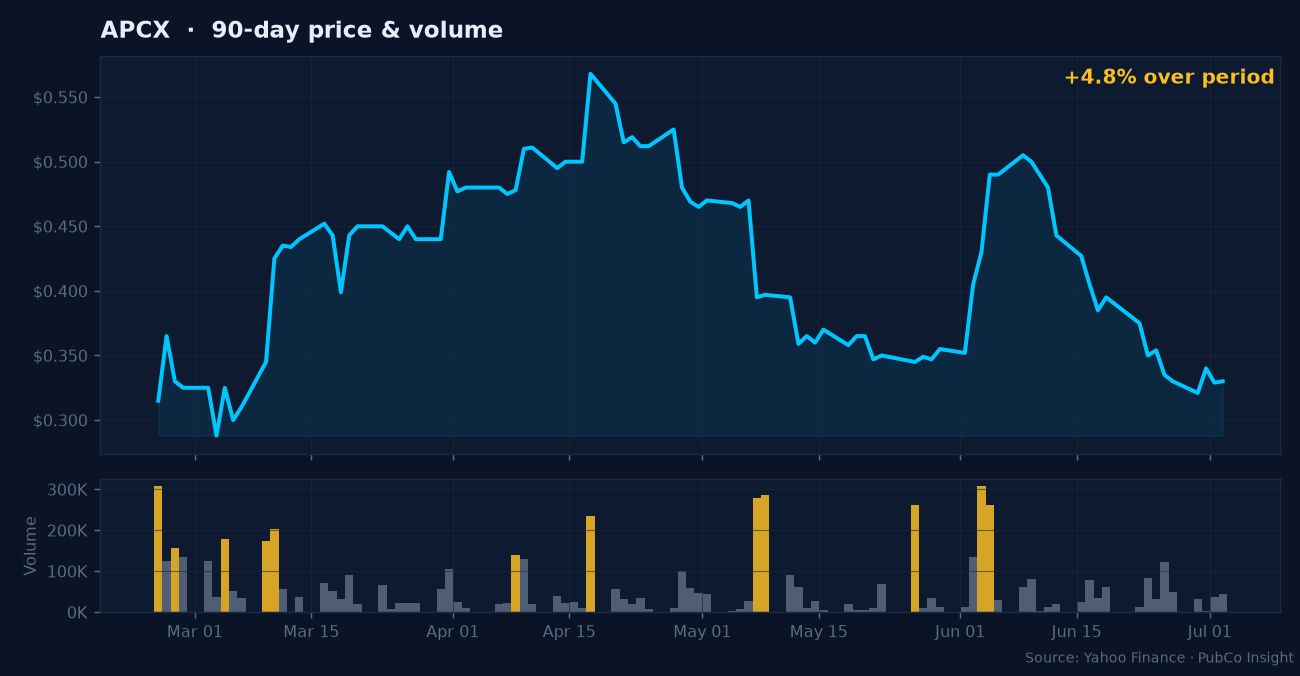
On October 5, 2026, AppTech Payments Corp. dropped an 8-K reporting an array of critical regulatory items: Item 1.01 for an entry into a material definitive agreement, Item 2.03 for the creation of a direct financial obligation, and Item 3.02 for an unregistered sale of equity securities. When Item 2.03 and Item 3.02 arrive together, the playbook is familiar. Rather than tapping conventional bank credit, micro-cap entities frequently lean on structured agreements that bundle fresh liabilities directly with equity consideration or conversion features.
This October action was not an isolated event. It represents the third time in quick succession that AppTech Payments Corp. has reported material agreements coupled with direct debt obligations, following similar Item 1.01 and Item 2.03 entries logged on July 21 and August 14. Investors monitoring these recurring financings can track the mechanics through our dilution risk tools, which gauge how repeated reliance on equity-linked obligations tends to pressure public float structures over time.
Adding another layer to the narrative, AppTech Payments Corp. followed up immediately on October 6, 2026, with an 8-K under Item 5.02, signaling changes involving directors or principal officers. Coupled with a cluster of Form 4 filings by company insiders spanning late August and early September, the company is undergoing executive realignment at the exact moment its capital structure is taking on new obligations and unregistered equity issuance.
None of this requires a cynical leap of imagination; it simply demands reading the docket as filed. For retail investors examining AppTech Payments Corp., the central question is whether incoming capital can generate meaningful operational returns before repeated debt creation and equity issuance dilute existing ownership stakes into smaller fractions.
Primary sources (SEC EDGAR)
8-K 2026-10-06: https://www.sec.gov/Archives/edgar/data/1070050/000168316826007665/apptech_8k.htm8-K 2026-10-05: https://www.sec.gov/Archives/edgar/data/1070050/000168316826007621/apptech_8k.htm4 2026-09-03: https://www.sec.gov/Archives/edgar/data/1070050/000168316826006934/xslF345X06/ownership.xml4 2026-08-31: https://www.sec.gov/Archives/edgar/data/1070050/000168316826006834/xslF345X06/ownership.xml4 2026-08-31: https://www.sec.gov/Archives/edgar/data/1070050/000168316826006833/xslF345X06/ownership.xml4 2026-08-26: https://www.sec.gov/Archives/edgar/data/1070050/000168316826006735/xslF345X06/ownership.xmlSee the dilution and promotion flags before you see the pitch.
Each week: the micro and small-caps now showing dilution or paid-promotion signals, with the SEC filing behind every flag. No recommendations, no price targets.