AppTech Payments (APCX) Navigates Debt Amidst Going Concern Warning
APCX
AppTech Payments Corp. (APCX) has been busy on the financing front, but the fine print in its recent 10-Q filing from November 16, 2026, details a 'going concern' warning. This disclosure indicates substantial doubt about the company's ability to continue as an operating entity without further funding. For a micro-cap company with a market capitalization around $4.2 million and 33.28 million shares outstanding, such a warning is not a mere formality.
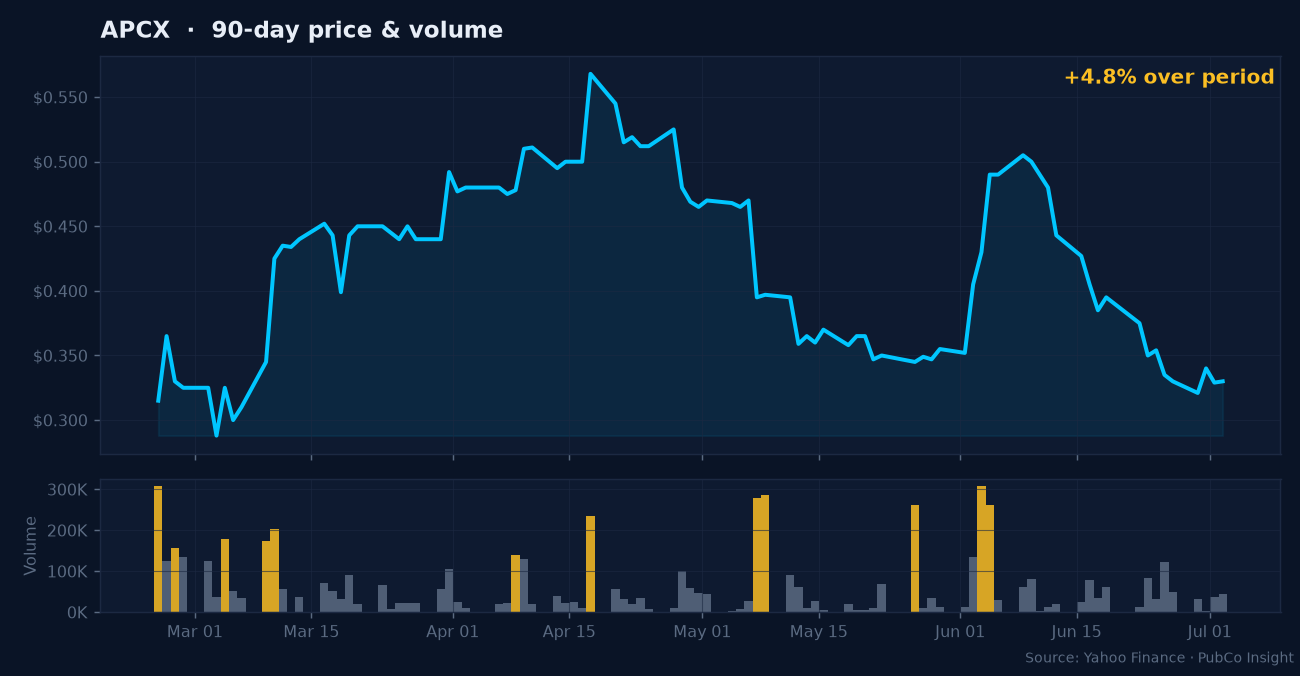
The company's November 17, 2026, 8-K filing further clarifies the ongoing financial maneuvers, detailing a material agreement under Item 1.01 and Item 2.03. This follows a previous 8-K on October 5, 2026, which also reported a material agreement and new debt. While these filings show an active effort to secure financing, they also underscore the persistent need for capital to sustain operations.
A going concern warning, particularly when coupled with repeated debt agreements, suggests that the company's current financial position is not self-sustaining. This often leads to dilution risk as companies frequently resort to issuing new shares to raise necessary funds, which can depress the value of existing holdings. Investors should pay close attention to the terms of these financing arrangements and any future equity raises.
The October 23, 2026, 8-K, which includes Item 7.01, provides little additional financial clarity, often indicating either a limited operational update or a non-material event. Meanwhile, the October 6, 2026, 8-K on Item 5.02, relating to changes in officers, further adds to the picture of a company in flux, potentially responding to its financial pressures.
For retail investors, the takeaway is straightforward: AppTech Payments Corp. is operating under a cloud of financial uncertainty. The going concern warning in the 10-Q is a direct signal from the company itself about its financial viability. While management is clearly working to secure funding, the continuous need for new debt or equity raises means shareholders must understand the potential for future share dilution and the inherent risks in a company facing such challenges.