Tribeca Strategic Acquisition Corp. (BID): A SPAC with No Target, But Plenty of Filings
BID
Tribeca Strategic Acquisition Corp. (BID) has been busy filing, but not with news of a merger target. The company, a blank check entity, has submitted multiple Schedule 13G reports and quarterly 10-Qs, all while its core purpose, identifying and acquiring an operating business, remains unfulfilled. For a Special Purpose Acquisition Company (SPAC) like BID, the clock is always ticking, and the absence of a definitive merger agreement introduces a unique set of considerations for investors.
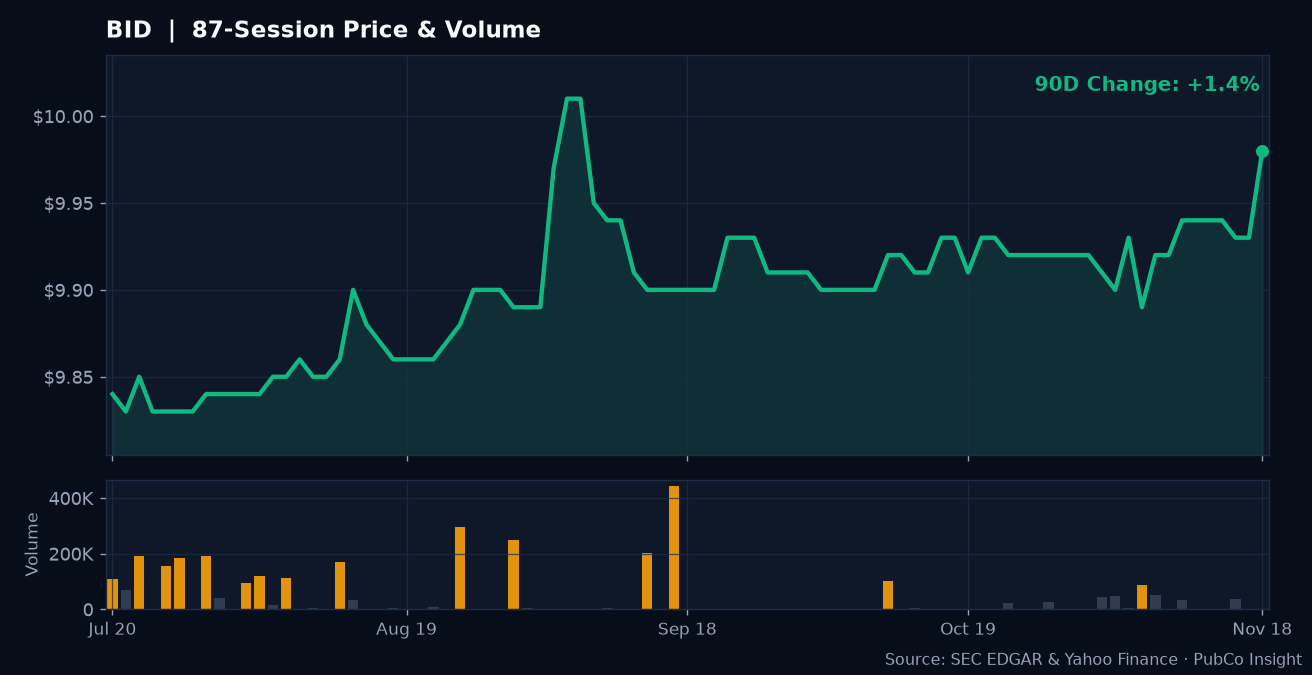
The regular cadence of Schedule 13G filings, including an amendment on November 17, 2026, and new reports in October and November 2026, indicates ongoing shareholder activity. However, these filings primarily reflect passive ownership stakes, not progress towards a business combination. The significant detail for shareholders lies in the company's 10-Q reports, filed on November 16, 2026, and August 14, 2026. These documents typically outline the company's financial position, which for a SPAC without a target, largely consists of cash held in trust and operating expenses.
For investors in a blank check company, the primary risk often centers on the eventual business combination, or lack thereof. A SPAC's charter usually stipulates a deadline by which it must complete an acquisition. If no suitable target is found, the company typically liquidates, returning capital to public shareholders, often at or near the initial offering price of the units, less any redemptions and operating costs. While this may seem like a floor, the opportunity cost and potential for extended periods with capital tied up are real factors.
The current state of Tribeca Strategic Acquisition Corp. as a blank check with ongoing operational costs, but no announced acquisition, means that its value is largely tied to the cash held in trust. Any deviation from a timely and successful business combination can lead to a return of capital that may not meet investor expectations, especially for those who acquired shares above the trust value in anticipation of a high-growth merger.
While the filings show compliance with reporting obligations, they do not alleviate the fundamental uncertainty inherent in a SPAC that has yet to identify its path forward. Investors should consider the implications of holding shares in a company whose future depends entirely on an as-yet-undisclosed transaction, or a potential liquidation. Understanding these structural risks is crucial for anyone looking at BID shares.