1606 Corp. (CBDW): A Low Market Cap, High Share Count Reality
CBDW
1606 Corp. (CBDW) currently trades with a market capitalization hovering around $200,000, a figure that might suggest a tightly held, nascent operation. However, a quick look at the reported share count tells a different story: over 1.3 billion shares are outstanding. This creates a situation where even a modest market valuation is spread across an exceptionally large number of shares, implying a per-share value that is effectively negligible.
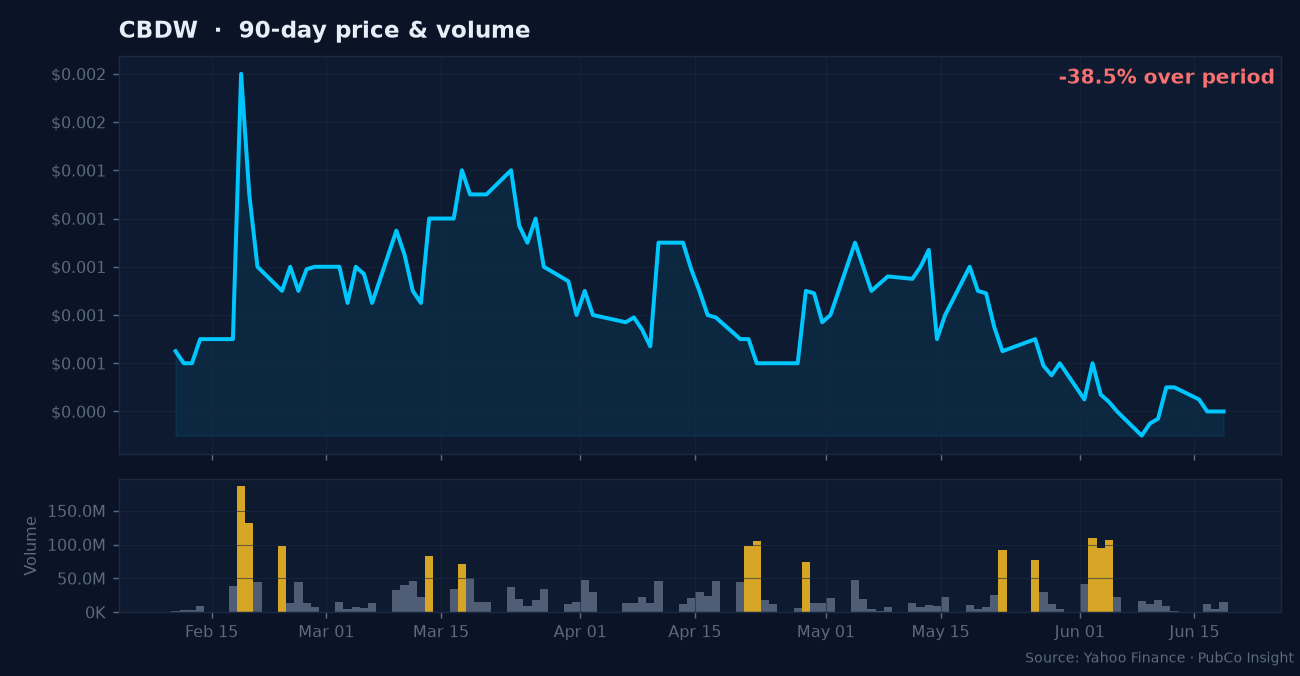
The company's recent filing activity consists primarily of a series of 8-K reports, with the most recent being on October 6, 2026. These filings, often used to disclose material events, do not paint a clear operational picture. More critically, a 10-Q filing, which would provide the necessary quarterly financial detail, was filed on November 16, 2026, but only for a period ending July 31, 2026. This means investors are operating without timely, comprehensive financial statements to assess the company's current health or operational trajectory.
For micro-cap companies like 1606 Corp., an elevated share count relative to market capitalization often indicates a history of significant share issuance, frequently to fund operations or settle debts. While the specific details of these issuances are not fully clear from the recent 8-Ks alone, the sheer volume of shares outstanding suggests that future financing, if any, could involve further dilution, potentially eroding the value of existing holdings. Investors interested in the mechanics of such share structures might find our dilution risk tool useful.
The absence of a robust, current financial overview makes it challenging to understand the company's burn rate, revenue generation, or overall solvency. Without these fundamentals, any investment thesis relies heavily on speculation rather than verifiable performance. The company's SIC description as "Services-Prepackaged Software" offers a sector, but without financial data, it remains just a label.
Ultimately, 1606 Corp. presents a common micro-cap scenario: a very low market cap combined with an extremely high share count, and a less-than-timely financial reporting cadence. For retail investors, understanding these structural factors is paramount. Owning a piece of a company with 1.3 billion shares outstanding and minimal market value requires a clear-eyed view of what that ownership truly entails.