Target Group Inc. (CBDY): A 10-Q Review Reveals Thin Operations Behind the Ticker
CBDY
Target Group Inc. (CBDY) maintains a public listing with a market capitalization under $1 million, yet a close look at its recent 10-Q filings reveals a company still in the very early stages of generating meaningful commercial activity. For the quarter ended September 30, 2026, and June 30, 2026, the company reported minimal revenue, indicating that its efforts in the medicinal chemicals and botanical products sector have yet to translate into significant sales.
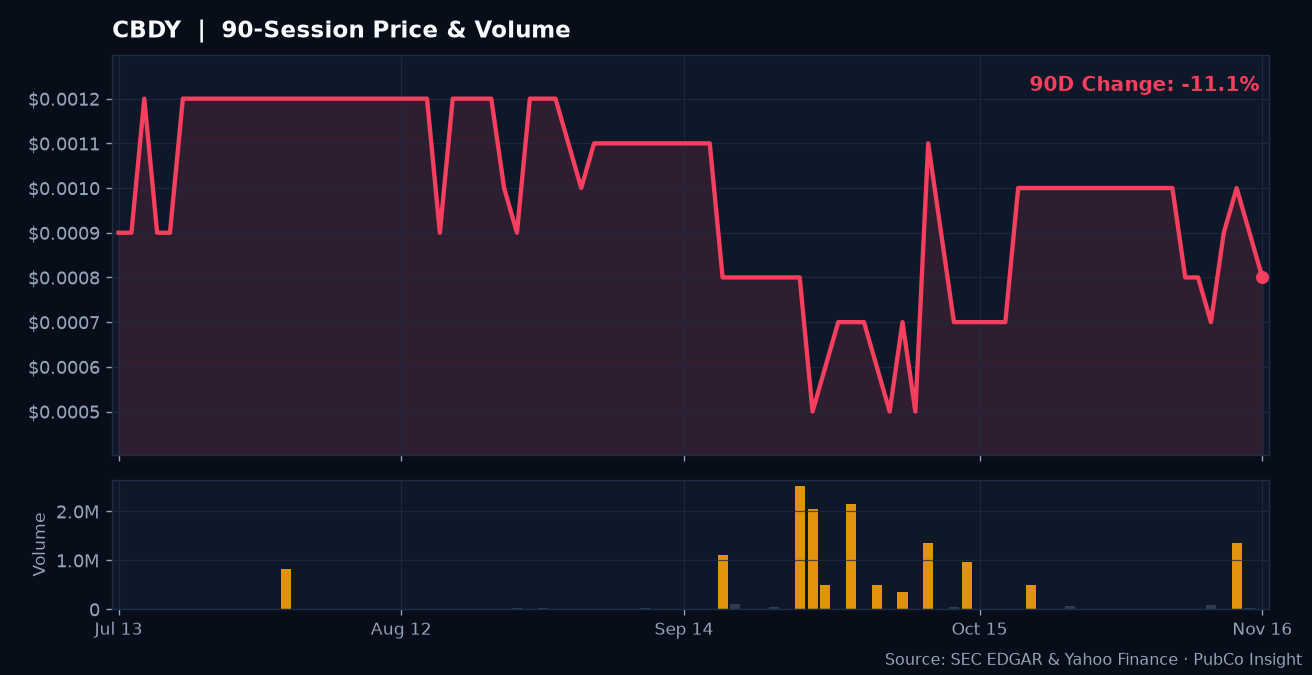
The September 30, 2026 10-Q filing, for instance, shows the company continuing to operate at a net loss. This trend is consistent with the prior quarter, where the June 30, 2026 filing also detailed ongoing operational expenses without a corresponding revenue stream robust enough to offset them. For retail investors looking at CBDY, these filings underscore a fundamental disconnect between the potential implied by a public listing and the current financial reality.
With 617.03 million shares outstanding and a microcap valuation, the company's financial results suggest that its primary activities are still more focused on organizational development or early-stage initiatives rather than established commercial operations. The lack of substantial revenue generation in its SEC reports means that any future growth or sustained operations would likely require additional capital. Such capital raises, particularly for microcap companies, often come with the potential for dilution to existing shareholders.
Target Group Inc.'s website indicates a focus on certain sectors, but the SEC filings provide the unvarnished financial picture. When a company's financial statements consistently show negligible revenue and ongoing losses, it indicates a significant uphill battle to achieve profitability and sustainable operations. This is not unusual for early-stage ventures, but it is a critical factor for investors to weigh when evaluating the company's prospects.
Ultimately, for anyone considering Target Group Inc. (CBDY), the filings paint a clear picture: this is a company where the commercial engine is barely idling. Understanding these basic financial realities, rather than relying on market chatter or sector-wide narratives, is essential to knowing what you own.