Chain Bridge I (CBGGF): A Blank Check with a Short Runway
CBGGF
Chain Bridge I (CBGGF) is a blank check company, or SPAC, that has yet to complete a business combination. Its recent 10-Q filing on November 16, 2026, alongside an 8-K from November 6, 2026, paints a picture of a company nearing the end of its initial mandate with no definitive deal in sight. The market narrative for SPACs often focuses on the promise of a future merger, but the filings show a more immediate concern: the clock is ticking.
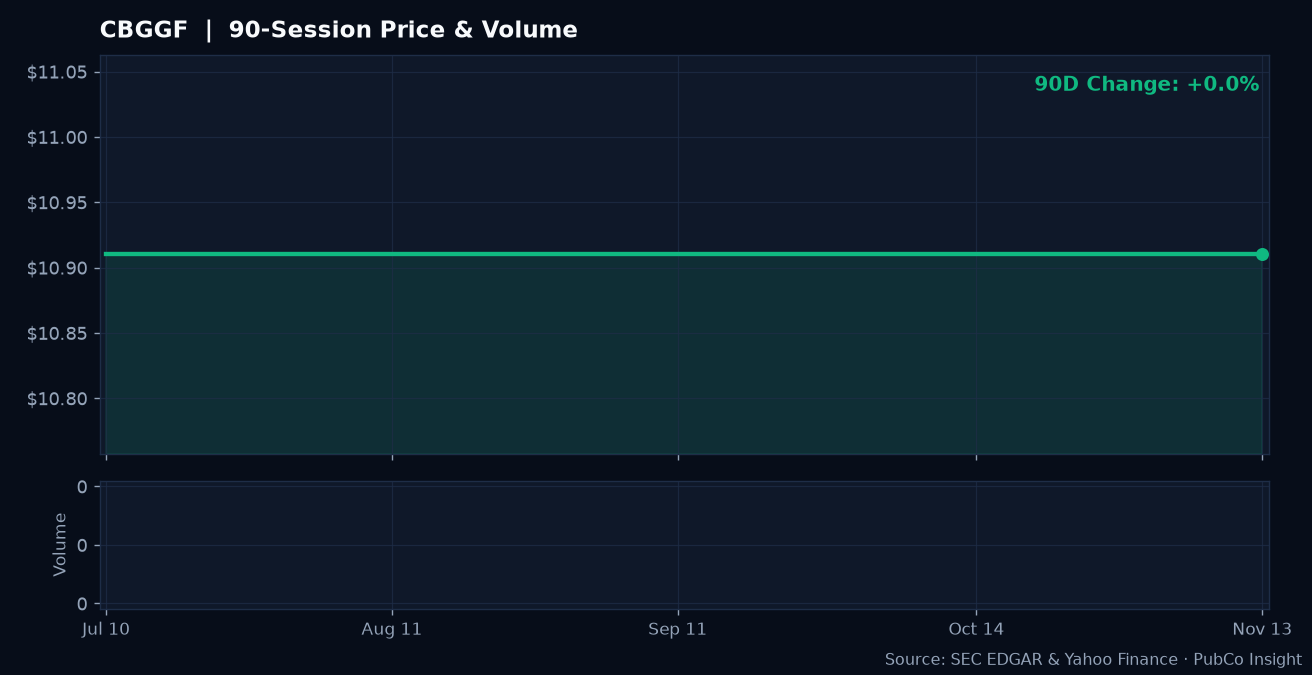
The November 6, 2026 8-K specifically details the results of a Special Meeting of Stockholders where a proposal to extend the deadline for completing a business combination was approved. This extension, however, is not indefinite. It pushed the liquidation date to May 2, 2027, or potentially earlier if a business combination is completed. For a blank check company, this extension is less a sign of progress and more an acknowledgment of the lack of it; the company needed more time because it hadn't found a target.
Shareholders should note the boilerplate in the 10-Q filed on November 16, 2026, which reiterates the company's going-concern disclosure. Without a business combination, the company's operations are limited to identifying a target, and its future is tied directly to either completing such a combination or liquidating. This is the fundamental contract of a SPAC, and for CBGGF, that contract is approaching its final terms.
The DEF 14A filing from October 2, 2026, further elaborated on the proposals for this extension, indicating management's efforts to keep the SPAC alive. While extensions are common in the SPAC world, they do not guarantee a successful merger. Instead, they often signal the difficulty in finding a suitable private company willing to go public via this route, or agreeing on terms. The extension simply provides a few more months to avoid the inevitable dissolution and return of trust funds to remaining shareholders.
For retail investors, understanding a SPAC means understanding its lifecycle. Chain Bridge I is in the late stages of that cycle, having extended its search period. The primary risk here is not operational, but structural: the company's value will converge to its trust value if no merger occurs, or it will execute a merger that may or may not create long-term value. The current situation suggests the former is a real possibility, despite the extension.
Knowing what you own in a blank check company means understanding its finite lifespan and the binary outcome of a business combination versus liquidation. For Chain Bridge I, the recent filings underscore that this decision point is now much closer on the horizon.
Get emailed the day $CBGGF files with the SEC.
Receive a source-linked alert when Chain Bridge I posts a new 8-K, 10-Q, 10-K or S-1 on EDGAR, plus our Thursday flags and down-market holdouts briefing. Free, no buy or sell pitches.