AMERICAS CARMART INC (CRMT): When Material Agreements Become a Weekly Habit
CRMT
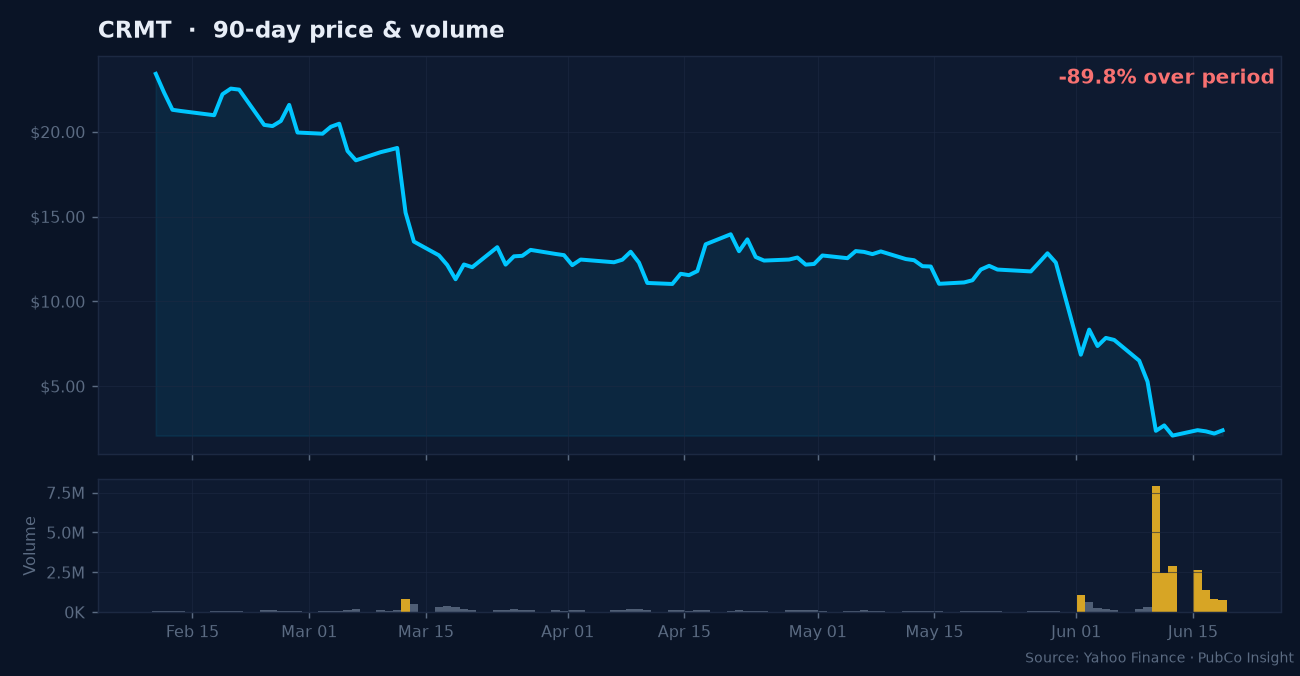
When a public company starts filing Form 8-K disclosures like clockwork every seven days, it is rarely announcing good news at a leisurely pace. For AMERICAS CARMART INC, the SEC Edgar log over September and October 2026 reads less like an occasional corporate update and more like an ongoing operational triage. Retail investors watching CRMT are looking at an equity valuation of roughly $6.6 million spread across 8.34 million shares, yet the company has generated a dizzying sequence of material definitive agreements and debt disclosures.
The cadence alone demands attention. Between September 4 and October 21, 2026, AMERICAS CARMART INC logged seven distinct Form 8-K filings triggering Item 1.01 for entry into material definitive agreements. By October 21, that paper trail expanded to include Item 2.03, formalizing the creation of a direct financial obligation or an obligation under an off-balance sheet arrangement. When a micro-cap dealership operator enters into binding commitments this frequently, the balance sheet is almost always undergoing rapid, pressurized restructuring.
Frequent debt amendments and bespoke financing pacts come at a steep cost for common shareholders. While headline operational metrics often draw the crowd, structured obligations can quietly shift priority away from equity holders. Investors assessing this sudden flurry of commitments should examine the underlying capital structure using tools like PubCo Insight dilution risk tracker to see how future debt covenants or conversion features might affect existing share ownership over time.
A Nasdaq listing and an active news footprint, with 13 news items flagged across three sources over a recent two-week stretch, can easily create the illusion of business as usual. Yet beneath the headlines, the filings reveal an organization repeatedly returning to the negotiating table. When a company with an equity base of just $6.6 million executes multiple weekly material agreements, those contracts dictate the rules of survival.
Understanding the difference between corporate momentum and structural defense is essential. AMERICAS CARMART INC may be maintaining its presence on the exchange, but its recent regulatory footprint points directly to binding financial arrangements that common shareholders must read closely before assuming the worst is priced in.
Primary sources (SEC EDGAR)
8-K 2026-10-21: https://www.sec.gov/Archives/edgar/data/799850/000117184326006742/f8k_102126.htm8-K 2026-10-15: https://www.sec.gov/Archives/edgar/data/799850/000117184326006667/f8k_101526.htm8-K 2026-10-08: https://www.sec.gov/Archives/edgar/data/799850/000117184326006538/f8k_100826.htm4 2026-10-02: https://www.sec.gov/Archives/edgar/data/799850/000168316826007590/xslF345X06/ownership.xml8-K 2026-10-01: https://www.sec.gov/Archives/edgar/data/799850/000117184326006326/f8k_093026.htm4 2026-09-25: https://www.sec.gov/Archives/edgar/data/799850/000168316826007427/xslF345X06/ownership.xmlSee the dilution and promotion flags before you see the pitch.
Each week: the micro and small-caps now showing dilution or paid-promotion signals, with the SEC filing behind every flag. No recommendations, no price targets.