Niocorp Developments Ltd. (NB): Cash Burn Continues Amidst Financing Efforts
NB
Niocorp Developments Ltd. (NB) continues its quest to develop a rare earth and critical minerals project in Nebraska, a story often presented with significant promise. However, a look at the most recent 10-Q filing for the period ending September 30, 2026, reveals the unglamorous reality of a company still in its development phase, consistently burning cash, and heavily reliant on external financing.
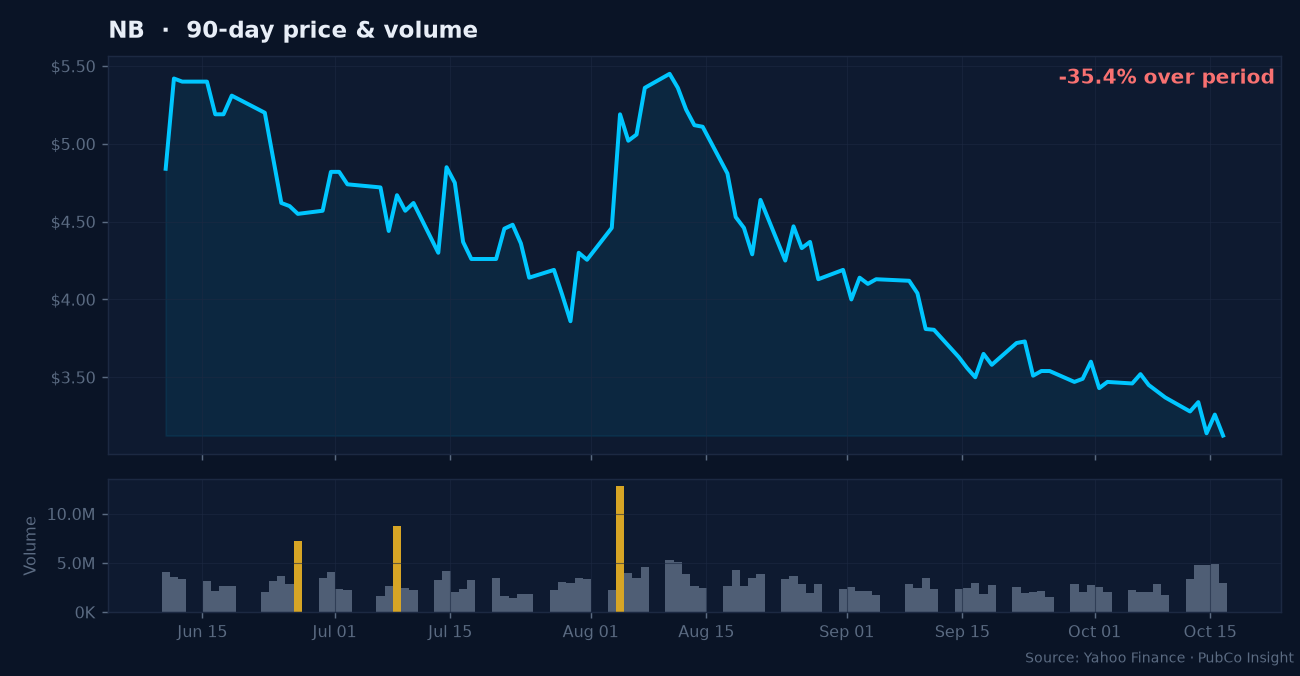
The September 30, 2026 10-Q highlights the persistent capital demands. The company reported a significant net loss and negative operating cash flow, which is typical for a pre-revenue mining exploration and development firm. What is critical for shareholders to grasp is that this burn rate necessitates continuous access to capital, and that capital often comes with strings attached for existing equity holders.
While the long-term vision for critical minerals is compelling, the immediate financial picture for Niocorp Developments Ltd. is one of ongoing dilution risk. Developing a large-scale mining project from the ground up is an immensely capital-intensive endeavor. The company's ability to secure the necessary funding without significantly impacting the existing share structure remains a key overhang. Investors should carefully consider how future financing rounds could affect their proportional ownership and the per-share value of their investment.
The company's strategic agreements, as noted in recent 8-K filings, often involve complex financing arrangements that can include debt, equity, or convertible instruments. These mechanisms, while essential for project advancement, directly contribute to the potential for further dilution. Understanding the terms of these agreements is paramount, as they dictate the future capital structure and the potential for a larger share count.
For any retail investor considering Niocorp Developments Ltd., the message is straightforward: know what you own. This is a company with a long development runway, requiring substantial capital infusions. The promise of future production is balanced by the present reality of significant cash burn and the structural risk of ongoing dilution to fund operations and project development. The filings paint a picture of a company executing a capital-intensive plan, not one nearing profitability without further financial engineering.