Intellia Therapeutics (NTLA): Biotech Hype Versus Cash Burn Reality
NTLA
Intellia Therapeutics, Inc. (NTLA) carries a market capitalization exceeding $1.3 billion, a valuation that suggests significant investor optimism. However, a deeper look into the company's recent 10-Q filing from November 5, 2026, reveals the unglamorous reality of its operational burn. For a company in the 'In Vitro & In Vivo Diagnostic Substances' sector, the path to profitability is often long and expensive, and NTLA is no exception.
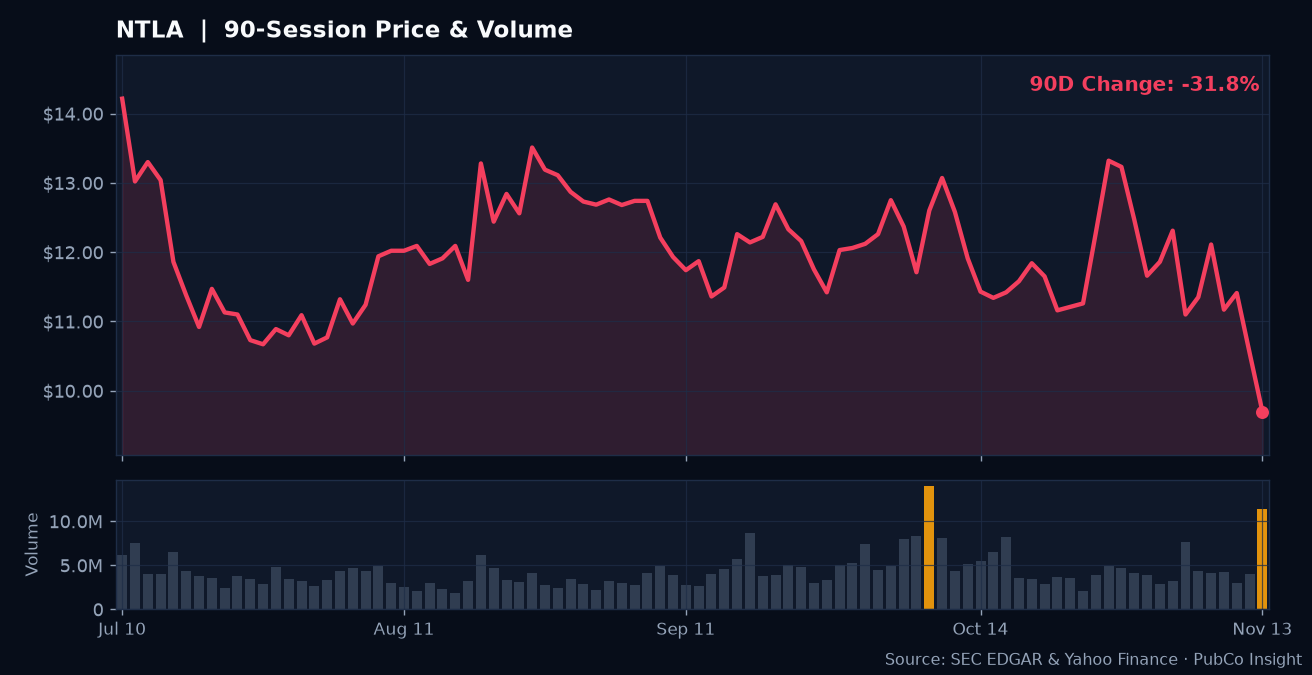
The 10-Q for the period ending September 30, 2026, details a net loss of $119.3 million for the three months ended September 30, 2026, and a net loss of $357.5 million for the nine months ended on the same date. These figures are not outliers; the company has consistently reported substantial losses, reflecting its intensive research and development activities. While R&D is the lifeblood of a biotech firm, it is also a significant drain on resources.
Shareholders should note that the company's balance sheet, as of September 30, 2026, shows cash, cash equivalents, and marketable securities totaling approximately $1.1 billion. While this appears to be a substantial war chest, it must be weighed against the ongoing cash consumption. At a burn rate of over $100 million per quarter, the runway, while not immediately critical, is finite. Investors often overlook the mechanics of how these cash reserves are replenished, which typically involves dilutive financing events.
The company's reliance on its existing cash and potential future financings to fund operations is a key risk. Biotech firms frequently turn to the capital markets to sustain their pipelines, which can lead to dilution for existing shareholders. While no immediate dilutive events are flagged in the most recent filings, the financial trajectory suggests that such considerations are part of the long-term operational calculus for Intellia Therapeutics.
For retail investors, understanding the relationship between a company's market valuation, its cash burn, and its financing needs is crucial. The current market capitalization of NTLA is built on future potential, but that potential requires continuous funding. Investors should know what they own, especially when that ownership is in a company with a high burn rate and a long path to commercialization.