Ocugen, Inc. (OCGN) Q3 Report Flags Ongoing Cash Burn and Shareholder Dilution
OCGN
Ocugen, Inc. (OCGN) recently filed its Q3 2026 10-Q, revealing a financial picture that continues to lean heavily on capital raises to fund operations. While the company's market capitalization stands near $296 million, the underlying financials in the latest filing underscore the persistent cash outflow common in pre-revenue biotech firms. For investors, the critical takeaway is not just the burn rate, but how it is being financed.
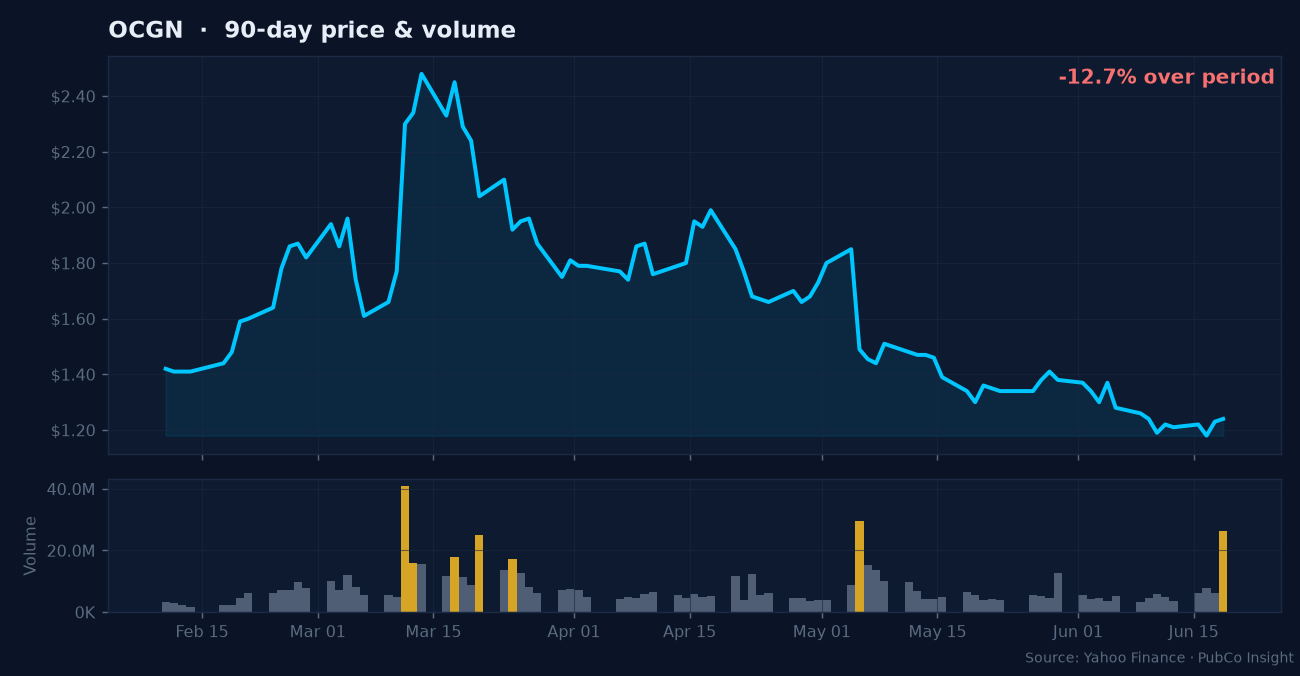
The 10-Q shows that Ocugen's operations consumed substantial cash during the period, a trend that has been consistent. With no approved products generating significant revenue, the company's clinical pipeline, while potentially promising, remains a net drain on resources. This structural reality means that, barring a sudden influx of non-dilutive capital, future funding will likely continue to come from equity sales, directly impacting existing shareholders through dilution.
Ocugen has a history of issuing shares to raise capital, a necessary but often unglamorous aspect of biotech development. With over 339 million shares outstanding, new equity offerings can quickly add to the share count, spreading future earnings, if any, across a larger base. Investors should consider how easily the current share count could expand further, given the ongoing need for funding to advance clinical trials and maintain operations. This is a common pattern for companies in this stage, and understanding the mechanics is key.
The recent 8-K filings, including those from mid-October, touch on material agreements and other corporate events, but they do not fundamentally alter the cash burn narrative presented in the 10-Q. These agreements often come with their own financial implications, which eventually feed back into the company's funding needs. For a deeper dive into how such capital raises can affect your stake, our dilution risk tool provides valuable context.
Ultimately, Ocugen's financial reports paint a clear picture: a biotech company with significant R&D expenses and a reliance on the capital markets. For retail investors, the prudent approach is to focus on the balance sheet and cash flow statements, understanding that every dollar spent on development must be sourced, often through means that expand the share base. Knowing what you own means understanding the financial engine driving the company, not just the clinical headlines.
Primary sources (SEC EDGAR)
10-Q 2026-11-04: https://www.sec.gov/Archives/edgar/data/1372299/000162828026069835/ocgn-20260930.htm8-K 2026-11-04: https://www.sec.gov/Archives/edgar/data/1372299/000110465926122401/tm2628896d1_8k.htm8-K 2026-10-15: https://www.sec.gov/Archives/edgar/data/1372299/000110465926115970/tm2627592d2_8k.htm8-K 2026-10-15: https://www.sec.gov/Archives/edgar/data/1372299/000110465926115921/tm2627592d1_8k.htm4 2026-10-13: https://www.sec.gov/Archives/edgar/data/1372299/000162828026065797/xslF345X06/wk-form4_1791940019.xml144 2026-10-09: https://www.sec.gov/Archives/edgar/data/1372299/000162828026065563/xsl144X01/primary_doc.xmlSee the dilution and promotion flags before you see the pitch.
Each week: the micro and small-caps now showing dilution or paid-promotion signals, with the SEC filing behind every flag. No recommendations, no price targets.