Red Cat Holdings, Inc. (RCAT): Growth Narratives Meet Ongoing Shelf Capacity
RCAT
When a defense-tech name trades with a market capitalization north of $676 million, the public narrative typically focuses on multi-source headlines and contract anticipation. For Red Cat Holdings, Inc., that attention has translated into real trading interest. Yet underneath the buzz surrounding recent operational developments, the regulatory docket reveals the familiar corporate plumbing of an expanding small-cap: persistent equity mechanisms and steady paper flow.
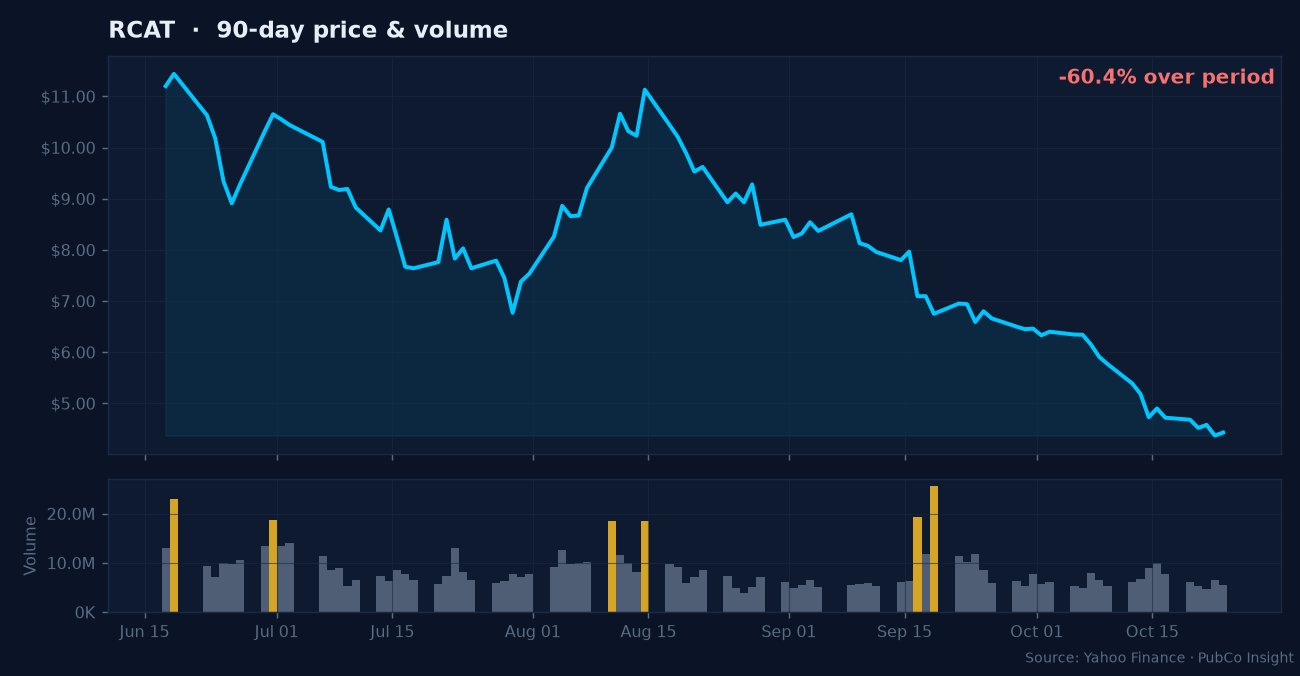
A review of the EDGAR trail shows an active October, anchored by an 8-K filing on October 23 flagging an Item 1.01 entry into a material definitive agreement alongside Item 8.01 other events. That contract milestone landed against a backdrop of regular insider transaction reporting, with multiple Form 4 disclosures recorded throughout September and October. Notably, a Form 144 filing appeared on October 15, documenting proposed sales of restricted stock by affiliates just as corporate news began to heat up.
Operational milestones require capital, and Red Cat Holdings, Inc. has spent recent cycles building the infrastructure to tap the equity markets. The company's recent regulatory history includes registration statements under Form S-3, two 424B prospectus supplements, and an Item 3.02 disclosure for unregistered equity sales. For public equity investors, keeping track of how rapidly authorized paper turns into outstanding shares is essential, and our dilution risk tracker maps how these shelf facilities can quietly alter share counts over time.
With roughly 152.7 million shares outstanding and ongoing reliance on capital markets to fund its footprint, the primary structural consideration is whether future commercial agreements can outpace equity expansion. Material contracts recorded under Item 1.01 represent real business activity, but secondary offerings and continuous distribution facilities can quietly dilute upside if share volume accelerates ahead of gross margins.
Retail market participants often price in future contract potential without accounting for the structural friction of insider liquidity and shelf registrations. Understanding the risk profile here means looking past the defense-sector narrative to examine how corporate agreements are funded and what those filings mean for long-term equity per share.
Primary sources (SEC EDGAR)
8-K 2026-10-23: https://www.sec.gov/Archives/edgar/data/748268/000149315226048228/form8-k.htm4 2026-10-19: https://www.sec.gov/Archives/edgar/data/748268/000162828026066340/xslF345X06/wk-form4_1792444375.xml144 2026-10-15: https://www.sec.gov/Archives/edgar/data/748268/000194984626000615/xsl144X01/primary_doc.xml4 2026-10-06: https://www.sec.gov/Archives/edgar/data/748268/000162828026065236/xslF345X06/wk-form4_1791317560.xml4 2026-09-17: https://www.sec.gov/Archives/edgar/data/748268/000149315226043191/xslF345X06/ownership.xml4 2026-09-01: https://www.sec.gov/Archives/edgar/data/748268/000149315226041010/xslF345X06/ownership.xmlSee the dilution and promotion flags before you see the pitch.
Each week: the micro and small-caps now showing dilution or paid-promotion signals, with the SEC filing behind every flag. No recommendations, no price targets.