Red Cat Holdings (RCAT) Sees New Share Issuances Amidst Market Activity
RCAT
Red Cat Holdings, Inc. (RCAT) has been generating market buzz, yet a closer look at recent SEC filings paints a more nuanced picture than headlines might suggest. While the company's market capitalization stands at a robust $616 million, the underlying mechanics of its capital structure, particularly around share issuances, warrant careful consideration for retail investors.
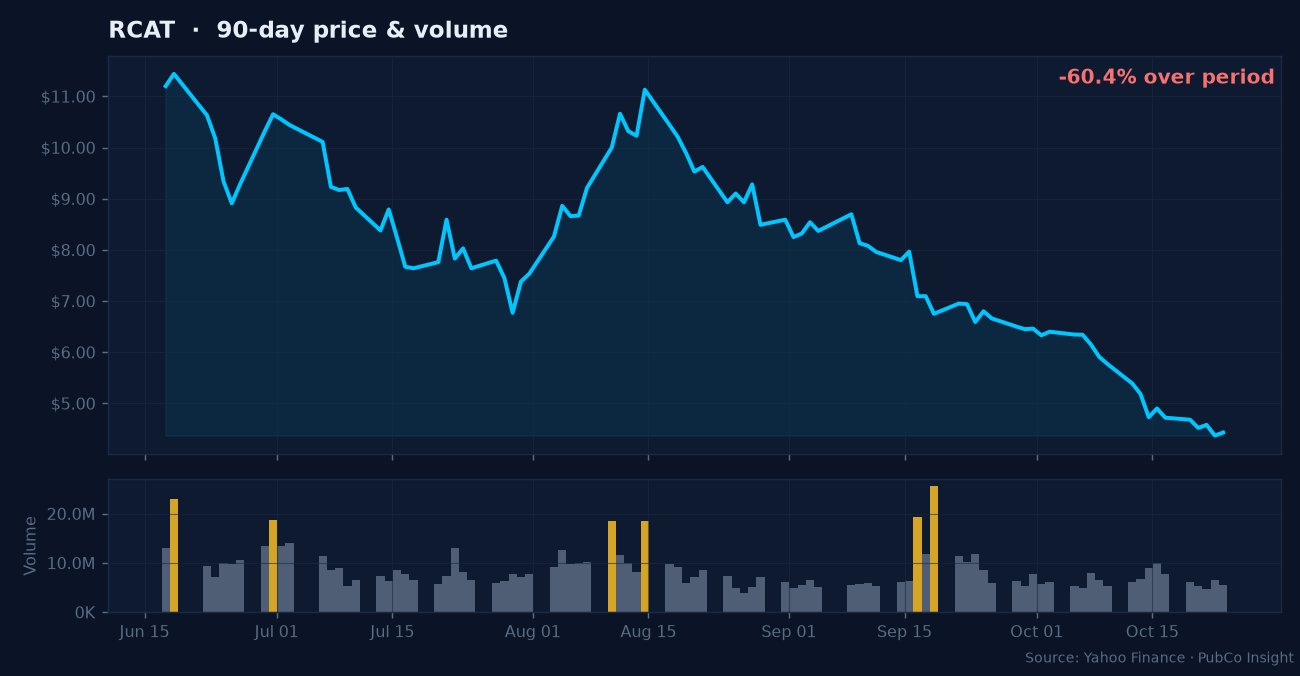
An 8-K filed on October 23, 2026, disclosed a material agreement, which, while potentially positive for operations, often carries financial implications. In conjunction with this, a series of Form 4 filings on October 30, 2026, and an earlier one on October 19, 2026, indicate ongoing insider transactions. While these forms track changes in ownership, they also signal a dynamic capital structure.
With 152.71 million shares currently outstanding, the consistent appearance of filings related to share activity suggests that investors should be mindful of potential dilution risk. The company's recent 8-K filing, combined with the frequency of Form 4s, highlights that changes in the share count or ownership structure are an active component of RCAT's financial landscape. This isn't necessarily a red flag for malfeasance, but it is a signal that the total number of shares available in the market could increase, which can impact per-share metrics.
PubCo Insight’s analysis of RCAT's filings points to a 'dilution risk' score of 6 and a 'promotion risk' of 11. These scores are derived from factors like the presence of 424B filings and recent quarterly reports, which often precede or accompany share offerings. For a company with RCAT's market cap, understanding these structural elements is as critical as following operational news.
Ultimately, the story of Red Cat Holdings, Inc. is not just about its sector or reported progress, but also about the financial plumbing beneath. Investors should always reconcile market narratives with the unglamorous reality found in SEC filings. Knowing what you own means understanding how shares are created and distributed, not just how they trade.
Primary sources (SEC EDGAR)
4 2026-10-30: https://www.sec.gov/Archives/edgar/data/748268/000149315226049498/xslF345X06/ownership.xml4 2026-10-30: https://www.sec.gov/Archives/edgar/data/748268/000149315226049496/xslF345X06/ownership.xml4 2026-10-30: https://www.sec.gov/Archives/edgar/data/748268/000149315226049494/xslF345X06/ownership.xml4 2026-10-30: https://www.sec.gov/Archives/edgar/data/748268/000149315226049492/xslF345X06/ownership.xml8-K 2026-10-23: https://www.sec.gov/Archives/edgar/data/748268/000149315226048228/form8-k.htm4 2026-10-19: https://www.sec.gov/Archives/edgar/data/748268/000162828026066340/xslF345X06/wk-form4_1792444375.xmlSee the dilution and promotion flags before you see the pitch.
Each week: the micro and small-caps now showing dilution or paid-promotion signals, with the SEC filing behind every flag. No recommendations, no price targets.