TLRY Files Its Q1 Numbers While Proxy Machinery Keeps Capital Wheels Turning
TLRY
Tilray Brands, Inc. continues to operate under the harsh glare of retail attention, but reading past the quarterly earnings release tells the quieter story of modern corporate maintenance. On October 8, 2026, the company dropped its latest Form 10-Q alongside an Item 2.02 Form 8-K, offering market participants their scheduled update on the top and bottom lines. While retail chat boards invariably chase the headline figures, seasoned filings readers know the operational narrative is only half the battle.
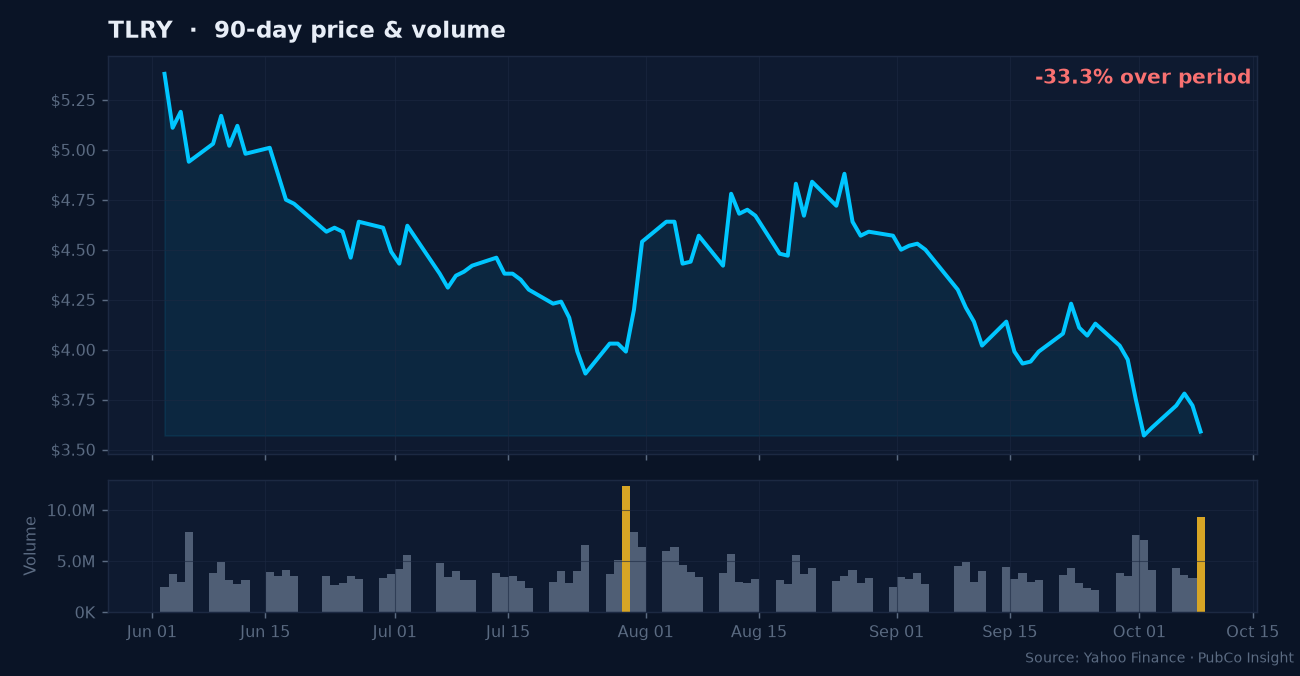
The company currently carries a market capitalization of approximately $464 million against a share count of 136.2 million shares. In the weeks leading directly into the quarterly report, corporate filings were dominated not by operational breakthroughs, but by proxy statements. A preliminary proxy on September 18, 2026, was swiftly followed by a definitive DEF 14A, an additional definitive proxy soliciting material filing, and an annual report submission on September 28, 2026.
Proxy season is where share authorizations, executive compensation structures, and corporate governance mechanics are actually codified. Tilray Brands, Inc. shows ongoing structural activity reflected in past prospectus supplements and proxy machinery. For investors trying to map out equity exposure, tracking the pipeline of past offerings alongside proxy authorizations is essential. Investors monitoring share issuance mechanics can track similar corporate profiles through our dilution risk tools to see how structural share expansion impacts microcap and mid-tier operators alike.
Earnings releases under Item 2.02 offer snapshot views of operational performance, but they rarely alter the underlying math of outstanding shares. When a company pairs regular quarterly reports with heavy proxy documentation, the capital structure demands just as much scrutiny as the revenue line. Knowing what you own in TLRY means looking beyond quarterly headlines and understanding how corporate machinery governs the share count over time.
Primary sources (SEC EDGAR)
10-Q 2026-10-08: https://www.sec.gov/Archives/edgar/data/1731348/000143774926032382/tlry20260831_10q.htm8-K 2026-10-08: https://www.sec.gov/Archives/edgar/data/1731348/000117184326006527/f8k_100826.htmARS 2026-09-28: https://www.sec.gov/Archives/edgar/data/1731348/000114036126037852/ny20076749x5_ars.pdfDEFA14A 2026-09-28: https://www.sec.gov/Archives/edgar/data/1731348/000114036126037828/ny20076749x3_defa14a.htmDEF 14A 2026-09-28: https://www.sec.gov/Archives/edgar/data/1731348/000114036126037827/ny20076749x2_def14a.htmPRE 14A 2026-09-18: https://www.sec.gov/Archives/edgar/data/1731348/000114036126037103/ny20076749x1_pre14a.htmSee the dilution and promotion flags before you see the pitch.
Each week: the micro and small-caps now showing dilution or paid-promotion signals, with the SEC filing behind every flag. No recommendations, no price targets.