Behind the Agassi Sports Entertainment Flurry: AASP Paper Trails Point to Rapid Issuance
AASP
Agassi Sports Entertainment Corp. has been keeping the SEC Edgar system remarkably busy lately, but the flurry of activity is not coming from blockbuster retail sales. Instead, the company has generated a steady stream of paperwork, leaving retail investors to decipher a complex trail of material agreements and private placements that could fundamentally reshape the share structure.
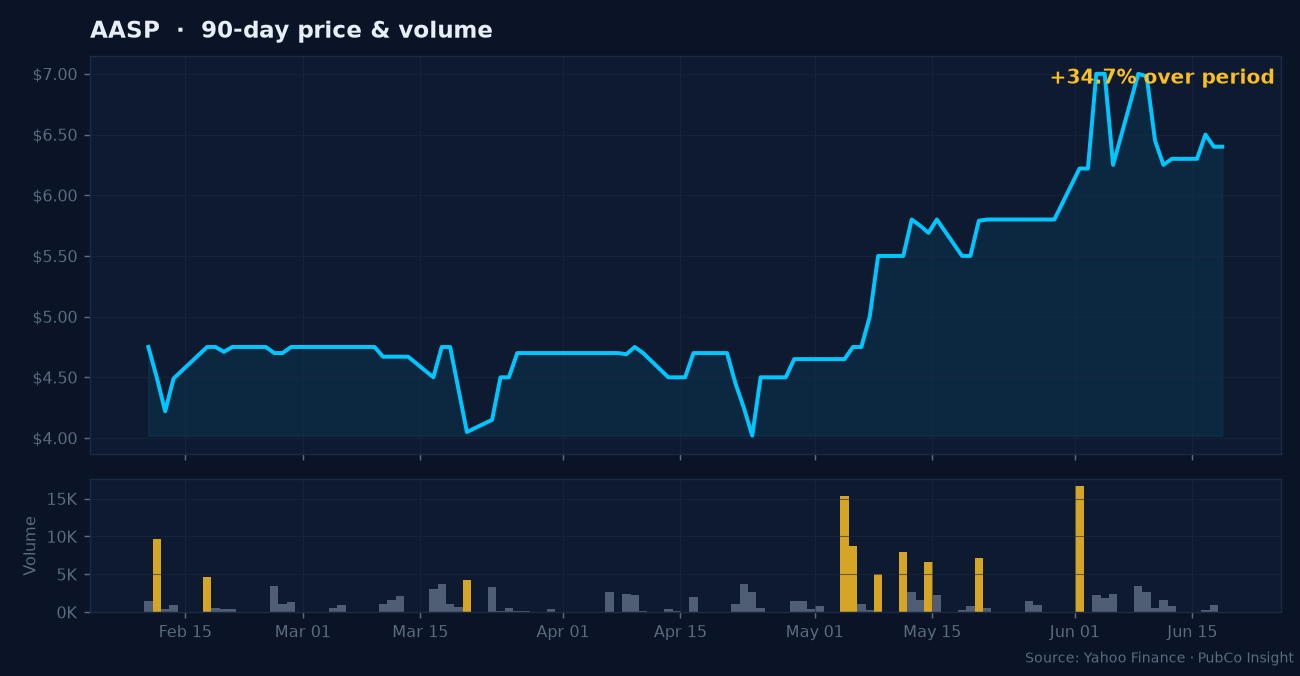
A look at the company filings from May and June 2026 reveals a rapid-fire sequence of 8-K reports. Specifically, the company filed 8-Ks on June 5 and June 10, both highlighting Item 1.01 for material agreements and Item 3.02 for the unregistered sales of equity securities. These consecutive filings indicate that Agassi Sports is actively issuing equity outside of public offerings, a classic mechanism that can dilute existing shareholders if the pace continues unchecked.
This issuance pattern is not a brand-new development. It follows an earlier 8-K on April 30, which also carried the same Item 1.01 and Item 3.02 designations. When a micro-cap company with a market capitalization of roughly 81.5 million dollars repeatedly issues unregistered equity, it suggests an ongoing reliance on private capital to fund its initiatives. The 10-Q filed on May 13 provides the financial backdrop to these transactions, laying out the balance sheet reality that necessitates these constant trips to the private placement well.
For retail investors, the risk is structural and mathematical rather than theoretical. Frequent Item 3.02 filings mean more shares are entering the ecosystem, which can put downward pressure on the stock price over time as those private buyers potentially seek liquidity. While the company brand may carry a high-profile name, the filings tell a much more sober story of financing hurdles and equity expansion. Know what you own, and remember that a company balance sheet always tells a more accurate story than a marketing presentation.
Primary sources (SEC EDGAR)
8-K 2026-06-10: https://www.sec.gov/Archives/edgar/data/930245/000147237526000160/ixform8k.htm8-K 2026-06-05: https://www.sec.gov/Archives/edgar/data/930245/000147237526000150/ixform8k.htm8-K 2026-05-26: https://www.sec.gov/Archives/edgar/data/930245/000147237526000145/ixform8k.htm10-Q 2026-05-13: https://www.sec.gov/Archives/edgar/data/930245/000147237526000143/ixform10q.htm4 2026-05-08: https://www.sec.gov/Archives/edgar/data/930245/000147237526000137/xslF345X06/primary_doc.xml8-K 2026-05-08: https://www.sec.gov/Archives/edgar/data/930245/000147237526000136/ixform8k.htmSee the dilution and promotion flags before you see the pitch.
Each week: the micro and small-caps now showing dilution or paid-promotion signals, with the SEC filing behind every flag. No recommendations, no price targets.