Behind the Flurry of Material Agreements at Agassi Sports Entertainment Corp. (AASP)
AASP
Agassi Sports Entertainment Corp. (AASP) has been keeping the SEC filing system remarkably warm this summer, spinning out a rapid-fire sequence of material agreements and corporate adjustments that suggest a business in a state of constant restructuring. For a micro-cap company with a market capitalization of roughly 85 million dollars, this high-frequency paper trail demands a closer look than the average retail trader usually gives it.
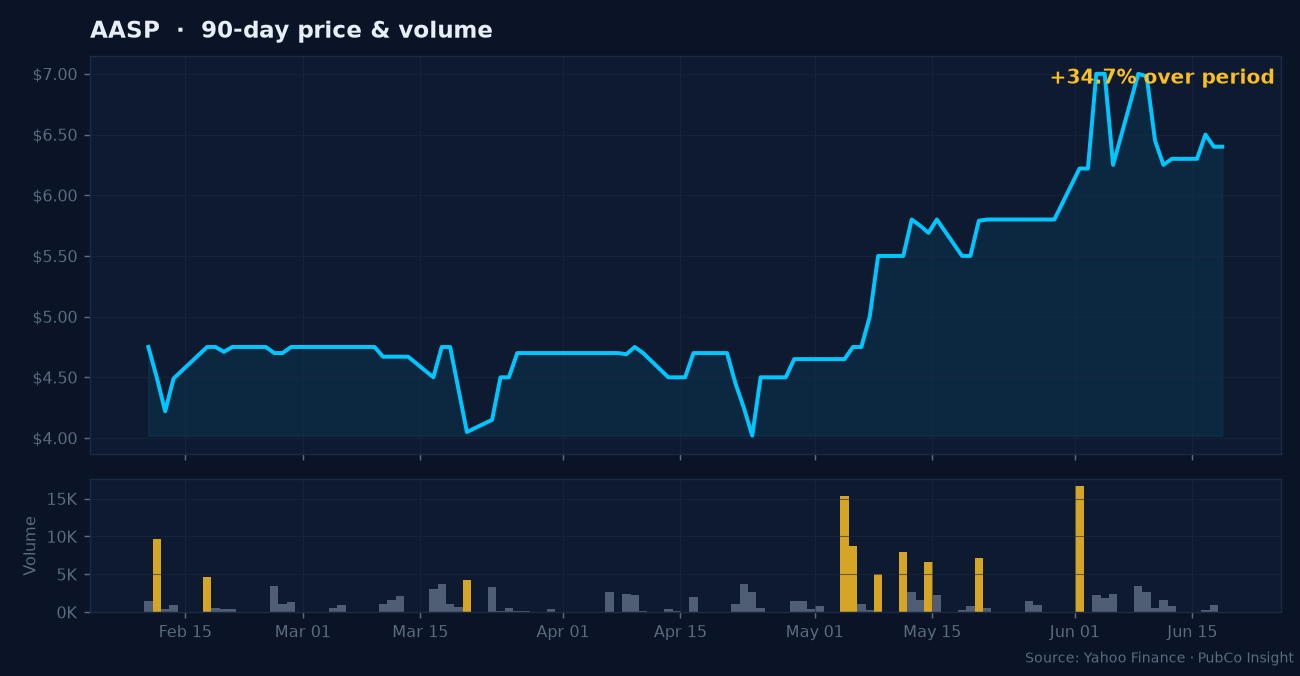
A look at the regulatory ledger reveals that Agassi Sports Entertainment Corp. filed four separate Form 8-Ks detailing material agreements under Item 1.01 between June 5 and July 2, 2026. This flurry of activity was not just about signing handshakes. The filings on June 5, June 10, and June 25 each carried Item 3.02 flags, signaling the unregistered sales of equity securities. When a company repeatedly issues shares outside of a traditional public offering, it often points to a reliance on private financing structures to keep the lights on or fund acquisitions.
The June 25 filing also carried an Item 2.03 designation, indicating the creation of a direct financial obligation or an off-balance sheet arrangement. This means Agassi Sports Entertainment Corp. is not just issuing equity, but also taking on debt or other binding liabilities. These financing maneuvers often carry restrictive covenants or conversion features that can put downward pressure on the common stock as new creditors and private investors secure their positions. You can track how these frequent unregistered share issuances impact the broader share structure through our dilution risk analysis tool.
Adding to the paper trail, a Schedule 13D/A filed on July 1, 2026, alongside a Form 4 insider transaction on the same day, indicates shifting concentrations of ownership among major stakeholders. While insider buying can sometimes be painted as a sign of confidence, in the context of rapid-fire material agreements and debt creation, it often reflects a restructuring of control or the conversion of debt into equity by insiders who are closest to the balance sheet.
With 12.73 million shares outstanding, every new unregistered issuance and debt conversion dilutes the existing retail base. When a company relies on a continuous stream of private agreements to navigate its financial path, the public filings are the only reliable map. Know what you own, keep an eye on the next quarterly report to see the true cost of these summer agreements, and remember that paper promises in an 8-K eventually show up on the bottom line.
Primary sources (SEC EDGAR)
8-K 2026-07-02: https://www.sec.gov/Archives/edgar/data/930245/000147237526000186/ixform8k.htmSCHEDULE 13D/A 2026-07-01: https://www.sec.gov/Archives/edgar/data/930245/000147237526000183/xslSCHEDULE_13D_X02/primary_doc.xml4 2026-07-01: https://www.sec.gov/Archives/edgar/data/930245/000147237526000182/xslF345X06/primary_doc.xml8-K 2026-06-25: https://www.sec.gov/Archives/edgar/data/930245/000147237526000179/ixform8k.htm8-K 2026-06-10: https://www.sec.gov/Archives/edgar/data/930245/000147237526000160/ixform8k.htm8-K 2026-06-05: https://www.sec.gov/Archives/edgar/data/930245/000147237526000150/ixform8k.htmSee the dilution and promotion flags before you see the pitch.
Each week: the micro and small-caps now showing dilution or paid-promotion signals, with the SEC filing behind every flag. No recommendations, no price targets.