ADI GLOBAL DISTRIBUTION INC. (ADIG) Filings Show Little Operating Detail
ADIG
Recent SEC filings for ADI GLOBAL DISTRIBUTION INC. (ADIG) consist primarily of Schedule 13G ownership disclosures and multiple Form 144 notices of proposed sale of securities. While these forms confirm shareholder activity, they provide no material information regarding the company's current business operations, financial condition, or strategic direction. Investors relying on public filings for fundamental analysis will find little to work with.
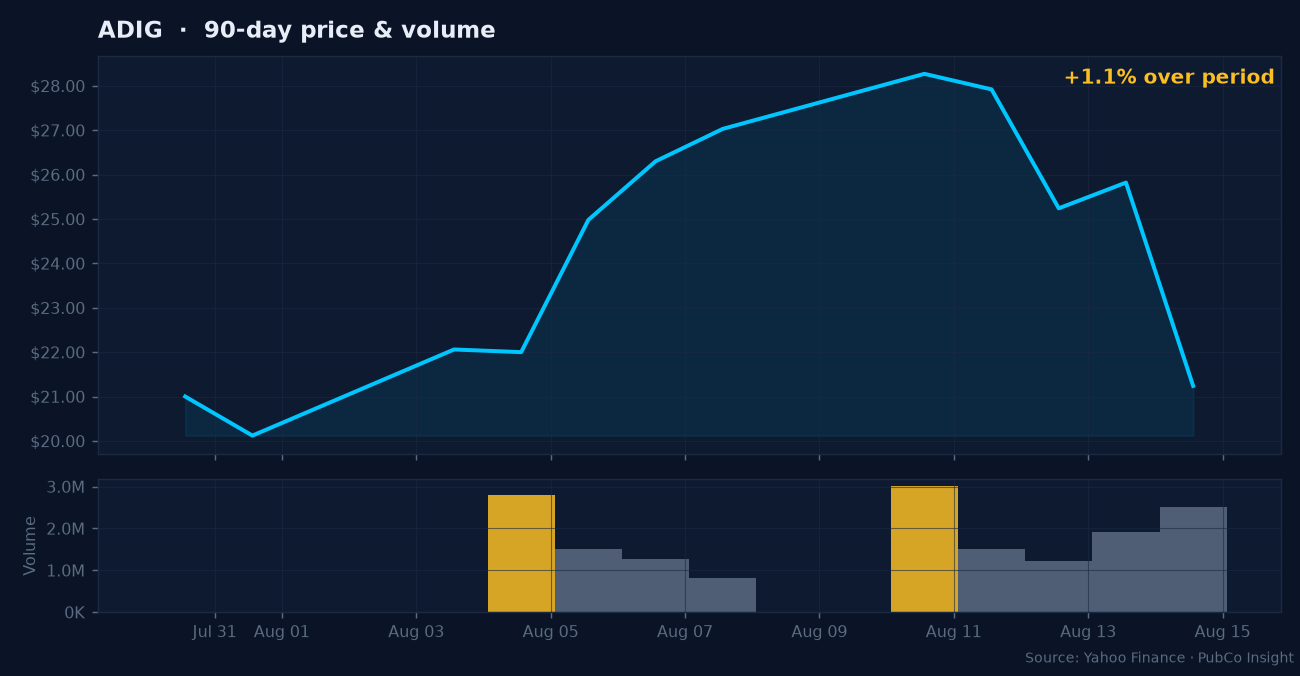
The repeated appearance of Form 144 filings in late August 2026 suggests ongoing insider or affiliate selling activity. These filings, while legally required, do not explain the rationale behind the sales or provide context for the company's performance. Without corresponding financial statements or management discussion and analysis, the market is left to speculate on the implications of these proposed sales.
Similarly, the Schedule 13G filings in early September 2026 disclose significant ownership stakes, but these are beneficial ownership reports, not operational updates. They confirm who owns shares, but not what the company is doing with its business. For a company trading on the OTC, a lack of regular, comprehensive financial reporting is a critical information gap.
The absence of recent 10-K or 10-Q filings, or even more frequent 8-K disclosures detailing material events beyond ownership changes, means there is no current public record of ADI GLOBAL DISTRIBUTION INC.'s revenues, expenses, assets, or liabilities. This makes it impossible for investors to assess profitability, solvency, or operational efficiency. The company's Standard Industrial Classification (SIC) code suggests it operates in "Wholesale-Hardware," but without financials, this is merely a label.
Retail investors considering ADIG should recognize the significant information asymmetry. The public record, as reflected in recent SEC filings, does not support an informed investment decision based on operational fundamentals. Understanding the limited available data is crucial when evaluating micro-cap opportunities, particularly those with a thin public reporting history. For more on navigating such situations, consider our resources on trapped shares.
Primary sources (SEC EDGAR)
SCHEDULE 13G 2026-09-08: https://www.sec.gov/Archives/edgar/data/2105139/000031506626002290/xslSCHEDULE_13G_X02/primary_doc.xmlSCHEDULE 13G 2026-09-04: https://www.sec.gov/Archives/edgar/data/2105139/000201238326003271/xslSCHEDULE_13G_X02/primary_doc.xml144 2026-08-28: https://www.sec.gov/Archives/edgar/data/2105139/000195004726008833/xsl144X01/primary_doc.xml144 2026-08-25: https://www.sec.gov/Archives/edgar/data/2105139/000195004726008695/xsl144X01/primary_doc.xml144 2026-08-24: https://www.sec.gov/Archives/edgar/data/2105139/000195004726008635/xsl144X01/primary_doc.xml144 2026-08-21: https://www.sec.gov/Archives/edgar/data/2105139/000195004726008566/xsl144X01/primary_doc.xmlSee the dilution and promotion flags before you see the pitch.
Each week: the micro and small-caps now showing dilution or paid-promotion signals, with the SEC filing behind every flag. No recommendations, no price targets.