Behind the Quiet Tape, Insiders at ADI GLOBAL DISTRIBUTION INC. (ADIG) Queue Up to Exit
ADIG
When a corporate overhaul hits the tape without a press tour, retail investors often mistake the silence for stability. That is rarely how micro-cap math actually works. For ADI GLOBAL DISTRIBUTION INC. (ADIG), the filings tell a clear story of profound internal turnover followed immediately by an orderly march toward the exits, regardless of how little noise the ticker makes on day-to-day screens.
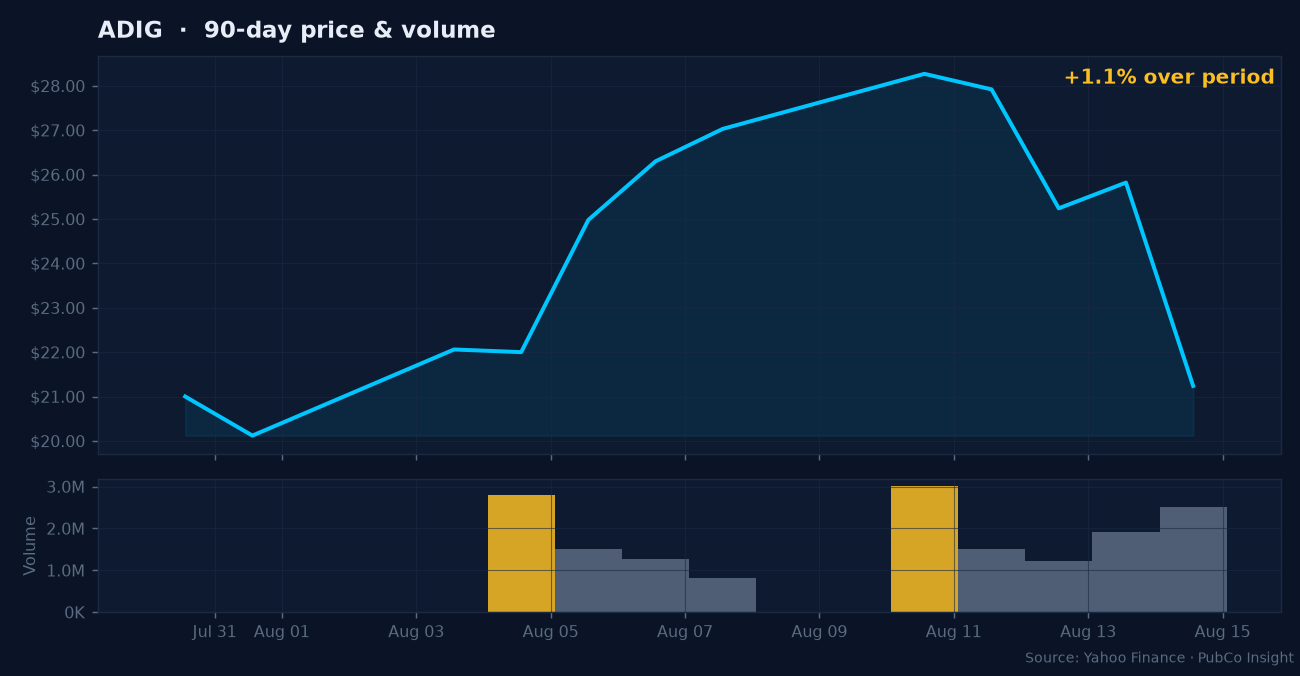
The catalyst trace starts in early August 2026, when an omnibus Form 8-K revealed a transformative suite of disclosures: an entry into a material definitive agreement, a change in control under Item 5.01, and an unregistered sale of equity securities under Item 3.02. In corporate parlance, the company changed hands and simultaneously put fresh equity on the board. Rather than a routine operational update, this combination points to an ownership shakeup that fundamentally rearranges who controls the equity and who is left holding the float.
The structural consequences appeared almost immediately in EDGAR's queue. Throughout late August and into September 2026, a relentless stream of Form 144 filings arrived in rapid succession on August 24, August 25, August 28, and September 11. These forms are legal notices of proposed share sales by affiliates, effectively signaling that holders tied to the company are ready to monetize. When multiple Form 144 notices drop back-to-back following an Item 3.02 equity issuance, investors monitoring dilution risk have to ask who is providing the liquidity to absorb that potential paper.
At the same time, institutional position notices appeared, with Schedule 13G filings landing on September 4 and September 8, reflecting concentrated five-percent-plus stakes. Such significant ownership shifts, coupled with insider sale declarations, mean the public market may be absorbing real distribution while operating without traditional company communication or updated public capitalization benchmarks.
Tracking ADI GLOBAL DISTRIBUTION INC. requires separating the lack of corporate hype from the paper trail in the regulatory register. When insiders file repeated intentions to sell right after control changes hands, the primary trading dynamic is rarely fundamental wholesale execution. It is float absorption, and investors who do not read the filings usually pay to discover it.
Primary sources (SEC EDGAR)
144 2026-09-11: https://www.sec.gov/Archives/edgar/data/2105139/000195004726009372/xsl144X01/primary_doc.xmlSCHEDULE 13G 2026-09-08: https://www.sec.gov/Archives/edgar/data/2105139/000031506626002290/xslSCHEDULE_13G_X02/primary_doc.xmlSCHEDULE 13G 2026-09-04: https://www.sec.gov/Archives/edgar/data/2105139/000201238326003271/xslSCHEDULE_13G_X02/primary_doc.xml144 2026-08-28: https://www.sec.gov/Archives/edgar/data/2105139/000195004726008833/xsl144X01/primary_doc.xml144 2026-08-25: https://www.sec.gov/Archives/edgar/data/2105139/000195004726008695/xsl144X01/primary_doc.xml144 2026-08-24: https://www.sec.gov/Archives/edgar/data/2105139/000195004726008635/xsl144X01/primary_doc.xmlSee the dilution and promotion flags before you see the pitch.
Each week: the micro and small-caps now showing dilution or paid-promotion signals, with the SEC filing behind every flag. No recommendations, no price targets.