AI Era Corp. Keeps Signing Agreements as Dilution Risk Mounts for AERA Shareholders
AERA
AI Era Corp. carries a name designed to conjure images of high-margin software and cutting-edge tech, but the company's recent SEC filings tell a much more terrestrial story of constant paper shuffling and capital raising. With a micro-cap market valuation of just over 6 million dollars, this OTC-traded entity has been exceptionally busy in the spring of 2026. A quick scan of its regulatory disclosures reveals a company operating on a treadmill of material agreements, board seat rotations, and private placements.
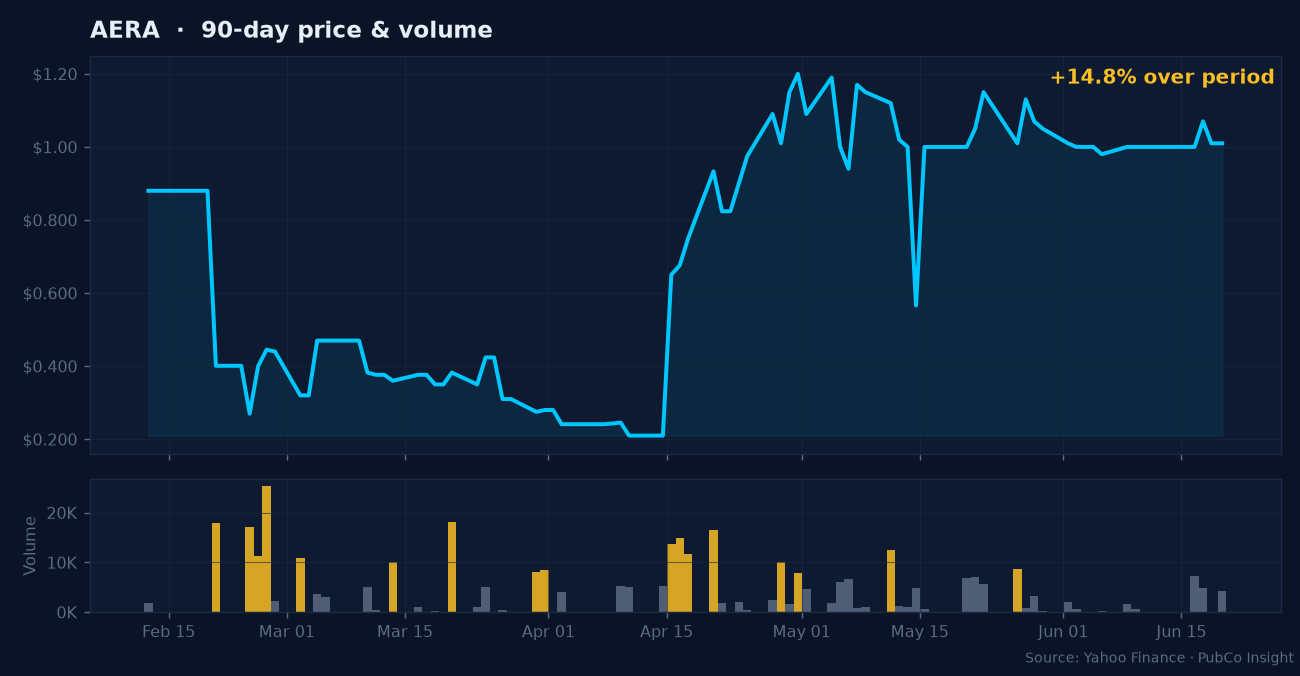
Between April and June of 2026, AI Era Corp. fired off multiple Form 8-K filings detailing new agreements and financing arrangements. On April 30, 2026, the company disclosed a transaction involving a material definitive agreement, the creation of a direct financial obligation, and an unregistered sale of equity securities under Item 3.02. When a micro-cap company frequently issues unregistered shares, it is often a sign that keeping the lights on requires a steady stream of new equity partners, which typically comes at the expense of existing retail shareholders.
The transactional velocity did not stop there. AI Era Corp. logged additional material agreements on April 20 and June 15, alongside key executive leadership changes in May and June. For retail investors holding AERA, this rapid succession of corporate restructuring and financing events points to a highly fluid capital structure. Those interested in the mechanics of how these frequent private placements impact equity value can track these patterns using our dilution risk analysis tool.
Ultimately, a company's name is just marketing, but its balance sheet and equity issuance history are reality. AI Era Corp. is currently operating as a patent owner and lessor with only 5.64 million shares outstanding, meaning every new private placement and unregistered share issuance has a concentrated, mathematically significant impact on ownership percentages. Before buying into the promise of a ticker like AERA, investors must decide if they are comfortable backing a business model that relies so heavily on frequent, dilutive financing agreements to sustain its operations.
Primary sources (SEC EDGAR)
8-K 2026-06-15: https://www.sec.gov/Archives/edgar/data/1605331/000166357726000191/aera8k_061226.htm8-K 2026-06-09: https://www.sec.gov/Archives/edgar/data/1605331/000166357726000187/aera8k_060926.htm8-K 2026-05-11: https://www.sec.gov/Archives/edgar/data/1605331/000166357726000136/aera8k_051126.htm4 2026-05-05: https://www.sec.gov/Archives/edgar/data/1605331/000166357726000130/xslF345X06/ownership.xml8-K 2026-04-30: https://www.sec.gov/Archives/edgar/data/1605331/000166357726000121/aera8k_042826.htm8-K 2026-04-20: https://www.sec.gov/Archives/edgar/data/1605331/000166357726000109/aera8k_042026.htmSee the dilution and promotion flags before you see the pitch.
Each week: the micro and small-caps now showing dilution or paid-promotion signals, with the SEC filing behind every flag. No recommendations, no price targets.