AETERNUM HEALTH, INC. Triggers Change of Control with July 8-K Filing as AETN Remakes Itself
AETN
AETERNUM HEALTH, INC. just remade its entire corporate identity in a single day, but retail investors buying into the buzz of a fresh start should look closely at the regulatory machinery turning behind the scenes. On July 7, 2026, the company filed a sweeping Form 8-K triggering several critical disclosure items, including an acquisition, an unregistered sale of equity, and a complete change of control. For a company historically classified under electrical machinery and supplies, this pivot represents a total overhaul of the business and its capital structure.
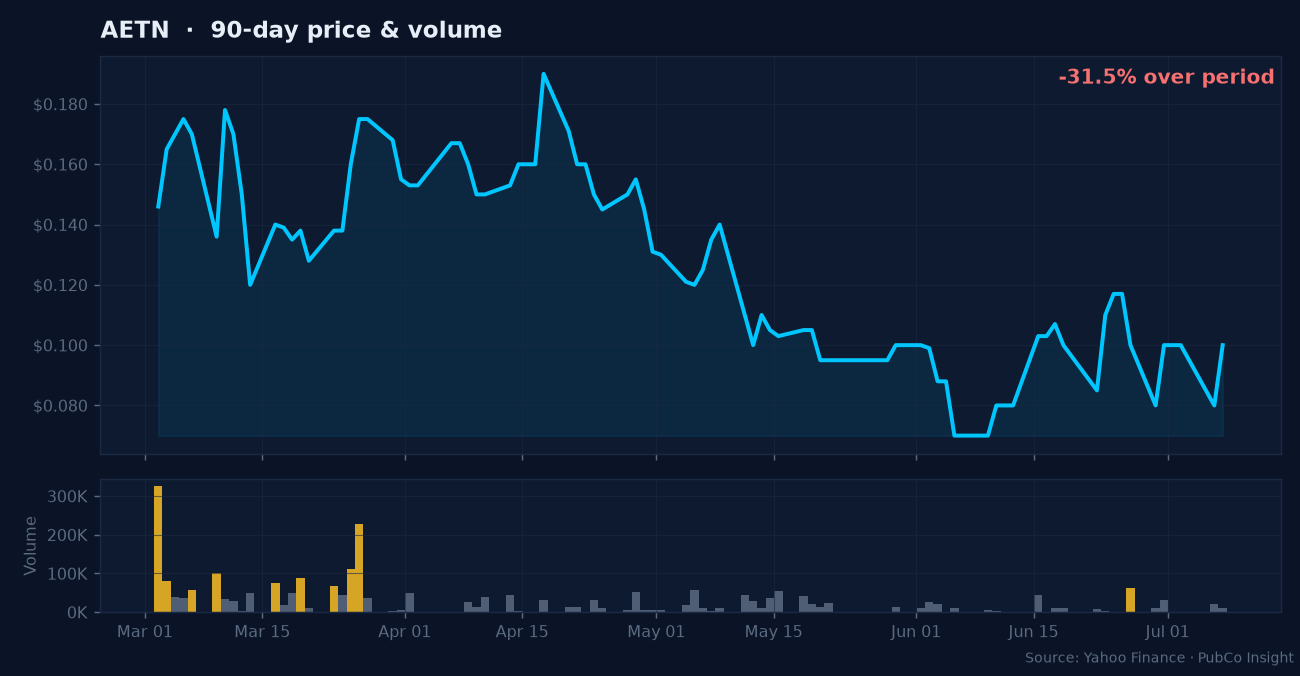
According to the July 8-K filing, the transaction brought in new leadership and altered the ownership landscape under Item 5.01 and Item 5.02. While a change of control can sometimes be painted as a fresh beginning, it often introduces significant structural risks for existing shareholders. The integration of new assets under Item 2.01, combined with the unregistered sales of equity securities under Item 3.02, means that the share structure is shifting rapidly, potentially diluting the value of public holdings.
These dramatic July changes follow a pattern of administrative stress earlier in the year. In May 2026, AETERNUM HEALTH, INC. filed an NT 10-Q indicating it could not file its quarterly report on time, followed by a delayed 10-Q filing just days later. When a company struggles to meet basic SEC reporting deadlines, it is a signal that administrative resources are stretched thin, even before taking on the massive task of integrating a newly acquired business and managing a change of control.
Investors looking at AETN need to look past the transition headlines and focus on the mechanics of the share issuance. The unregistered sale of equity securities is a classic precursor to increased float and potential selling pressure. You can track how these corporate actions impact outstanding share counts by checking our analysis of dilution risk to see how private placements ultimately affect public market valuations.
Ultimately, AETERNUM HEALTH, INC. is a company in the middle of a high-stakes transformation, marked by late filings in the spring and a total control shift in the summer. When a micro-cap company changes its business, its management, and its equity structure all at once, the historical financials become nearly obsolete. Know what you own, and recognize that the risk profile of AETN today is entirely different from what it was just a few months ago.
Primary sources (SEC EDGAR)
8-K 2026-07-07: https://www.sec.gov/Archives/edgar/data/764630/000149315226032365/form8-k.htm10-Q 2026-05-19: https://www.sec.gov/Archives/edgar/data/764630/000149315226024377/form10-q.htmNT 10-Q 2026-05-15: https://www.sec.gov/Archives/edgar/data/764630/000149315226023460/formnt10-q.htm10-K 2026-03-31: https://www.sec.gov/Archives/edgar/data/764630/000149315226014008/form10-k.htmDEF 14C 2026-03-09: https://www.sec.gov/Archives/edgar/data/764630/000149315226009334/formdef14c.htmPRE 14C 2026-02-24: https://www.sec.gov/Archives/edgar/data/764630/000149315226007908/formpre14c.htmSee the dilution and promotion flags before you see the pitch.
Each week: the micro and small-caps now showing dilution or paid-promotion signals, with the SEC filing behind every flag. No recommendations, no price targets.