AETERNUM HEALTH, INC. (AETN): Late 10-Q and Reverse Split Signals
AETN
AETERNUM HEALTH, INC. (AETN) recently filed a Notification of Late Filing (NT 10-Q) for its quarterly report, a move that often precedes further scrutiny for micro-cap companies. The company acknowledged it would not be able to file its 10-Q for the period ended June 30, 2026, by the due date. While the 10-Q was subsequently filed, the delay itself, especially when combined with other recent corporate actions, warrants investor attention.
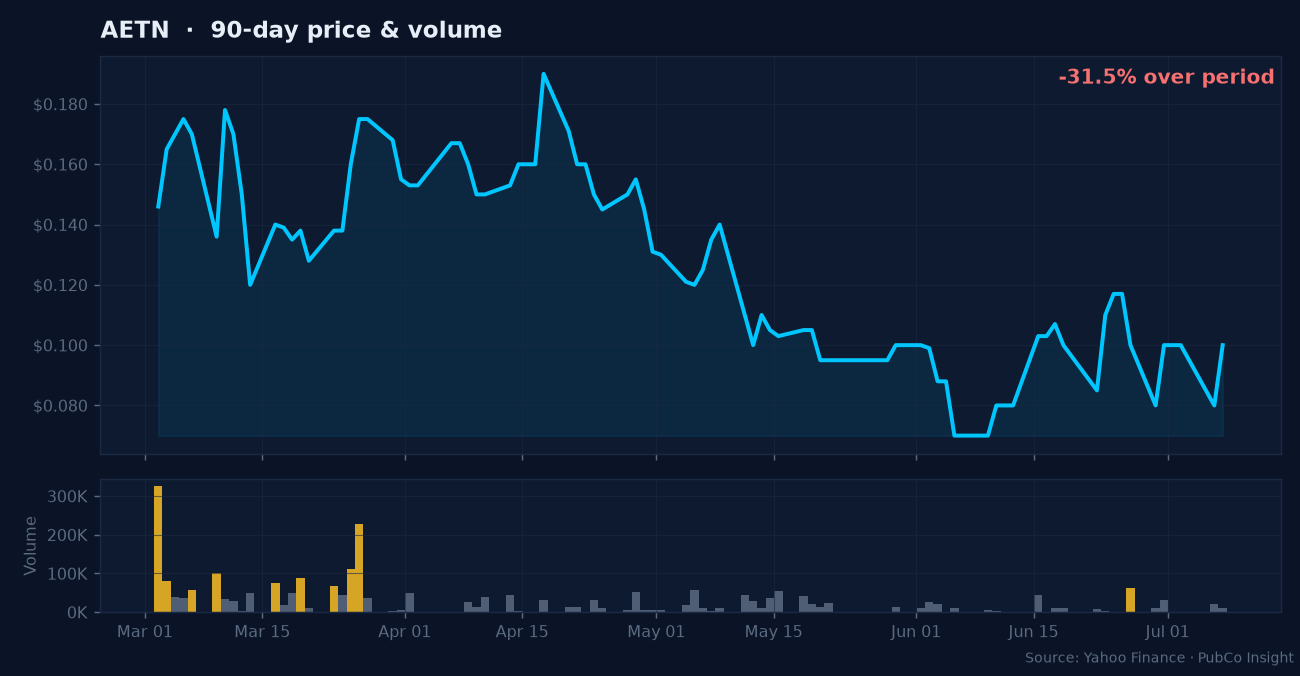
Adding to the complexity, AETN filed a PRE 14C on August 21, 2026, indicating an intent to authorize a reverse stock split. The proposed amendment to its Certificate of Incorporation would grant the Board of Directors discretion to effect a reverse stock split of the company's common stock at a ratio ranging from 1-for-2 up to 1-for-200. While companies often undertake reverse splits to boost share price and meet exchange listing requirements, for an OTC-traded entity like AETN, such a move can also be a precursor to further capital raises or an attempt to enhance stock appeal without a fundamental change in operations.
The PRE 14C details reveal that the primary purpose for the reverse split is to increase the per-share trading price of the common stock. This is a common tactic, but it does not inherently create value. Instead, it re-denominates existing value across fewer shares. Investors holding shares before a reverse split will own fewer shares, each theoretically worth more, but the total value of their holdings should remain the same immediately after the split. The risk, particularly for micro-caps, is that the price often drifts back down, leaving shareholders with fewer shares at a lower per-share price than before the split.
Beyond the reverse split, recent 8-K filings signal other significant shifts. An August 13, 2026 8-K details a material agreement and the issuance of convertible promissory notes, which could lead to future dilution. Earlier, a July 7, 2026 8-K disclosed an acquisition and a change of control. These events, taken together, paint a picture of a company undergoing substantial corporate restructuring and capital-raising activities.
For retail investors, the combination of a late filing, a proposed reverse stock split, and recent material agreements involving convertible notes suggests a need for careful due diligence. Late filings can sometimes be a harbinger of deeper financial or operational issues, even if the report is eventually submitted. A reverse split, while aiming for a higher share price, does not guarantee sustained value and can sometimes be followed by further declines. These dynamics are important to understand for any investor in the micro-cap space.
Understanding these structural changes and their potential implications is crucial. Investors should review the detailed terms of the reverse split and the convertible notes outlined in the filings. Know what you own, especially when a company is actively changing its capital structure and facing reporting challenges.
Primary sources (SEC EDGAR)
PRE 14C 2026-08-21: https://www.sec.gov/Archives/edgar/data/764630/000149315226039600/formpre14c.htm10-Q 2026-08-19: https://www.sec.gov/Archives/edgar/data/764630/000149315226039164/form10-q.htmNT 10-Q 2026-08-14: https://www.sec.gov/Archives/edgar/data/764630/000149315226038480/formnt10-q.htm8-K 2026-08-13: https://www.sec.gov/Archives/edgar/data/764630/000149315226037609/form8-k.htm3 2026-07-15: https://www.sec.gov/Archives/edgar/data/764630/000149315226033330/xslF345X06/ownership.xml8-K 2026-07-07: https://www.sec.gov/Archives/edgar/data/764630/000149315226032365/form8-k.htmSee the dilution and promotion flags before you see the pitch.
Each week: the micro and small-caps now showing dilution or paid-promotion signals, with the SEC filing behind every flag. No recommendations, no price targets.